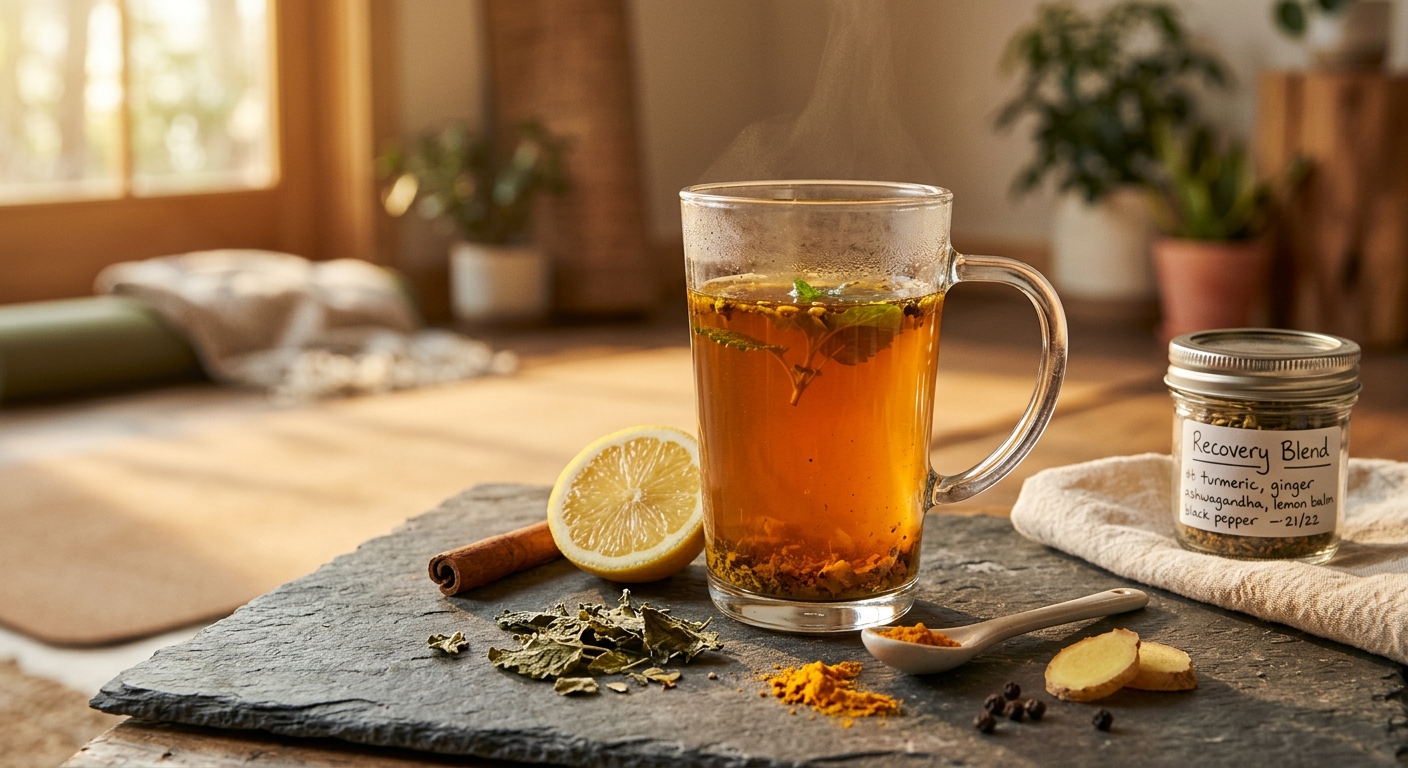
The final pose of a yoga session, savasana, is often called the most important posture of all. It is the moment when the body integrates the work of practice and the nervous system begins its shift from effort into ease. Yoga Recovery Tea was designed with that same philosophy in mind: a carefully layered herbal blend that meets your body in the transition between exertion and rest. Drawing on Ayurvedic traditions thousands of years old, this blend pairs the warming fire of ginger and turmeric with the grounding calm of ashwagandha and the gentle nervine action of lemon balm.
In Ayurvedic medicine, turmeric (Curcuma longa) has been revered since at least 1500 BCE as a rasayana, a rejuvenating tonic that supports vitality and reduces inflammation. Ginger (Zingiber officinale) appears in nearly every classical Ayurvedic formula as a bioavailability enhancer, warming digestive agent, and circulatory stimulant. Ashwagandha (Withania somnifera), often called Indian ginseng, is one of the most celebrated adaptogens in Ayurvedic practice, used to rebuild strength and resilience after physical depletion. Lemon balm (Melissa officinalis) arrives from the European herbal tradition, where it has been used since the Middle Ages to quiet an overactive mind and ease nervous tension after stress.
Together, these four herbs create something genuinely greater than the sum of their parts. Turmeric and ginger address the physical dimension of recovery, modulating inflammation and supporting circulation to fatigued muscles. Ashwagandha works at the hormonal and cellular level to reduce the stress response and replenish energy reserves. Lemon balm bridges the physical and mental, softening the mental chatter that can persist after an intense practice. Whether you are a dedicated yogi, a runner, or simply someone who has had a physically demanding day, this tea offers a ritual of restoration that is both scientifically grounded and deeply nourishing.
2
cups
Ingredients
- 1 tspground turmeric or 1-inch fresh turmeric root, grated
- 0.5 tspground ginger or 1-inch fresh ginger root, sliced thin
- 1 tspashwagandha root powder
- 1 tspdried lemon balm leaves
- 480 mlwater (95°C / 203°F)
- 0.25 tspfreshly cracked black pepper
- —raw honey to taste (optional)
- —splash of full-fat milk or coconut milk (optional, enhances curcumin absorption)
How to Brew
Click on an item below to shop for the recommended items for this recipe on Amazon.
As an Amazon Associate, we earn from qualifying purchases.
- Bring 480 ml of water to 95°C (203°F) in a small saucepan. If using fresh ginger and turmeric, add them directly to the water and allow to simmer gently for 8 minutes. If using ground powders, bring the water to temperature first.
- Add the ashwagandha root powder and ground black pepper to the simmering water. Whisk briefly to disperse the powders evenly. Continue to simmer on low heat for 3 to 4 more minutes. The black pepper activates piperine, which increases curcumin absorption from turmeric by up to 2000 percent.
- Remove the saucepan from heat and allow the temperature to drop for 60 to 90 seconds. Add the dried lemon balm leaves. Cover the saucepan with a lid to trap the volatile aromatic oils. Steep for 5 minutes.
- Strain the tea through a fine mesh strainer or cheesecloth into two warmed mugs. Press the spent herbs gently with a spoon to extract remaining liquid.
- Stir in raw honey if desired. Add a splash of coconut milk or full-fat dairy milk for a creamier texture and improved fat-soluble curcumin absorption. Sip slowly within 15 minutes for maximum aromatic benefit.
- Place the dried lemon balm, ashwagandha powder, ground turmeric, ground ginger, and black pepper into a clean glass jar. Use slightly larger quantities than the hot brew: increase ashwagandha to 1.5 tsp and lemon balm to 1.5 tsp per 480 ml to compensate for the slower cold extraction.
- Pour 480 ml of room-temperature filtered water over the herbs. Stir vigorously for 30 seconds to fully disperse the powders. If using fresh ginger and turmeric, slice them thinly to increase surface area for cold extraction.
- Seal the jar and allow it to rest at room temperature for 1 hour. Then transfer it to the refrigerator and let it steep for 10 to 14 hours. Overnight is ideal.
- The following morning, strain the liquid through a fine mesh strainer lined with cheesecloth into a pitcher or serving jar, pressing the solids firmly. The brew will appear a deep, slightly darker amber-gold than the hot version.
- Serve over a large glass of ice. Add a drizzle of raw honey or a slice of fresh lemon to brighten the flavor. For a post-workout recovery version, blend the cold tea briefly with half a frozen banana and a tablespoon of coconut oil for a creamy recovery smoothie base.
- Add 600 ml of filtered water to a small saucepan. Add freshly grated turmeric root (1.5 inches), freshly grated ginger root (1 inch), ashwagandha root powder (1.5 tsp), and cracked black pepper (0.25 tsp). Using fresh roots rather than powders is strongly recommended for a decoction, as the longer cooking time extracts deeper resinous compounds without the gritty texture powders can leave.
- Bring the mixture to a full rolling boil, then immediately reduce the heat to a gentle low simmer. Do not cover the pot, as the decoction method works by gently reducing and concentrating the liquid. Simmer for 20 to 25 minutes, stirring occasionally, until the volume has reduced by roughly one third.
- At the 20-minute mark, remove the pot from heat and allow to cool for 2 minutes. Add dried lemon balm (1.5 tsp) to the hot but no-longer-simmering liquid. Cover the pot and allow the lemon balm to steep off-heat for 5 minutes. This two-stage approach extracts the heat-stable root compounds fully while preserving the delicate volatile oils of lemon balm.
- Strain through a fine mesh strainer lined with cheesecloth into a heat-safe measuring cup. You should have approximately 360 to 400 ml of concentrated decoction for two servings.
- Pour into mugs. Stir in raw honey and a splash of warm coconut milk. The decoction will be notably stronger, earthier, and more intensely flavored than the hot brew. This is your most potent preparation and is best consumed in the 30 minutes following intense physical activity.
Health Benefits
Curcumin from turmeric and 6-gingerol from ginger both inhibit key inflammatory pathways including NF-kB and COX-2, mirroring the mechanism of non-steroidal anti-inflammatory drugs without the gastrointestinal side effects. A 2015 meta-analysis in the Journal of the International Society of Sports Nutrition confirmed that ginger supplementation significantly reduces DOMS 24 to 72 hours after exercise.
Ashwagandha’s withanolides directly modulate the hypothalamic-pituitary-adrenal (HPA) axis, reducing the output of cortisol during and after physical stress. A double-blind, randomized controlled trial published in Medicine in 2019 found that 600 mg of ashwagandha extract daily significantly reduced serum cortisol and self-reported stress scores compared to placebo.
Lemon balm contains rosmarinic acid, which inhibits the enzyme GABA transaminase, effectively slowing the breakdown of GABA in the brain and increasing its calming effect. Clinical studies have shown that lemon balm extracts reduce anxiety and improve mood within 1 to 2 hours of ingestion, making it an ideal complement to the parasympathetic state yoga is intended to cultivate.
Ginger has demonstrated vasodilatory effects in clinical studies, improving peripheral circulation and helping to deliver oxygen and nutrients to muscles recovering from exertion. This thermogenic action also produces the characteristic warming sensation that makes ginger a staple of recovery-oriented herbal traditions worldwide.
Intense physical activity generates reactive oxygen species (free radicals) that damage muscle cells and prolong recovery. Curcumin, rosmarinic acid, and 6-gingerol are all potent free-radical scavengers. Research published in Phytotherapy Research demonstrates that curcumin supplementation significantly reduces markers of oxidative stress including malondialdehyde and increases endogenous antioxidant enzyme activity after exercise.
🧪 Key Bioactive Compounds
The Science Behind Turmeric
The synergy in Yoga Recovery Tea is not accidental. Each herb was selected because its active compounds operate on a distinct but complementary physiological pathway. Turmeric’s curcumin is perhaps the most extensively studied anti-inflammatory compound in natural medicine, with over 3000 published studies to its name. Its primary mechanism involves the suppression of NF-kB, a master regulatory protein that controls the expression of pro-inflammatory genes. When NF-kB is inhibited, the downstream production of TNF-alpha, interleukin-1, interleukin-6, and COX-2 is significantly reduced. This is precisely the same cascade that produces the soreness, swelling, and stiffness felt in muscles after vigorous physical activity. The critical addition of black pepper provides piperine, which inhibits the liver and intestinal enzymes that would otherwise rapidly metabolize and excrete curcumin before it reaches systemic circulation. This single pairing transforms turmeric from a mildly beneficial spice into a clinically relevant anti-inflammatory agent.
Ashwagandha’s withanolides operate at a higher regulatory level, targeting the hypothalamic-pituitary-adrenal (HPA) axis, which governs the body’s entire stress response architecture. Physical exertion triggers cortisol release as part of a necessary acute stress response, but chronically elevated cortisol impairs muscle repair, disrupts sleep, and depletes the nervous system over time. Withanolides, particularly withaferin A and withanolide D, act as adaptogenic modulators, meaning they help normalize cortisol output whether it is too high or too low. Multiple randomized controlled trials have confirmed statistically significant reductions in morning cortisol, perceived stress, and biological markers of oxidative damage in adults taking ashwagandha extract at doses achievable through regular tea consumption. This makes ashwagandha particularly valuable in a post-yoga context, where the goal is not merely to reduce inflammation but to complete the stress cycle and return the body to genuine homeostasis.
Lemon balm’s contribution is primarily neurochemical. Its principal active compound, rosmarinic acid, is a potent inhibitor of GABA transaminase, the enzyme responsible for breaking down gamma-aminobutyric acid in the synaptic cleft. By slowing this degradation, lemon balm effectively prolongs and amplifies the inhibitory signal that GABA transmits throughout the brain, producing an anxiolytic and mildly sedative effect without impairing cognitive function. A 2014 study published in Nutrients found that a single dose of lemon balm extract significantly reduced self-reported anxiety and improved mood and calmness in healthy adults within 1 to 3 hours. Combined with the physical recovery action of turmeric and ginger and the hormonal rebalancing of ashwagandha, lemon balm completes the circuit by addressing the mental dimension of post-practice recovery, quieting the residual activation that often lingers in the mind long after the body has come to rest.
Brewing Tips
- Always add black pepper to any preparation containing turmeric. Even a small pinch, about 0.25 teaspoon per serving, is sufficient to activate piperine and dramatically increase curcumin bioavailability. This single step is the difference between a flavorful beverage and a therapeutically effective one.
- Ashwagandha powder has a naturally earthy, slightly bitter taste that some people find challenging. Whisking it into the hot brew rather than simply stirring it ensures it fully disperses without clumping. Adding coconut milk not only improves the texture and masks any chalkiness but also enhances absorption of the fat-soluble withanolides.
- For the best lemon balm flavor and therapeutic effect, always add the dried herb off-heat and cover the vessel immediately. The volatile terpenoids responsible for its calming aroma and rosmarinic acid content are partially heat-sensitive. A covered 5-minute steep after removing from the flame preserves these compounds far better than extended simmering.
- Prepare a large batch of the decoction base (turmeric, ginger, ashwagandha, and pepper simmered together) and refrigerate it for up to 3 days. When you need a post-practice cup, simply reheat a portion and add fresh lemon balm for the final steep. This saves time and encourages daily use.
- If you practice in the evenings, increase the lemon balm to 2 teaspoons and reduce the ginger slightly to soften the stimulating, thermogenic quality of the blend. This evening variation leans more toward nervous system calming and sleep preparation, while the standard recipe is better suited to daytime or early afternoon recovery.