Few plants carry as much symbolic and medicinal weight as hawthorn. Thorny, resilient, and bursting with small crimson berries each autumn, hawthorn trees have stood at the edges of European hedgerows and sacred sites for thousands of years. In Celtic tradition, the hawthorn was a portal tree, associated with the fairy realm and the threshold between worlds. Medieval herbalists prescribed its berries for “melancholy of the heart,” a phrase that captured something genuinely physiological long before the science existed to explain it. Across China, where the closely related Crataegus pinnatifida has been used in Traditional Chinese Medicine for over a thousand years, hawthorn was valued as much for digestion and emotional tension as for the heart itself.
What makes hawthorn berry tea so enduring is the remarkable alignment between its folk reputation and its modern pharmacological profile. The berries contain one of the most thoroughly studied combinations of polyphenols in herbal medicine, including oligomeric proanthocyanidins, hyperoside, and vitexin, compounds that work synergistically to improve blood flow, reduce oxidative stress, and regulate the nervous system’s response to sustained pressure. When stress tightens the chest and raises the resting heart rate, hawthorn works quietly on multiple levels at once, addressing the cardiovascular component of anxiety that many other calming herbs simply do not reach.
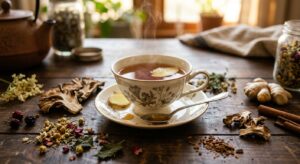
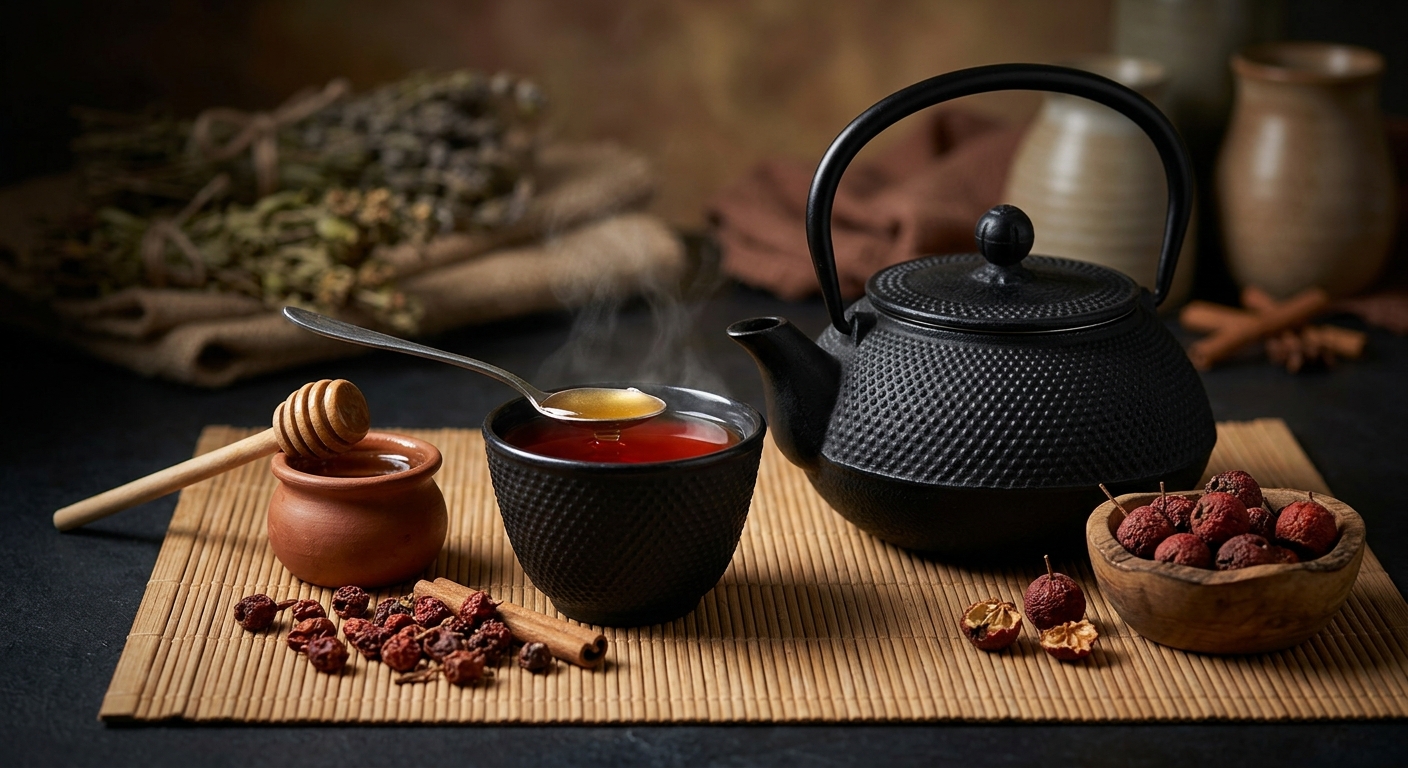
As a tea, hawthorn berry offers a deeply satisfying sensory experience that matches its medicinal depth. The brew is a rich garnet red, tart and slightly earthy with a whisper of dried fruit sweetness, not unlike a gentler version of hibiscus or rose hip. It can be sipped hot on a slow evening, cold-brewed for a refreshing daytime tonic, or simmered as a traditional decoction to draw out every last compound from those tough, fibrous berries. Whether you are drawn to hawthorn for its history, its science, or simply its beautiful color, this is a tea that rewards patience and attention.
2
cups
Ingredients
- 3 tbspdried hawthorn berries (whole or cracked)
- 480 mlwater (95°C / 203°F)
- —raw honey or maple syrup to taste (optional)
- —cinnamon stick for added warmth (optional)
How to Brew
Click on an item below to shop for the recommended items for this recipe on Amazon.
As an Amazon Associate, we earn from qualifying purchases.
- Lightly crack the dried hawthorn berries using the back of a spoon or a mortar and pestle. You are not grinding them to powder, just splitting the skin to expose the inner flesh.
- Bring filtered water to 95°C (203°F). A full rolling boil is too harsh and can degrade some delicate flavonoids, so pull the kettle just before it reaches a full boil or use a temperature-controlled kettle.
- Add the cracked berries to a fine-mesh tea infuser or place them loosely in your teapot. Pour the hot water over the berries and cover immediately to trap volatile aromatic compounds.
- Steep for 15 to 20 minutes. Hawthorn berries are dense and fibrous, so they need significantly longer than leaf-based herbs to release their full spectrum of polyphenols. The brew will deepen from pale pink to a rich garnet as it steeps.
- Strain into warmed mugs and taste before sweetening. If desired, add a small drizzle of raw honey. Drink slowly and ideally away from screens or other stimulation.
- Lightly crack 4 tablespoons of dried hawthorn berries using a mortar and pestle or the flat of a heavy knife. Use a slightly higher ratio than hot brew to compensate for the slower cold extraction.
- Place the cracked berries directly into a clean glass jar. Add 600 ml of cold, filtered water. Do not use hot water at any stage, as this fundamentally changes the extraction chemistry and flavor profile.
- Stir gently to ensure all berries are submerged, then seal the jar. Leave at room temperature for the first hour to begin the extraction process, then transfer to the refrigerator.
- Allow to steep in the refrigerator for 12 to 14 hours, or overnight. The liquid will slowly deepen to a translucent ruby red without the tannin sharpness that hot brewing can produce.
- Strain through a fine-mesh strainer or cheesecloth into a clean bottle or pitcher. The cold brew will keep refrigerated for up to 3 days. Serve over ice and add a squeeze of lemon juice to brighten the flavor.
- Add 4 tablespoons of whole or lightly crushed dried hawthorn berries to a small stainless steel or ceramic saucepan. Using whole berries works well here because the extended simmering time will fully break down the fruit tissue.
- Pour 700 ml of cold filtered water over the berries. Starting with cold water and bringing it up slowly allows the berries to begin releasing their constituents gradually before the boil.
- Bring the water to a gentle boil over medium heat, then immediately reduce to a low simmer. Cover the saucepan with a lid, leaving a small gap for steam to escape. Simmer for 25 to 30 minutes, checking occasionally and adding a small splash of water if the volume reduces too dramatically.
- Remove from heat and allow the decoction to rest, covered, for 10 additional minutes. This resting phase allows the temperature to drop slightly and encourages further polyphenol release without the harshness of sustained boiling.
- Strain through a fine-mesh strainer into a warmed teapot or directly into mugs, pressing the spent berries gently with a spoon to extract the last of the liquid. The resulting brew will be deeply colored, full-bodied, and noticeably more concentrated than a standard steep. A small amount of honey and a slice of fresh ginger complement this preparation well.
Health Benefits
Hawthorn’s OPCs and flavonoids improve coronary circulation and reduce the oxidative damage that chronic stress inflicts on the cardiovascular system. Multiple clinical trials, including the landmark SPICE trial, have confirmed hawthorn extract’s efficacy in improving exercise tolerance and reducing symptoms in people with mild heart insufficiency.
Several randomized controlled trials have found that standardized hawthorn extract produces modest but significant reductions in resting diastolic blood pressure. The mechanism involves vasodilation through nitric oxide potentiation and mild ACE-inhibitory activity from its polyphenol content.
Vitexin and its rhamnoside derivative interact with adenosine receptors in the central nervous system, producing a gentle calming effect distinct from sedation. This makes hawthorn particularly valuable for stress-related anxiety that manifests physically as heart palpitations or chest tightness.
Psychological stress sharply elevates reactive oxygen species throughout the body, accelerating cellular aging and inflammation. Hawthorn’s exceptionally high OPC content neutralizes these free radicals with an antioxidant capacity comparable to or exceeding that of green tea and blueberries per gram.
In Traditional Chinese Medicine, hawthorn berry (Shan Zha) is primarily classified as a digestive herb, used to resolve food stagnation and improve the breakdown of fats. Modern research confirms that its organic acids and proanthocyanidins stimulate bile secretion and gastric enzyme activity, making it a useful ally after heavy meals that accompany stressful periods.
🧪 Key Bioactive Compounds
The Science Behind Hawthorn Berry
Hawthorn berries contain one of the most complex and well-characterized polyphenol profiles in medicinal botany. The dominant bioactive class is oligomeric proanthocyanidins, condensed tannin polymers built from flavan-3-ol units that give the berry its characteristic astringency and deep color. These compounds are powerful antioxidants, but their therapeutic significance goes beyond free radical scavenging. Research published in journals including Phytomedicine and the American Journal of Cardiology has demonstrated that hawthorn OPCs inhibit phosphodiesterase, the enzyme that breaks down cyclic AMP in heart muscle cells. By preserving cyclic AMP, they enhance myocardial contractility through a mechanism that parallels some pharmaceutical cardiac drugs, but with a far safer side-effect profile at physiological concentrations.
The flavonoid glycosides vitexin-2-rhamnoside and hyperoside contribute a distinct dimension to hawthorn’s pharmacology. Vitexin derivatives have been shown in animal studies and preliminary human research to relax the smooth muscle lining of coronary arteries, increasing blood flow to the heart itself during periods of high demand. Critically, vitexin also interacts with adenosine A1 receptors in the central nervous system, producing anxiolytic effects without the sedation or dependence risks of GABA-targeting herbs like valerian or kava. This dual cardiovascular and anxiolytic action through separate receptor pathways is part of what makes hawthorn scientifically compelling: it addresses stress through the body’s circulatory response, not just the brain chemistry of calm.
Chlorogenic acid and ursolic acid round out the therapeutic picture with anti-inflammatory and lipid-modulating properties. Chronic psychological stress is now understood to be a significant driver of systemic inflammation and dyslipidemia, both of which accelerate cardiovascular disease. Chlorogenic acid suppresses NF-kB signaling, a master inflammatory pathway upregulated by cortisol and catecholamines released during stress, while ursolic acid has demonstrated inhibition of HMG-CoA reductase activity in vitro, the same pathway targeted by statin drugs. The combined effect of all these compounds working simultaneously helps explain why hawthorn has maintained its clinical credibility across thousands of years and two distinct medical traditions.
Brewing Tips
- Always crack or lightly crush dried hawthorn berries before any brewing method. The berries have a thick, fibrous skin and a hard seed inside that dramatically slows extraction if left completely intact. Even a gentle press with the flat of a spoon is enough to significantly improve your brew.
- Store dried hawthorn berries in a sealed glass jar away from direct light and heat. Their polyphenol content degrades noticeably when exposed to UV light over time. Properly stored berries retain potency for 12 to 18 months.
- If your hawthorn tea tastes overly astringent, you likely steeped it at too high a temperature or for too long. Try dropping to 90°C and reducing steep time by 5 minutes. Adding a small amount of honey or a few dried apple slices during brewing will also soften the tannic edge without masking the berry’s character.