Few plants carry the cultural weight of ginseng. Revered in Traditional Chinese Medicine for over 5,000 years, the gnarled root of Panax ginseng was once so prized that Chinese emperors sent expeditions deep into the mountains of Manchuria to harvest it. The word Panax derives from the Greek for “all-healing,” a name that speaks to the extraordinary breadth of benefits ancient healers attributed to this single root. In Korean tradition, wild-harvested mountain ginseng, known as sansam, was considered more valuable than gold, and stories of solitary root hunters spending decades in remote forests in pursuit of aged specimens became woven into folklore and legend.
What makes ginseng botanically unusual is its slow, deliberate growth. A root destined for medicinal use typically matures over six years, during which time it accumulates a dense concentration of bioactive compounds called ginsenosides. These triterpenoid saponins are found nowhere else in the plant kingdom at such complexity or variety, and they are the biochemical foundation of ginseng’s celebrated adaptogenic properties. An adaptogen, in the language of modern herbalism, is a plant that helps the body maintain equilibrium under physical, emotional, and environmental stress, neither overstimulating nor sedating, but recalibrating.
Today, ginseng tea is enjoyed worldwide in two primary forms: Asian ginseng (Panax ginseng), which is considered warming and tonifying in Traditional Chinese Medicine, and American ginseng (Panax quinquefolius), which is regarded as cooler and more moistening in its energetic quality. Both are genuinely effective, and your choice between them can be guided by your constitution and goals. Those seeking sharp mental energy and yang vitality often favor the Asian variety, while those managing burnout or heat-related stress may find American ginseng more balancing. Whichever you choose, brewing ginseng tea is an act of patience that rewards the careful practitioner.
2
cups
Ingredients
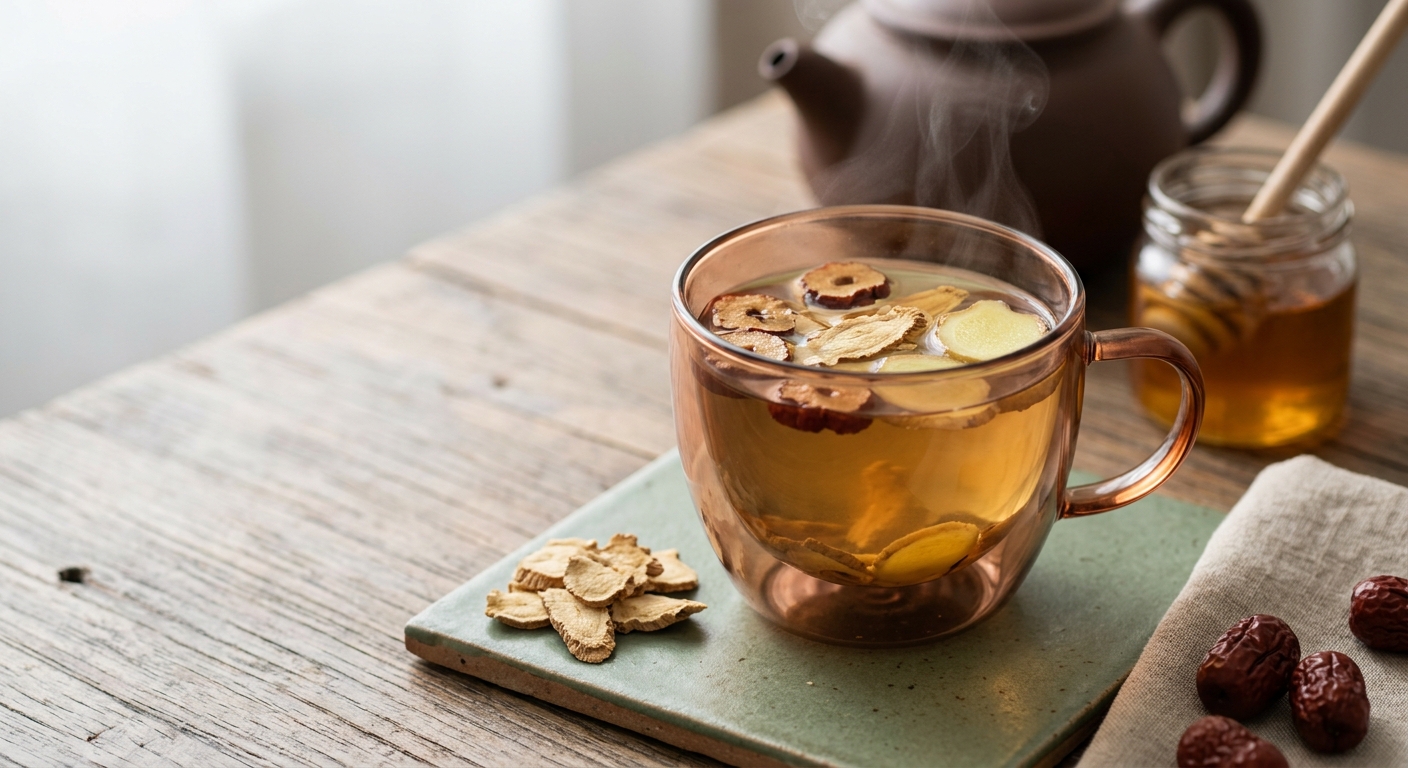
- 4 tspdried ginseng root slices (or 2 tsp ginseng powder)
- 500 mlwater (85 to 90°C / 185 to 194°F)
- —raw honey or jujube dates to taste (optional)
- —thin slices of fresh ginger (optional, for warming depth)
How to Brew
Click on an item below to shop for the recommended items for this recipe on Amazon.
As an Amazon Associate, we earn from qualifying purchases.
- Measure 4 teaspoons of dried ginseng root slices per 500 ml of water. If using whole root pieces, lightly crush them with the back of a spoon to increase surface area and improve extraction.
- Heat your water to 85 to 90°C (185 to 194°F). If you do not have a temperature-controlled kettle, bring water to a full boil and let it rest uncovered for 3 to 4 minutes before using.
- Place the ginseng slices in a small saucepan or a pre-warmed teapot. Pour the hot water over the root and cover immediately to trap volatile aromatic compounds.
- Steep for 10 to 15 minutes depending on your desired intensity. A 10-minute steep yields a lighter, cleaner cup; 15 minutes produces a richer, more assertive brew with stronger bitterness.
- Strain the tea through a fine-mesh strainer into warmed mugs. Sweeten with raw honey or add a few jujube dates to the pot during steeping for a traditional Korean-style sweetness. The steeped root slices can be chewed or re-steeped once for a lighter second cup.
- Measure 5 to 6 teaspoons of dried ginseng root slices per 500 ml of filtered cold water. The higher ratio compensates for the slower cold extraction rate and produces a balanced final cup.
- Lightly bruise the root slices using the back of a spoon or a muddler to open the cellular structure and encourage gentle overnight extraction without the help of heat.
- Combine the bruised root slices and cold water in a clean glass jar. Stir briefly to ensure all the root is submerged, then seal the jar with a lid.
- Leave the jar at room temperature for 1 hour, then transfer it to the refrigerator. Allow the ginseng to infuse for a total of 10 to 14 hours, or overnight, for the best flavor and compound extraction.
- Strain through a fine-mesh strainer or cheesecloth into a clean jar or pitcher. Serve over ice, optionally sweetened with a light honey syrup or paired with a few slices of Asian pear for a refreshing, mineral-rich summer drink. Keeps refrigerated for up to 48 hours.
- Use 6 to 8 teaspoons of dried ginseng root slices or 2 to 3 whole root pieces per 750 ml of cold filtered water. Place the ginseng directly into a small ceramic or clay saucepan. Traditionally, metal cookware is avoided as it can interact with the root’s compounds, though a modern stainless steel or enamel saucepan is an acceptable alternative.
- Add the cold water to the saucepan along with any companion herbs you wish to include, such as jujube dates, astragalus slices, or a strip of dried longan, all of which are classic partners in traditional tonifying formulas.
- Bring the water to a gentle simmer over medium-low heat, then reduce the heat to maintain a low, steady simmer. Do not allow the liquid to reach a rolling boil. Cover the saucepan with a lid slightly ajar to allow some steam to escape while retaining most of the volatile compounds.
- Simmer gently for 30 to 45 minutes, checking occasionally. The liquid will reduce by roughly one-third and deepen in color to a rich amber or light caramel brown. Skim off any foam that rises to the surface during the first 10 minutes.
- Remove from heat and allow the decoction to rest, covered, for 10 additional minutes before straining. Pour through a fine-mesh strainer into a ceramic teapot or directly into mugs. The yield is a small, concentrated cup of approximately 150 to 200 ml per serving. Sip slowly and mindfully, ideally in the morning or early afternoon. The spent root can be re-decocted once with fresh water for a lighter, gentler second preparation.
Health Benefits
Ginseng’s ginsenosides act on the hypothalamic-pituitary-adrenal (HPA) axis, helping to regulate cortisol secretion during acute and chronic stress. Multiple human trials have documented measurable reductions in self-reported stress and fatigue scores following regular ginseng supplementation, making it one of the most clinically studied adaptogens available.
Ginsenoside Rg1 promotes nitric oxide synthesis in cerebrovascular endothelial cells, increasing blood flow to the brain and supporting sustained attention and working memory. A double-blind crossover trial published in Psychopharmacology found that a single dose of Panax ginseng significantly improved performance on serial subtraction tasks and reduced mental fatigue in healthy adults.
Ginseng has been shown in several randomized controlled trials to reduce fatigue in both healthy individuals and those with chronic fatigue conditions. Its ability to enhance mitochondrial efficiency and reduce oxidative stress in muscle tissue is believed to underpin these anti-fatigue effects, offering a sustainable energy lift without the crash associated with stimulants.
Ginseng polysaccharides and select ginsenosides stimulate natural killer cell activity and enhance macrophage function, two pillars of innate immunity. Clinical studies have found that regular ginseng consumption reduces the incidence and duration of upper respiratory tract infections, particularly in older adults and those under chronic stress.
American ginseng in particular has been studied for its ability to moderate postprandial blood glucose spikes. Ginsenoside Re and certain polysaccharides appear to enhance insulin sensitivity and slow glucose absorption in the gastrointestinal tract, with a 2000 study in the Archives of Internal Medicine demonstrating significant blood glucose reduction in both diabetic and non-diabetic individuals.
🧪 Key Bioactive Compounds
The Science Behind Ginseng
The pharmacological story of ginseng is inseparable from its ginsenosides, a family of over 100 structurally distinct triterpenoid saponins unique to the genus Panax. Unlike many plant compounds that act through a single mechanism, ginsenosides are remarkably multidirectional in their effects, which explains why traditional practitioners described ginseng as a tonic that addressed virtually every organ system. The two most studied subgroups, the protopanaxadiol (PPD) ginsenosides such as Rb1 and Rc, and the protopanaxatriol (PPT) ginsenosides such as Rg1 and Re, often exert opposing or complementary actions. Rb1, for instance, tends toward sedation and neuroprotection, while Rg1 is more stimulating and vasodilatory. This apparent paradox is precisely what makes ginseng adaptogenic: the net effect of the full ginsenoside complex tends toward homeostasis rather than a single fixed outcome.
At the neuroendocrine level, ginsenosides modulate the hypothalamic-pituitary-adrenal (HPA) axis, the body’s central stress-response system. Research published in the Journal of Ethnopharmacology and elsewhere has demonstrated that ginsenoside Rb1 reduces the secretion of corticotropin-releasing hormone (CRH) from the hypothalamus and blunts adrenocortical output of cortisol during acute stress. This is not suppression of the stress response so much as calibration of it: ginseng appears to lower the stress system’s hair-trigger sensitivity without impairing the body’s ability to respond appropriately to genuine threats. Concurrently, Rg1 promotes the synthesis of nitric oxide in vascular endothelial cells, widening blood vessels and improving circulation to the brain, which translates into the sharper cognitive performance and reduced mental fatigue that users and clinical trial participants consistently report.
The immunomodulatory effects of ginseng are mediated through a distinct class of compounds: acidic polysaccharides collectively called ginsenans. These large sugar chains interact with pattern-recognition receptors on macrophages and dendritic cells, essentially priming the innate immune system to respond more efficiently to pathogens. Because chronic stress is known to suppress natural killer cell activity and reduce secretory IgA levels in mucosal tissues, ginseng’s dual action on both the stress axis and the immune system makes it a uniquely coherent herbal intervention for the modern pattern of stress-driven immune vulnerability. Notably, polysaccharide extraction is favored by longer, lower-temperature decoction methods, which is one reason the traditional simmered preparation remains popular among practitioners who value the full-spectrum therapeutic profile of the root.
Brewing Tips
- Store dried ginseng root slices in an airtight glass jar away from light and moisture. Properly stored, the root retains its potency for up to two years. Avoid plastic containers, as ginseng’s aromatic compounds can be absorbed by the plastic over time.
- Traditional practitioners recommend cycling ginseng use: consume it for 3 to 4 weeks, then take a 1-week break. This prevents the body from adapting to its effects and maintains its adaptogenic efficacy over the long term.
- Grade and age matter significantly when buying ginseng. Six-year-old root is considered the medicinal standard in Korean herbal tradition. When possible, choose certified wild-simulated or six-year-cultivated roots from reputable suppliers and look for third-party testing to ensure authentic ginsenoside content.