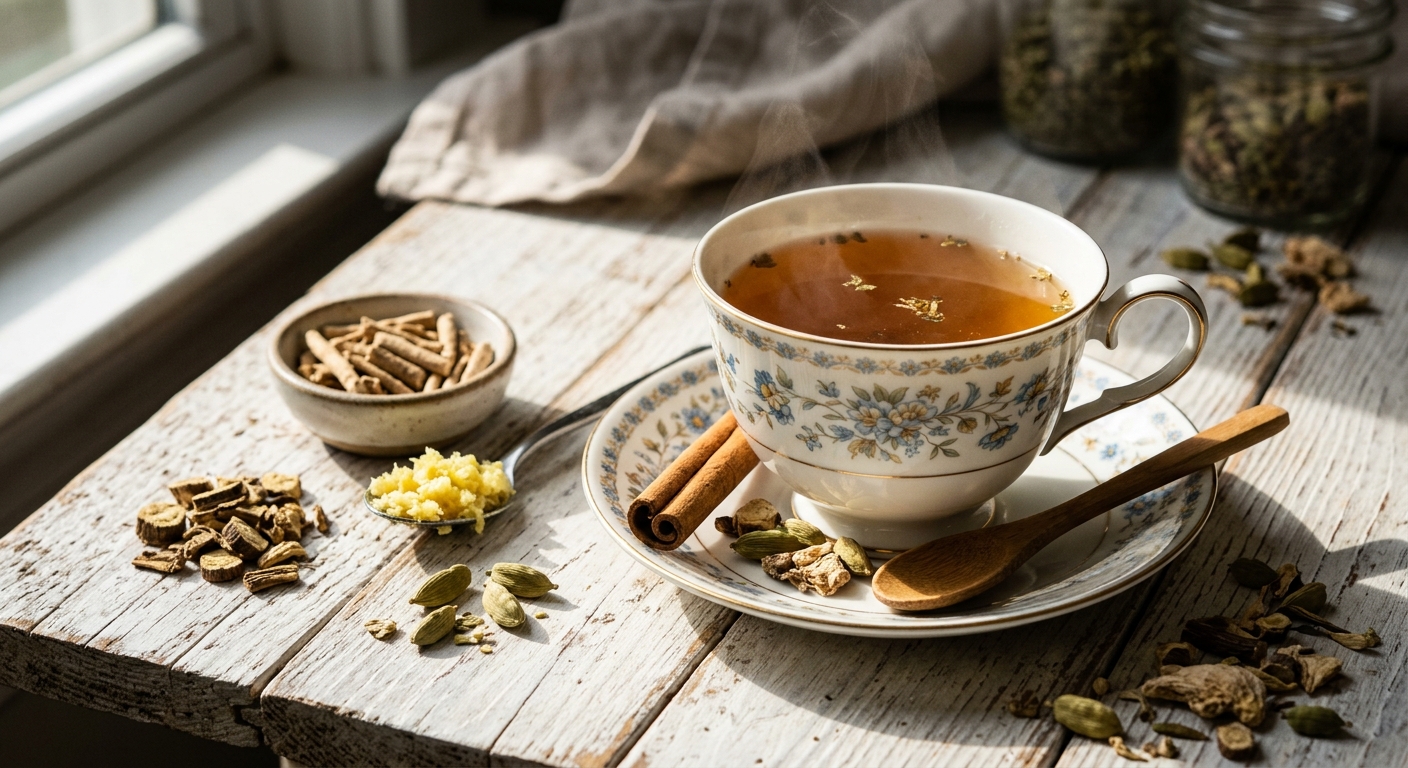
In Ayurveda, the world’s oldest living medical system, Vata dosha governs all movement in the body and mind. When Vata becomes excessive, the result is familiar to many modern people: racing thoughts, disrupted sleep, dry skin, constipation, and a pervasive sense of anxiety and overwhelm. For thousands of years, Ayurvedic practitioners have reached for warming, grounding herbs to bring Vata back into balance, and this blend draws directly from that tradition. Ashwagandha, ginger, cardamom, and licorice root have each played a central role in classical Ayurvedic texts such as the Charaka Samhita and the Ashtanga Hrdayam, where they are praised for their ability to nourish the nervous system, kindle digestive fire, and restore a sense of calm rootedness.
What makes this blend particularly elegant is how each herb reinforces the others. Ashwagandha (Withania somnifera) is the cornerstone, an adaptogen revered in Ayurveda as a Rasayana, or rejuvenating tonic, that builds ojas, the subtle essence of vitality. Ginger warms the digestive tract and improves bioavailability of the other herbs. Cardamom lifts the blend with a bright, aromatic sweetness that also calms the mind and supports healthy respiration. Licorice root serves as a harmonizer, coating inflamed mucous membranes, sweetening the cup naturally, and amplifying the adaptogenic properties of ashwagandha through its own mild cortisol-modulating activity.
Beyond its biochemistry, this tea is a ritual. Preparing it slowly, warming your hands around the cup, and breathing in its spiced, earthy aroma is itself an act of Vata pacification. In Ayurvedic philosophy, the senses are gateways to the nervous system, and the warmth, weight, and sweetness of this blend speak directly to what Vata most craves: stability, nourishment, and stillness.
2
cups
Ingredients
- 2 tspashwagandha root powder or cut root
- 1 tspfreshly grated or dried ginger
- 4 podsgreen cardamom, lightly crushed
- 1 tspdried licorice root, cut and sifted
- 500 mlwater (for hot brew)
- —raw honey or jaggery to taste (optional)
- —a splash of warm whole milk or oat milk (optional, traditional)
How to Brew
Click on an item below to shop for the recommended items for this recipe on Amazon.
As an Amazon Associate, we earn from qualifying purchases.
- Combine the ashwagandha root, dried ginger, crushed cardamom pods, and licorice root in a small saucepan. Pour in 500 ml of cold, filtered water.
- Bring the mixture to a full boil over medium-high heat, then immediately reduce the heat to low so the liquid maintains a gentle, steady simmer.
- Simmer uncovered for 10 to 15 minutes, stirring occasionally. You will notice the liquid deepening to a warm amber and the kitchen filling with a warming, spiced aroma. Allow the volume to reduce by roughly one quarter, which concentrates the active compounds.
- Remove from heat and allow to rest for 2 minutes. Strain through a fine-mesh strainer or cheesecloth into two warmed mugs, pressing the solids gently to extract the last of the liquid.
- Add a splash of warm whole milk or oat milk if desired, a traditional Ayurvedic addition that increases the fat-solubility of withanolides and rounds out the earthiness of the ashwagandha. Sweeten with raw honey or jaggery, but wait until the tea has cooled slightly below 60°C (140°F) before adding honey, as Ayurveda cautions against heating honey.
- Measure out the ashwagandha root, dried ginger, crushed cardamom pods, and licorice root and place them into a clean glass jar. Pour 600 ml of filtered water at room temperature over the herbs. The higher water ratio compensates for the slower cold extraction.
- Stir the herbs gently to ensure they are fully submerged. Leave the jar uncovered or loosely covered at room temperature for 2 hours to begin activating the aromatic volatile compounds, particularly from the cardamom.
- Cover the jar with a lid and transfer it to the refrigerator. Allow the blend to cold brew for a further 10 to 14 hours, or overnight. Do not agitate during this phase, as still cold infusion produces a cleaner, less astringent result.
- Strain the finished cold brew through a fine-mesh strainer lined with a small piece of cheesecloth into a serving pitcher or directly into glasses filled with ice. Press the herbs lightly to extract the liquid without squeezing in excess bitterness.
- Taste before sweetening. The natural sweetness of the licorice root is often more pronounced in cold brew than in the hot decoction. If desired, stir in a small amount of liquid honey or a thin coconut sugar syrup. Serve immediately over ice or store refrigerated for up to 48 hours.
- Double all herb quantities: use 4 tsp ashwagandha root, 2 tsp dried ginger, 8 lightly crushed cardamom pods, and 2 tsp licorice root. Combine in a medium saucepan with 1 liter of filtered water.
- Bring to a full boil over medium-high heat, then reduce to a steady low simmer. Leave the pan partially uncovered to allow steam to escape, and simmer for 25 to 35 minutes, until the liquid has reduced to approximately 250 to 300 ml of concentrated decoction, roughly one quarter of the original volume.
- Monitor the pot regularly during this phase and stir every 5 minutes. The goal is a deep, dark amber concentrate with a pronounced earthy spice aroma. If it reduces too quickly, add a small splash of water and lower the heat.
- Remove from heat and allow to cool completely at room temperature. Strain through a fine-mesh strainer lined with cheesecloth into a clean glass jar, pressing the herbs to extract all remaining liquid. Discard the spent herbs.
- Seal the jar and store in the refrigerator for up to 7 days. To serve, dilute 2 to 3 tablespoons of concentrate with 200 to 240 ml of hot water, warm plant-based milk, or a combination of both. Sweeten as desired with honey added only after dilution when the temperature is below 60°C (140°F).
Health Benefits
Multiple double-blind, placebo-controlled human trials have demonstrated that ashwagandha root extract significantly reduces serum cortisol levels. A landmark 2012 study published in the Indian Journal of Psychological Medicine found a 27.9% reduction in cortisol in participants taking ashwagandha extract over 60 days, alongside significant improvements in perceived stress scores.
Ashwagandha contains the amino acid triethylene glycol, identified in a 2017 study in PLOS ONE as the compound responsible for its sleep-inducing activity. Its withanolides also appear to modulate GABAergic signaling in the hypothalamus, helping to reduce sleep-onset latency and improve overall sleep quality.
Both ashwagandha and cardamom work synergistically on the central nervous system. Withaferin A has demonstrated anxiolytic effects comparable to low-dose lorazepam in animal models, while 1,8-cineole from cardamom supports serotonergic signaling. Together they provide a grounding, non-sedating calm appropriate for daytime use.
Ginger’s 6-gingerol stimulates bile production and motility, addressing the sluggish digestion that often accompanies high Vata. Licorice root soothes the gastric mucosa, protecting against stress-related gastric irritation. Together they prepare the digestive system to absorb the adaptogenic compounds in the blend more efficiently.
Chronic stress depletes adrenal reserves and suppresses immune function. Ashwagandha’s withanolides have been shown to restore adrenal gland weight and function in stressed animals, while also increasing natural killer cell activity and immunoglobulin production in human clinical trials, suggesting a meaningful role in rebuilding resilience after prolonged stress.
🧪 Key Bioactive Compounds
The Science Behind Ashwagandha
The adaptogenic action of this blend is anchored in ashwagandha’s withanolides, a class of naturally occurring steroidal lactones unique to Withania somnifera. These compounds work primarily by modulating the hypothalamic-pituitary-adrenal (HPA) axis, the central stress-response system of the body. Under chronic stress, the HPA axis becomes dysregulated, driving persistently elevated cortisol levels that damage hippocampal neurons, suppress immune function, and disrupt sleep architecture. Withanolides, particularly withaferin A and withanolide D, appear to reduce the sensitivity of cortisol receptors in the hypothalamus and restore normal negative feedback loops, effectively telling the body to downregulate its emergency stress response. Human clinical trials using standardized ashwagandha root extract have consistently shown reductions in serum cortisol ranging from 14% to 32%, alongside significant improvements in self-reported anxiety, fatigue, and cognitive function.
Glycyrrhizin from licorice root adds a complementary layer of hormonal modulation. It inhibits the enzyme 11-beta-hydroxysteroid dehydrogenase type 2, which normally converts active cortisol into inactive cortisone at the tissue level. In small quantities, this prolongs the beneficial anti-inflammatory effect of the body’s own cortisol without raising systemic levels, while also supporting aldosterone balance. Meanwhile, 6-gingerol from ginger inhibits both COX-2 and 5-lipoxygenase, two key enzymes in the inflammatory cascade that is both a cause and consequence of chronic psychological stress. This anti-inflammatory action in the gut supports the gut-brain axis, a bidirectional communication pathway increasingly recognized as central to mood regulation and anxiety.
Cardamom contributes 1,8-cineole, a monoterpene that crosses the blood-brain barrier with relative ease and has been shown in preclinical studies to reduce neuroinflammation and modulate serotonin receptor sensitivity. Serotonergic signaling plays a critical role in mood stability, and several clinical aromatherapy studies have found measurable reductions in anxiety scores when participants inhale cardamom-rich essential oil preparations, suggesting that even the act of breathing in the steam from this tea contributes pharmacologically active compounds to the body. Taken together, this blend targets the stress response through at least four distinct but overlapping mechanisms: HPA axis modulation, cortisol metabolism regulation, COX-2 inhibition, and serotonergic support, making it a genuinely multi-modal herbal intervention rooted in both ancient wisdom and emerging science.
Brewing Tips
- Use cut-and-sifted ashwagandha root rather than powder for the cold brew and concentrate methods, as powder can be difficult to fully strain and may make the tea gritty. Reserve the powder for hot decoctions where straining through cheesecloth is easier.
- Always crush the cardamom pods lightly with a mortar and pestle or the flat of a knife before adding them to the brew. The aromatic volatile oils responsible for cardamom’s anxiolytic and digestive benefits are sealed inside the pod and will not release without cracking the hull.
- Prepare this tea in the evening as part of a wind-down ritual to take full advantage of ashwagandha’s sleep-supportive effects. Consistent daily use over 4 to 8 weeks appears to produce cumulative improvements in stress resilience that single-dose brewing cannot replicate, so treat it as a tonic rather than a quick fix.