Deep in the birch forests of Siberia, Scandinavia, and the northern reaches of North America, a strange dark mass clings to the bark of aging birch trees. Known as Chaga (Inonotus obliquus), this slow-growing fungal conk has been harvested and brewed as a medicinal tea for at least five centuries. Siberian shamans called it the “Gift of God,” while Russian folk healers ground it into powder and simmered it over open fires as a remedy for fatigue, stomach ailments, and what we might today recognize as chronic stress. The 16th-century Russian Tsar Alexis I is said to have used it regularly, and ethnobotanical records from Finland and the Khanty people of western Siberia document its use as both a daily tonic and a targeted medicine.
What makes Chaga so compelling is its position as a true adaptogen, a class of botanicals and fungi that help the body maintain homeostasis when exposed to physical, emotional, or environmental stressors. Unlike stimulants that artificially elevate energy or sedatives that blunt anxiety, Chaga works by modulating the body’s stress-response systems over time, making it particularly well-suited for people dealing with low-grade, persistent stress rather than acute crises. It is also one of the most antioxidant-dense substances ever measured in nature, with an ORAC (Oxygen Radical Absorbance Capacity) score that dwarfs even blueberries and dark chocolate.
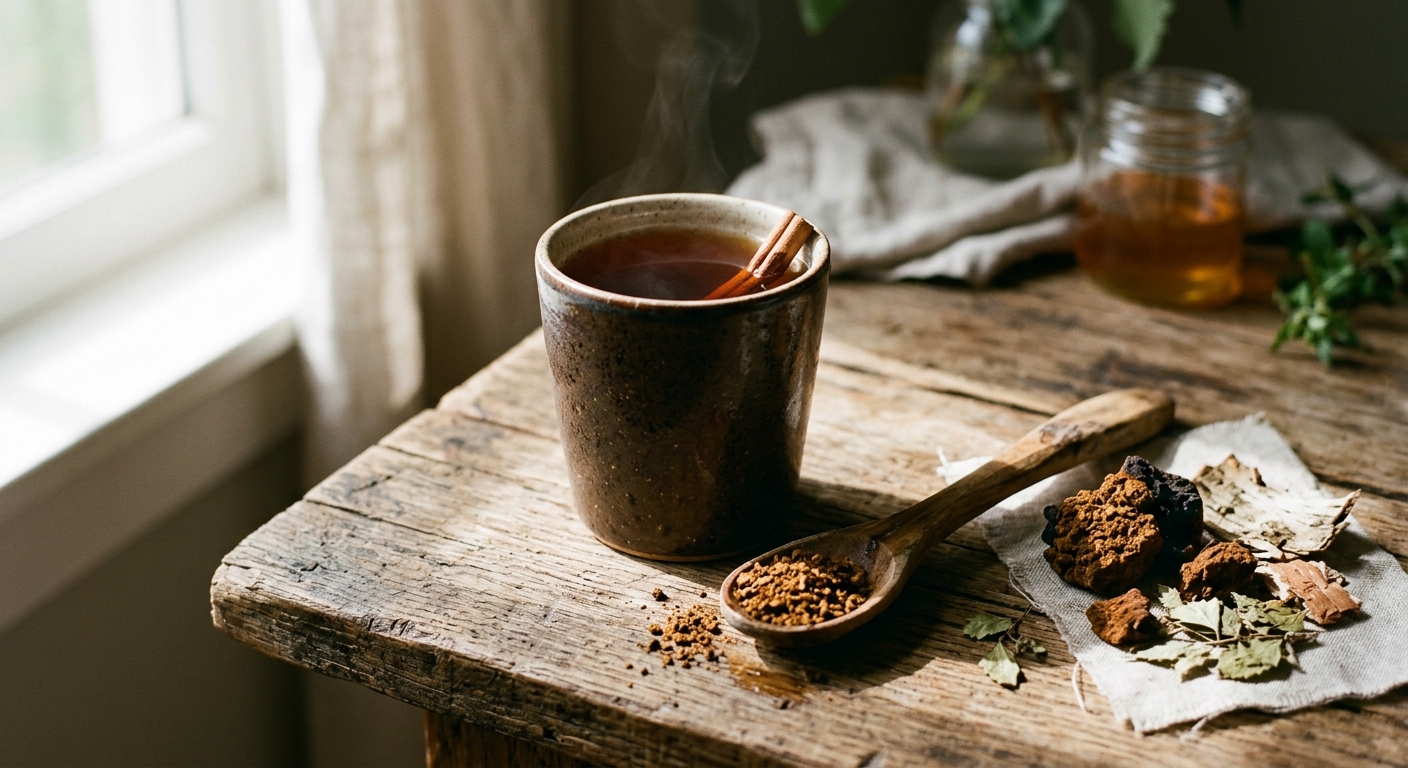
Visually, Chaga is unlike anything you might expect from a tea ingredient. The exterior of the conk is a rough, charcoal-black crust formed by melanin pigments, while the interior reveals a warm amber and rust-colored flesh. When brewed, Chaga releases a tea that is deep amber to dark brown, with a flavor profile that is earthy, slightly vanilla-like, and mildly bitter without the sharpness of coffee. It contains no caffeine, making it an ideal daily ritual for anyone stepping away from stimulants while still craving a warming, grounding beverage with genuine functional depth.
2
cups
Ingredients
- 10 gdried chaga chunks or coarsely ground chaga
- 500 mlwater (below 70°C / 158°F)
- —raw honey or maple syrup to taste (optional)
- —a small cinnamon stick (optional, for warmth)
How to Brew
Click on an item below to shop for the recommended items for this recipe on Amazon.
As an Amazon Associate, we earn from qualifying purchases.
- Measure 10 g of dried chaga chunks or coarsely ground chaga per 500 ml of water. Chunks release compounds more slowly and evenly; ground chaga extracts faster but may require straining through a fine-mesh sieve or cheesecloth.
- Pour cold, filtered water into a small saucepan. Add the chaga directly to the cold water so it begins to hydrate before the heat is applied.
- Heat the saucepan over low to medium-low heat, targeting a temperature between 60 and 70°C (140 to 158°F). Use a kitchen thermometer for precision. You should see very gentle steam rising but no bubbling or simmering.
- Maintain this low heat for 20 to 25 minutes, stirring occasionally. The water will gradually deepen from pale amber to a rich walnut brown as the bioactive compounds are released.
- Remove from heat and allow to rest for 5 minutes. Strain through a fine-mesh sieve into warmed mugs. Add raw honey, maple syrup, or a pinch of cinnamon if desired, and serve immediately.
- Use finely ground chaga for cold brewing. Measure 12 g of ground chaga per 600 ml of cold, filtered water. The increased ratio compensates for the slower extraction rate at low temperatures.
- Combine the ground chaga and cold water in a glass jar. Stir vigorously for 30 seconds to ensure the chaga is fully dispersed and wetted, not clumped at the bottom.
- Seal the jar loosely with a lid or cover with a clean cloth secured with a rubber band. Leave the jar at room temperature (around 20°C / 68°F) for the first 2 hours to allow initial hydration, then transfer to the refrigerator.
- Allow the chaga to cold brew in the refrigerator for a total of 12 to 18 hours. A longer steep produces a darker, more concentrated brew; 12 hours yields a lighter, more delicate cup.
- When ready, strain the brew through a fine-mesh sieve lined with cheesecloth into a clean jar or pitcher. Press the spent grounds gently to extract the remaining liquid. Serve over ice or chilled, and consume within 3 days.
- Select large, whole chaga chunks rather than ground chaga for this method. Use 20 to 25 g of whole dried chaga chunks per 1 liter of cold, filtered water. The thick cellular walls of whole chunks are designed for slow, prolonged extraction.
- Combine the chaga chunks and cold water in a heavy-bottomed saucepan or slow cooker. If using a slow cooker, set it to the low or warm setting, which typically holds between 60 and 75°C, and do not use the high setting.
- If using a stovetop, heat the saucepan over the lowest possible flame, monitoring with a thermometer to ensure the water stays between 60 and 70°C throughout. Place a heat diffuser under the pot if needed to prevent hot spots.
- Allow the chaga to decoct at this sustained low temperature for 2 to 4 hours. Check every 30 to 45 minutes and add small amounts of hot (not boiling) water to maintain the original volume as evaporation occurs.
- After the decoction period, remove from heat and allow the liquid to cool to room temperature. Strain through a fine-mesh sieve, pressing the chunks firmly to extract all remaining liquid. The chunks can be refrigerated and reused for a second, slightly lighter decoction.
- The resulting concentrate is strong and should be diluted 1:1 or 1:2 with hot water before drinking. Store the concentrate in a sealed glass jar in the refrigerator for up to 7 days. Reheat individual portions gently, never exceeding 70°C, before serving.
Health Benefits
Chaga’s beta-glucans and triterpenes help regulate the hypothalamic-pituitary-adrenal (HPA) axis, reducing exaggerated cortisol responses to chronic stressors. Animal studies published in journals including the Journal of Natural Products have demonstrated measurable reductions in stress-induced hormonal dysregulation with regular chaga supplementation.
Chaga has one of the highest recorded ORAC values of any natural substance, driven by its melanin complex, polyphenols, and superoxide dismutase enzymes. Regular consumption may reduce oxidative stress biomarkers, which are directly linked to accelerated aging, neuroinflammation, and anxiety-related cellular damage.
The beta-D-glucans in Chaga act as biological response modifiers, stimulating innate immune activity during periods of immune suppression while helping to calm overactive immune responses. A 2011 study in the International Journal of Medicinal Mushrooms found that Chaga polysaccharides significantly enhanced splenocyte proliferation and natural killer cell activity in mice.
Betulinic acid and inotodiol inhibit NF-kB signaling pathways, one of the body’s primary drivers of systemic inflammation. Chronic low-grade inflammation is now recognized as a key contributor to anxiety disorders, mood disruption, and stress-related cognitive decline.
Chaga’s polysaccharides act as prebiotics, selectively feeding beneficial gut bacteria including Lactobacillus and Bifidobacterium species. Given the well-established gut-brain axis connection, supporting microbial diversity through regular Chaga consumption may indirectly improve mood regulation and stress resilience.
🧪 Key Bioactive Compounds
The Science Behind Chaga Mushroom
Chaga’s therapeutic reputation rests on an unusually diverse and dense portfolio of bioactive compounds, many of which are rare or absent in other herbal teas. The star of the show is its beta-D-glucan content, a class of branched polysaccharides that interact directly with immune receptors on macrophages, dendritic cells, and natural killer cells. Unlike simple immune stimulants that push the immune system into overdrive, beta-glucans are true modulators: they prime immune cells without over-activating them, a distinction that makes Chaga particularly relevant for stress-related immune suppression, where chronic cortisol elevation systematically depresses immune vigilance. Researchers have also proposed that beta-glucans influence the HPA axis indirectly by reducing the peripheral inflammatory signals that amplify the body’s stress response, creating a compounding anti-stress effect over consistent use.
The antioxidant mechanisms in Chaga are particularly remarkable because they operate through multiple independent pathways simultaneously. The melanin complex, which forms Chaga’s distinctive black exterior crust, is a high-molecular-weight polyphenolic polymer that directly scavenges reactive oxygen species (ROS) with extraordinary efficiency. Alongside this, Chaga harbors one of the highest known concentrations of superoxide dismutase (SOD) in any food source, an enzyme that catalytically neutralizes superoxide radicals before they can initiate lipid peroxidation or DNA strand breaks. Oxidative stress is now firmly linked to the neurobiological underpinnings of anxiety and mood disorders, as excess ROS disrupt serotonin synthesis pathways, damage mitochondrial function in neurons, and promote neuroinflammation. By addressing oxidative load at this enzymatic level, Chaga may help protect the neurochemical environment in which mood regulation occurs.
The triterpenes found in Chaga, particularly betulinic acid and inotodiol, add a third layer of activity through their inhibition of NF-kB (nuclear factor kappa-light-chain-enhancer of activated B cells), a transcription factor that governs the expression of pro-inflammatory cytokines including TNF-alpha and IL-6. Chronically elevated cytokine levels are now understood to be not only a consequence of stress but a driver of it, creating a bidirectional feedback loop between inflammation and psychological distress. By suppressing NF-kB activation, Chaga’s triterpenes may help break this loop, reducing the inflammatory burden that perpetuates anxiety, cognitive fog, and stress-related fatigue. Critically, these beneficial compounds are heat-sensitive, which is why maintaining brew temperatures below 70°C is not merely a preference but a biochemical necessity for a therapeutically active cup.
Brewing Tips
- Never boil your Chaga. Temperatures above 70°C (158°F) degrade heat-sensitive beta-glucans and antioxidants. Use a thermometer every time until you can reliably judge the temperature by sight and steam.
- Spent Chaga chunks from your hot brew or decoction can be rinsed, dried, and refrigerated for up to 3 days, then reused for a second extraction. The second brew will be lighter but still contains meaningful levels of water-soluble polysaccharides.
- Source matters enormously with Chaga. Look for wild-harvested Chaga from birch trees in Siberia, Canada, or Scandinavia with third-party heavy metal testing certificates. Chaga grown on other tree species or in polluted environments can accumulate toxins and lacks the betulinic acid derived from birch.