Deep in the forests of Japan, China, and the northeastern United States, a frilly, fan-shaped fungus clings to the base of oak, elm, and maple trees. Known as Grifola frondosa, maitake translates from Japanese as “dancing mushroom,” a name rooted in the legend that those who discovered it in the wild would dance with joy at their fortune. For centuries, maitake was so prized in feudal Japan that it was traded weight-for-weight with silver. Herbalists and physicians in both Japanese Kampo medicine and Traditional Chinese Medicine incorporated it as a tonic for vitality, longevity, and resilience against physical and emotional strain.
What makes maitake particularly compelling among medicinal mushrooms is its identity as a true adaptogen, a substance that helps the body maintain homeostasis when faced with biological, chemical, or psychological stress. Unlike stimulants that simply override fatigue, maitake works with the body’s own regulatory systems, particularly the hypothalamic-pituitary-adrenal (HPA) axis that governs our cortisol and stress hormone output. Traditional herbalists prescribed it not for a single dramatic effect, but as a long-term tonic to be taken daily, building resilience gradually over weeks and months.
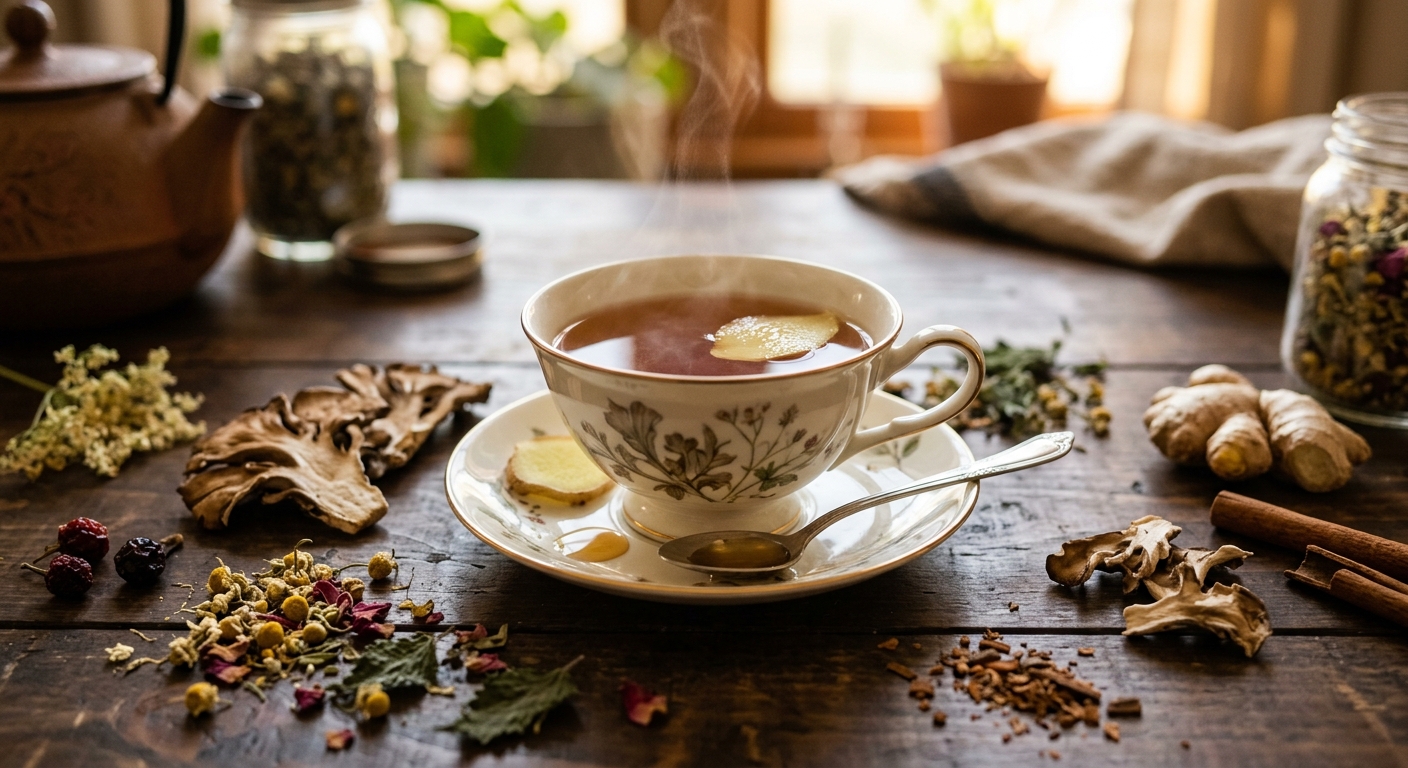
Brewing maitake into a tea or decoction extracts its water-soluble bioactive compounds, most notably the remarkable D-fraction and SX-fraction beta-glucans, along with a suite of polysaccharides, ergosterol, and antioxidant phenolics. The resulting brew is dark, deeply savory, and warming, with an umami depth that sets it apart from floral or citrus herbal teas. It is a cup that asks you to slow down, breathe deeply, and treat wellness as a daily practice rather than a quick fix.
2
cups
Ingredients
- 10 gdried maitake mushroom slices
- 500 mlfiltered water
- —1 tsp raw honey or maple syrup (optional)
- —1 small slice fresh ginger (optional, for warmth)
- —pinch of cinnamon (optional, for sweetness)
How to Brew
Click on an item below to shop for the recommended items for this recipe on Amazon.
As an Amazon Associate, we earn from qualifying purchases.
- Add 10 g of dried maitake mushroom slices and 500 ml of cold filtered water to a small saucepan. Starting in cold water helps draw out compounds gradually as the temperature rises.
- Bring the water to a full rolling boil over medium-high heat, then immediately reduce the heat to a gentle simmer. Partially cover the saucepan with a lid to reduce evaporation while still allowing steam to escape.
- Simmer steadily for 25 to 35 minutes. The liquid will reduce and deepen in color to a rich amber or mahogany brown. If you added ginger or cinnamon, include them now so they meld into the brew.
- Remove from heat and allow the decoction to rest for 5 minutes. This brief resting period lets the compounds settle and the temperature drop to a comfortable drinking heat.
- Strain the liquid through a fine mesh strainer or cheesecloth into your mug, pressing gently on the mushroom pieces to extract the remaining liquid. Sweeten lightly with raw honey or maple syrup if desired, and serve immediately.
- Place 12 g of dried maitake mushroom slices into a clean glass jar or pitcher. Use slightly more mushroom than in the hot method to compensate for the lower extraction efficiency of cold water.
- Pour 500 ml of cold filtered water over the mushroom slices. Stir gently to ensure all the mushroom pieces are submerged. Do not use hot or warm water, as the goal is a slow, cool extraction.
- Cover the jar with a lid or plastic wrap and leave it at room temperature for 1 hour to begin the initial hydration phase, then transfer it to the refrigerator.
- Allow the mushroom to cold-brew in the refrigerator for 10 to 14 hours, ideally overnight. The liquid will slowly shift from clear to a pale golden amber tone, much lighter than a hot decoction.
- Remove from the refrigerator and strain the liquid through a fine mesh strainer or cheesecloth into a glass, pressing gently on the mushroom pieces. Serve over ice or drink chilled. Sweeten with a small amount of honey dissolved in warm water if desired, as cold liquids do not dissolve honey easily.
- Combine 30 g of dried maitake mushroom slices with 500 ml of cold filtered water in a medium saucepan. This higher mushroom-to-water ratio is intentional, as the concentrate will be diluted before drinking.
- Bring to a full boil over medium-high heat, then reduce to a low simmer. Cover partially and allow to simmer for 45 to 60 minutes, checking periodically to ensure the liquid does not reduce below 250 ml. Add small amounts of water if necessary to maintain volume.
- After 60 minutes, remove from heat and allow to cool to room temperature for approximately 20 minutes. The resulting liquid should be very dark, thick, and intensely savory.
- Strain through a fine mesh strainer lined with cheesecloth into a clean glass jar, pressing firmly on the mushroom pieces to extract every drop. Discard the spent mushroom solids or compost them.
- Allow the concentrate to cool completely before sealing the jar and storing it in the refrigerator for up to 7 days. To serve, dilute 60 to 80 ml of concentrate with 160 to 180 ml of hot water. Adjust ratio to taste and add honey, ginger, or a splash of oat milk if desired.
Health Benefits
Maitake acts as an adaptogen by modulating the hypothalamic-pituitary-adrenal axis, helping regulate cortisol output during periods of chronic stress. Its beta-glucan fractions interact with immune receptors that communicate directly with stress-response pathways, fostering a more balanced physiological reaction to stressors over time.
The D-Fraction beta-glucans in maitake are among the most studied immunomodulatory compounds in medicinal fungi, activating key immune cells including macrophages, dendritic cells, and natural killer cells. Chronic psychological stress suppresses immune function, and maitake’s immune-supportive action helps counteract this stress-induced immune dysregulation.
The SX-Fraction in maitake has shown in clinical and preclinical research to improve insulin sensitivity and moderate post-meal blood glucose spikes. Stable blood sugar is directly linked to mood and anxiety levels, as glucose crashes trigger cortisol release and can worsen feelings of stress and mental fatigue.
Compounds including grifolins and ergothioneine neutralize the excess free radicals generated during chronic psychological and physiological stress, which left unchecked can damage brain tissue and impair neurotransmitter production. Regular intake of maitake has been associated with reduced oxidative stress markers in animal studies.
Adenosine present in maitake promotes natural sleepiness and nervous system downregulation, and has been shown to reduce physiological markers of arousal associated with anxiety. Combined with its adaptogenic and blood-sugar-stabilizing properties, maitake tea consumed in the evening may support a smoother transition into restful sleep.
🧪 Key Bioactive Compounds
The Science Behind Maitake Mushroom
The science behind maitake’s stress and anxiety benefits centers on its uniquely structured beta-glucans, particularly the D-Fraction, a proteoglucan complex not found at comparable levels in other culinary mushrooms. These beta-1,3 and beta-1,6 linked glucan chains bind to pattern recognition receptors, most notably Dectin-1, on immune cells throughout the gut-associated lymphoid tissue. This interaction initiates a cascade of signaling that reaches the HPA axis, the central regulator of the body’s stress hormone system, effectively recalibrating its sensitivity over time. This is the mechanistic basis of maitake’s classification as an adaptogen, a substance that non-specifically increases resistance to biological, physical, and psychological stress.
The SX-Fraction beta-glucan adds another layer of stress-modulating benefit through metabolic pathways. By improving insulin receptor sensitivity and moderating post-meal glucose excursions, SX-Fraction helps prevent the blood sugar volatility that triggers cortisol secretion. Given that many people experiencing anxiety and chronic stress also struggle with dysregulated blood sugar, this metabolic stabilization can meaningfully reduce a physiological driver of anxious feelings. A 2002 pilot study published in the Journal of Naturopathic Medicine demonstrated that SX-Fraction supplementation significantly improved glucose metabolism in subjects with type 2 diabetes, supporting this mechanistic link.
At the neuronal level, ergothioneine and grifolins provide critical antioxidant protection against the reactive oxygen species that accumulate during chronic stress. Oxidative stress in the brain damages mitochondria, depletes neurotransmitter precursors, and impairs the hippocampus, the region governing memory, emotional regulation, and feedback control of the HPA axis. By protecting these structures, maitake’s antioxidant compounds help preserve the brain’s own capacity to regulate stress responses. Adenosine, another bioactive compound present in maitake, acts directly on adenosine A1 and A2A receptors in the central nervous system to reduce neuronal excitability and promote the physiological quieting that underpins both sleep onset and anxiety reduction.
Brewing Tips
- Do not discard spent maitake pieces after straining. They can be lightly seasoned with tamari and eaten as a savory side, or blended into a broth, ensuring you get the full benefit of the mushroom beyond just the water-soluble compounds.
- Consistency is key with adaptogenic mushroom teas. Unlike acute herbal remedies such as valerian for sleep, maitake builds its stress-modulating effects over weeks of daily use. Commit to at least four to six weeks before evaluating whether it is working for you.
- Source matters enormously with medicinal mushrooms. Always choose products made from whole dried fruiting bodies rather than mycelium grown on grain substrate, as the fruiting body contains significantly higher concentrations of active beta-glucans. Look for a Certificate of Analysis confirming beta-glucan content.