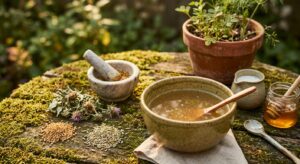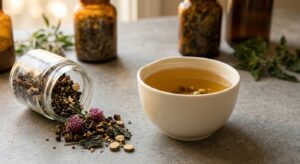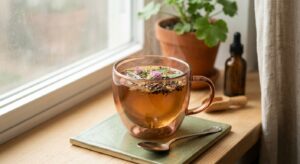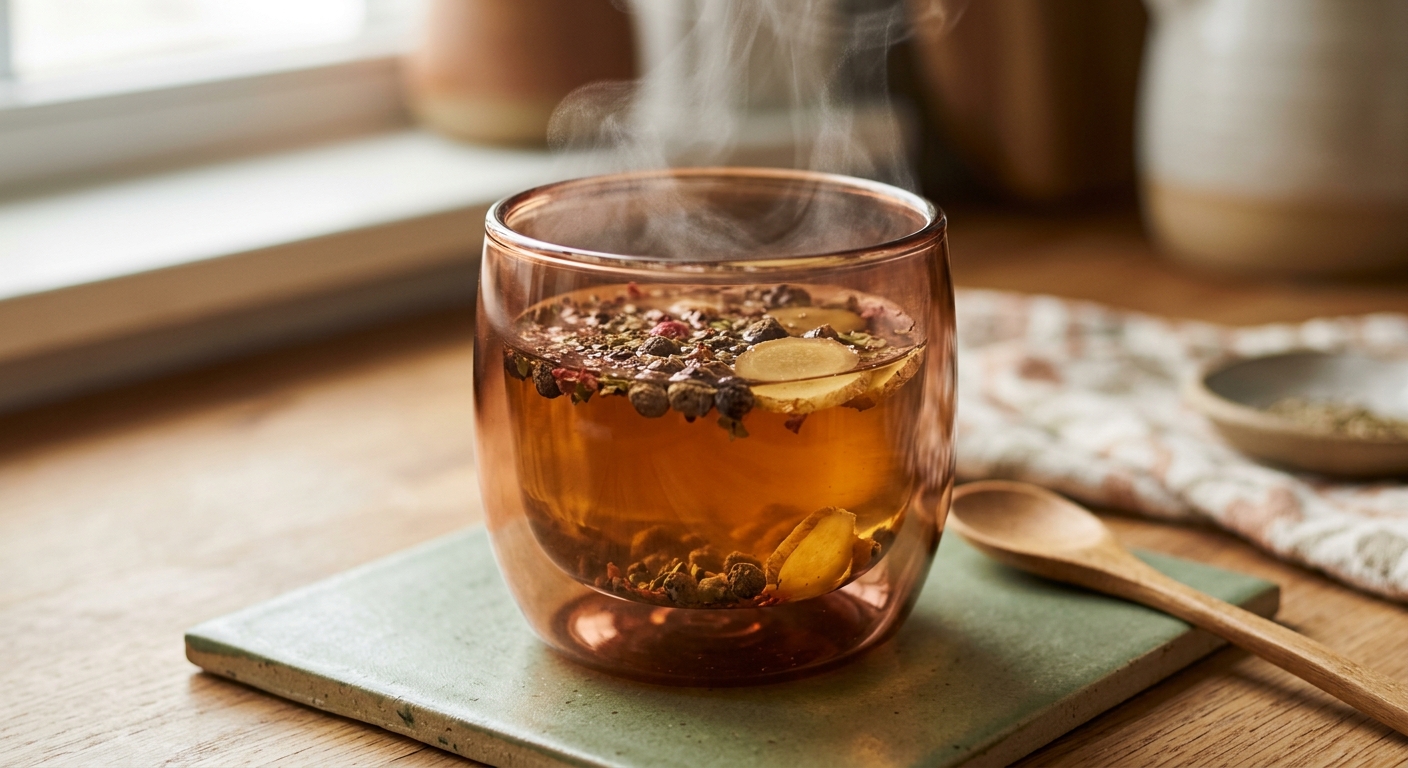
For centuries, women across cultures have turned to plant medicine to support their reproductive health. From European midwives steeping red raspberry leaf for their clients to Ayurvedic practitioners prescribing ashwagandha for hormonal balance, herbal traditions worldwide share a common understanding: the female cycle is deeply responsive to botanical support. This Irregular Cycle Tea draws on that collective wisdom, blending vitex berry, red raspberry leaf, and ginger root into a warming, nourishing daily ritual.
Vitex agnus-castus, known as chasteberry or monk’s pepper, is the cornerstone of this blend. Revered since ancient Greece and documented in European herbal pharmacopoeias for over 2,000 years, vitex works gently on the pituitary gland to help regulate the hormonal signals that govern the menstrual cycle. Unlike synthetic hormone therapies, vitex does not contain plant hormones itself. Instead, it nudges the body’s own feedback systems toward greater balance, making it especially useful for cycles that are too long, too short, or unpredictably absent. Red raspberry leaf adds a rich mineral foundation, supplying magnesium and calcium that support smooth uterine muscle function, while ginger brings warming, anti-inflammatory properties that ease cramping and improve pelvic circulation.
This is a tea best understood as a long-term ally rather than a quick fix. Hormonal rhythms shift slowly, and the herbs in this blend are most effective when consumed consistently over several menstrual cycles. Many women begin to notice improvements in cycle regularity and reduced PMS symptoms within two to three months of daily use. Whether you are navigating PCOS-related irregularity, post-pill cycle recovery, or the subtle hormonal fluctuations of perimenopause, this blend offers a grounding, plant-centered point of support.
2
cups
Ingredients
- 1 tspdried vitex berries (lightly crushed)
- 2 tspdried red raspberry leaf
- 1 tspfresh ginger root (thinly sliced) or 0.5 tsp dried ginger
- 500 mlwater
- —raw honey or maple syrup to taste (optional)
- —a squeeze of fresh lemon juice (optional, brightens flavor)
How to Brew
Click on an item below to shop for the recommended items for this recipe on Amazon.
As an Amazon Associate, we earn from qualifying purchases.
- Lightly crush the dried vitex berries using a mortar and pestle or the back of a spoon. This breaks the outer shell and allows water to extract the active iridoid glycosides and diterpenes more efficiently.
- Bring 500 ml of fresh, filtered water to a full boil at 95 to 100°C (203 to 212°F). Pour it into your teapot or directly over the herbs in a covered mug or French press.
- Add the crushed vitex berries, dried red raspberry leaf, and sliced or dried ginger to your infuser, teapot, or French press basket. Pour the boiling water over the herbs immediately.
- Cover the vessel tightly with a lid, a small saucer, or a folded cloth. Steep for 10 to 15 minutes. Do not rush this step – vitex in particular requires extended contact time with hot water to fully release its beneficial compounds.
- Press or remove the infuser. If using a French press, press the plunger slowly. Pour into warmed mugs and sweeten with raw honey if desired. Add a small squeeze of lemon to brighten the earthy flavor. Drink one cup in the morning as a consistent daily ritual.
- Lightly crush the dried vitex berries as you would for hot brew – this step remains important even for cold infusion, as the cold water needs maximum surface contact with the woody berry to extract effectively over time.
- Combine the crushed vitex berries, red raspberry leaf, and ginger slices in a clean glass jar. Pour 500 ml of room-temperature filtered water over the herbs. Do not use hot water – the slow cold extraction produces a distinctly different, mellower flavor profile.
- Stir gently to ensure all herbs are submerged. Seal the jar with a lid and place it in the refrigerator. Allow to infuse for 12 to 16 hours, or overnight. The longer the steep, the stronger the extraction – 14 hours is a reliable sweet spot.
- Strain the cold brew through a fine mesh strainer or cheesecloth into a clean glass or pitcher. Discard the spent herbs. Serve over ice with a slice of fresh lemon or a small sprig of fresh mint for a refreshing lift. The strained cold brew keeps refrigerated for up to 48 hours.
- Add the crushed vitex berries and sliced ginger root to a small stainless steel or ceramic saucepan. Pour in 600 ml of cold, filtered water – you start with more water than the recipe calls for to account for evaporation during simmering.
- Bring the water to a gentle boil over medium heat, then immediately reduce the heat to low so the liquid maintains a steady, gentle simmer. Do not allow it to boil vigorously, as this can degrade some of the more delicate aromatic compounds in ginger.
- Simmer the vitex berries and ginger uncovered for 15 minutes. Then add the red raspberry leaf directly to the simmering water, turn off the heat, and cover the pot. Allow the raspberry leaf to infuse off the heat for an additional 5 to 10 minutes. This two-stage approach protects the more delicate plant compounds in the raspberry leaf from excessive heat degradation.
- Strain the finished decoction through a fine mesh strainer into a warmed teapot or directly into mugs. You should have approximately 400 to 450 ml of rich, concentrated liquid. Sweeten with raw honey if desired, and sip slowly. Because of its concentration, one cup of this decoction is equivalent to roughly one and a half cups of standard hot brew.
Health Benefits
Vitex has been the subject of multiple clinical trials demonstrating its ability to lengthen a short luteal phase and regularize cycle length in women with irregular periods. A 2013 placebo-controlled study published in Phytomedicine found that women taking vitex extract over three menstrual cycles showed statistically significant improvements in cycle regularity compared to controls.
By modulating dopamine signaling in the pituitary gland, vitex helps reduce excess prolactin and supports the body’s own production of progesterone during the second half of the cycle. This is particularly relevant for women experiencing short or symptomatic luteal phases, spotting before menstruation, or difficulty maintaining early pregnancy.
Ginger’s ability to inhibit prostaglandin and thromboxane synthesis, key mediators of uterine cramping, has been supported by several randomized controlled trials. A notable 2009 study in the Journal of Alternative and Complementary Medicine found that ginger supplementation reduced dysmenorrhea pain to a similar degree as ibuprofen in a student population.
Red raspberry leaf is a rich source of bioavailable magnesium, calcium, and iron, minerals that are frequently depleted in women with heavy or irregular periods. Adequate magnesium in particular is associated with reduced PMS symptoms, improved mood regulation during the luteal phase, and lower rates of menstrual migraine.
A 2000 double-blind trial published in the British Medical Journal involving 178 women found that vitex extract significantly reduced PMS symptoms including breast tenderness, mood changes, headaches, and bloating over three treatment cycles, with the herb well-tolerated and producing minimal side effects.
🧪 Key Bioactive Compounds
The Science Behind Vitex (Chasteberry)
The hormonal action of vitex is rooted in its influence on the hypothalamic-pituitary axis, the control center for reproductive hormone signaling. Several diterpenes and iridoid glycosides in vitex berries, particularly rotundifuran and agnuside, have been shown to bind to dopamine D2 receptors in the anterior pituitary gland. This binding action inhibits the release of prolactin, a hormone that, when elevated, can suppress ovulation and shorten or eliminate the luteal phase. By normalizing prolactin levels, vitex creates the hormonal conditions necessary for a well-timed, progesterone-supported second half of the menstrual cycle. Some researchers also suggest that flavonoids in vitex, including casticin, may exhibit weak affinity for progesterone and estrogen receptors, though this secondary mechanism remains an area of active investigation.
Red raspberry leaf contributes a different but complementary dimension of support. Its high mineral content, particularly magnesium, plays a key role in modulating the neuromuscular activity of the uterus. Magnesium acts as a natural calcium antagonist: by blocking excess calcium from entering smooth muscle cells, it helps prevent the overcontraction associated with menstrual cramps. The alkaloid fragarine, though less extensively studied than the herb’s mineral content, has historically been associated with a toning effect on uterine tissue, and is why red raspberry leaf has been used by traditional midwives for centuries as a uterine tonic. Ellagic acid, a polyphenol present in significant quantities in raspberry leaf, also exhibits antioxidant and mild anti-estrogenic activity that may help buffer estrogen dominance, a common driver of cycle irregularity, heavy bleeding, and PMS.
Ginger’s contribution to this blend centers on its powerful anti-inflammatory action. The primary active compounds in fresh ginger, the gingerols, and in dried ginger, the shogaols, potently inhibit cyclooxygenase (COX) and lipoxygenase (LOX) enzymes, two key pathways in the synthesis of prostaglandins and leukotrienes. In the context of menstrual health, this matters enormously: excess prostaglandin E2 and F2-alpha produced by the uterine lining trigger the intense smooth muscle contractions experienced as cramping, and also contribute to the systemic symptoms of primary dysmenorrhea including nausea, headache, and low back pain. By reducing prostaglandin synthesis, ginger addresses cramping at its biochemical root, and several randomized controlled trials have now confirmed its effectiveness for dysmenorrhea pain as clinically comparable to ibuprofen at appropriate doses.
Brewing Tips
- Crush vitex berries fresh before each brew rather than grinding a large batch. The volatile diterpenes responsible for its hormonal activity are sensitive to air exposure and degrade faster once the berry is broken open.
- Consistency is everything with this blend. Drink one cup daily, ideally in the morning, throughout your entire cycle, not just around menstruation. Vitex in particular requires weeks to months of regular use before its pituitary-modulating effects become established.
- If you find the earthy, peppery flavor of vitex difficult to enjoy, increase the proportion of red raspberry leaf slightly and add a cinnamon stick to the brew. Cinnamon harmonizes beautifully with the other flavors and has its own emerging evidence base for supporting insulin sensitivity in women with PCOS.