Long before European settlers arrived in North America, Indigenous peoples of the eastern woodlands had already discovered the remarkable properties of a gnarled, slow-growing root tucked beneath the forest floor. Cherokee healers used American ginseng to sharpen mental clarity and ease exhaustion, while Iroquois and Ojibwe traditions recognized it as a tonic for overall vitality. When Jesuit missionaries encountered it in the 18th century, they were astonished to find a plant so closely resembling the prized Asian ginseng that Chinese traders had valued for millennia. Within decades, American ginseng became one of North America’s most lucrative wild exports, shipped by the ton to China where it was celebrated as a cooling, yin-tonifying alternative to the warming Korean variety.
What sets American ginseng apart in the world of adaptogens is its distinctly different energetic profile. While Asian (Panax) ginseng tends to be stimulating and warming, American ginseng is considered cooling and grounding by both Traditional Chinese Medicine practitioners and Western herbalists. This makes it particularly well-suited for the modern stress response: the frantic, overheated, wired-but-tired feeling that many people live with daily. Rather than pushing you forward with a caffeine-like surge, American ginseng works gently over time, helping the body regulate its cortisol response and restore a sense of calm alertness.
Today, American ginseng is cultivated primarily in Wisconsin, Ontario, and British Columbia, though wild-harvested roots remain highly prized and are now protected in many states due to overharvesting. The dried root produces a tea that is earthy, faintly sweet, and lightly bitter, with a characteristic warming sensation at the back of the throat despite its cooling energetic nature. It is a tea that rewards patience, both in brewing and in use, as its adaptogenic benefits build meaningfully with consistent consumption over several weeks.
2
cups
Ingredients
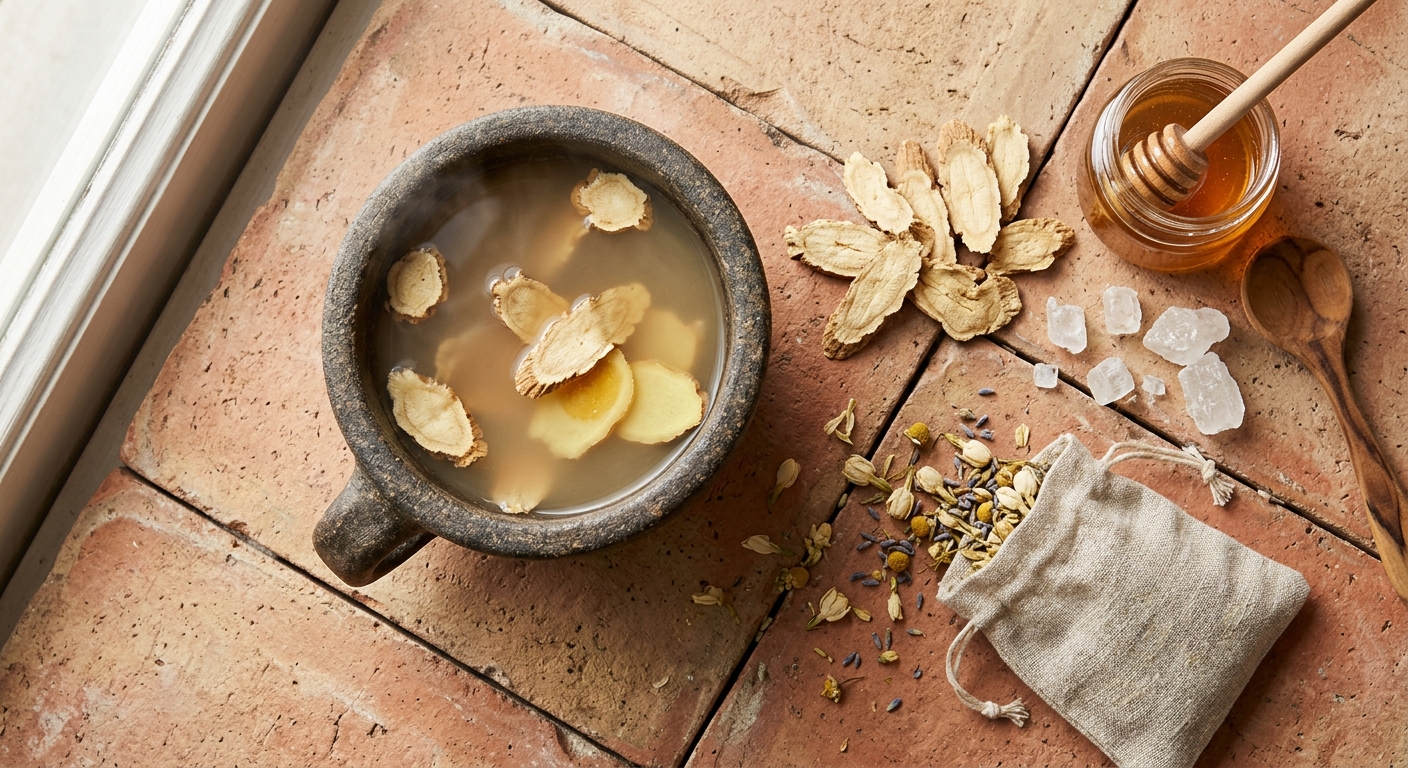
- 6 gdried American ginseng root slices
- 480 mlwater (90°C / 194°F)
- —raw honey or rock sugar to taste (optional)
- —thin ginger slices (optional, for warming balance)
How to Brew
Click on an item below to shop for the recommended items for this recipe on Amazon.
As an Amazon Associate, we earn from qualifying purchases.
- Measure 3 grams of dried American ginseng root slices per cup. If using whole dried slices, lightly crush them with the back of a spoon to increase surface area and improve extraction.
- Heat filtered water to 88 to 92°C (190 to 198°F). If you do not have a temperature-controlled kettle, bring water to a full boil and let it rest for 2 minutes before pouring.
- Place the root slices in a tea infuser or small teapot. Pour the hot water over the roots and cover the vessel immediately to trap volatile aromatic compounds.
- Steep for 10 to 15 minutes. Taste at 10 minutes for a milder brew, or allow the full 15 minutes for a more robust, slightly bitter infusion.
- Remove the infuser or strain the liquid through a fine-mesh strainer into your cup. Add honey or rock sugar if desired. The roots can be re-steeped one to two more times at the same temperature, with each subsequent steep lasting 5 minutes longer than the last.
- Measure 8 grams of dried American ginseng root slices. Lightly rinse the slices under cool water to remove any surface dust, then place them in a clean glass jar.
- Add 500 ml of room-temperature filtered water to the jar. Do not use cold water straight from the refrigerator, as starting at room temperature allows an initial period of gentle extraction before chilling.
- Stir briefly, then seal the jar and leave it at room temperature for 1 hour. After this initial hour, move the jar to the refrigerator.
- Allow the roots to steep in the refrigerator for 12 to 16 hours, or overnight. The cold, slow extraction draws out a higher proportion of polysaccharides relative to bitter saponins, producing a milder, slightly sweeter flavor.
- Strain through a fine-mesh strainer or cheesecloth into a glass. Serve over ice if desired. The cold-brewed concentrate can be stored in the refrigerator for up to 48 hours, and the spent roots can be re-steeped one additional time using the same cold method.
- Measure 10 grams of dried American ginseng root slices or small root pieces. Place them in a small ceramic or stainless-steel saucepan. Avoid aluminum cookware, as it can react with the root’s saponins and introduce a metallic note.
- Add 600 ml of cold filtered water to the saucepan. Allow the roots to soak in the cold water for 20 minutes before applying heat. This pre-soaking step softens the root tissue and improves compound extraction during the simmer.
- Place the saucepan over medium-low heat and bring the water slowly to a gentle simmer. Do not allow the liquid to reach a full rolling boil. Maintain a steady, gentle simmer with small bubbles breaking the surface.
- Simmer uncovered for 25 to 35 minutes, or until the liquid has reduced to approximately 300 to 350 ml. The brew will deepen to a warm amber color and develop a noticeably more robust, earthy aroma.
- Remove from heat and allow to cool for 3 to 5 minutes. Pour through a fine-mesh strainer into a cup or small ceramic bowl. Add a small piece of rock sugar or a drizzle of honey to balance the bitterness if needed. Consume slowly and mindfully, treating this preparation as a tonic rather than a casual beverage.
Health Benefits
American ginseng’s Rb1 and Rc ginsenosides have been shown in multiple studies to modulate the hypothalamic-pituitary-adrenal (HPA) axis, reducing the release of cortisol and adrenocorticotropic hormone (ACTH) during acute and chronic stress. A 2013 study published in the Journal of Ethnopharmacology found that regular Panax quinquefolius supplementation significantly lowered perceived stress scores and salivary cortisol levels in healthy volunteers over an eight-week period.
Unlike caffeine or even Asian ginseng, American ginseng produces what herbalists describe as a calm alertness, a state of focused mental function without agitation or jitteriness. Research suggests this effect is mediated partly through GABAergic pathways and partly through the neuroprotective action of Rg1 ginsenoside, which supports hippocampal function and working memory under stress conditions.
Several controlled trials have demonstrated that American ginseng lowers postprandial blood glucose levels, particularly the Re ginsenoside’s role in enhancing insulin secretion and peripheral glucose uptake. Because blood sugar fluctuations are a major driver of mood instability, anxiety, and fatigue, this glycemic-stabilizing effect contributes meaningfully to the herb’s reputation as a stress and mood tonic.
Chronic psychological stress is one of the most well-documented suppressors of immune function. American ginseng’s polysaccharide fraction, particularly the panaxans, has been shown to stimulate macrophage and natural killer cell activity. A randomized controlled trial published in the Canadian Medical Association Journal found that Panax quinquefolius extract significantly reduced the incidence and duration of upper respiratory infections compared to placebo.
A double-blind crossover study by researchers at the University of Northumbria found that a single dose of Panax quinquefolius extract significantly improved working memory performance, accuracy on sustained attention tasks, and reaction times compared to placebo. These cognitive benefits are attributed to the combined neuroprotective effects of ginsenosides Rb1 and Rg1 on hippocampal neurons.
🧪 Key Bioactive Compounds
The Science Behind American Ginseng
The adaptogenic power of American ginseng (Panax quinquefolius) is anchored in its rich profile of dammarane-type triterpenoid saponins, collectively known as ginsenosides. More than 30 individual ginsenosides have been identified in the root, but the dominant compound in American ginseng, Rb1, is particularly significant for stress and anxiety. Rb1 has been shown to downregulate the hypothalamic-pituitary-adrenal (HPA) axis, the hormonal cascade that governs the body’s stress response, by inhibiting excessive corticotropin-releasing hormone (CRH) secretion in the hypothalamus. This results in measurably lower circulating cortisol levels during periods of psychological or physical stress, without blunting the normal alertness and energy that a healthy stress response provides.
American ginseng also exerts meaningful effects on neurotransmitter systems associated with anxiety and mood. Animal and in vitro studies suggest that ginsenosides Rb1 and Rg1 interact with GABA-A receptors and influence dopaminergic and serotonergic tone in the prefrontal cortex and limbic system. Rg1, in particular, has been shown to stimulate nerve growth factor (NGF) expression and protect hippocampal neurons from stress-induced atrophy, a process strongly implicated in anxiety disorders and depression. This neuroplasticity-supporting mechanism may explain why consistent consumption over several weeks produces more pronounced calming effects than a single-dose experience.
The immune and metabolic dimensions of American ginseng’s chemistry also contribute indirectly to its stress-relieving profile. The root’s high-molecular-weight polysaccharides, especially the panaxans, modulate innate immune signaling pathways including NF-kB and Toll-like receptor 4, reducing the low-grade systemic inflammation that chronic stress reliably promotes. Meanwhile, the Re ginsenoside’s well-documented ability to enhance insulin secretion from pancreatic beta cells and improve peripheral glucose uptake helps stabilize blood sugar, preventing the energy crashes and mood dysregulation that accompany glycemic instability. Together, these mechanisms paint a picture of an herb that addresses stress from multiple physiological angles simultaneously, making it one of the more scientifically substantiated adaptogens in the Western herbal pharmacopoeia.
Brewing Tips
- Buy roots from certified Wisconsin or Ontario growers whenever possible. Cultivated American ginseng is more sustainably sourced and often more consistent in ginsenoside content than wild-harvested root, which also carries significant ethical and legal concerns in many regions.
- Store dried ginseng root slices in an airtight glass container away from heat and light. Properly stored root retains its potency for 18 to 24 months. Avoid plastic containers for long-term storage, as the root’s volatile compounds can be affected by plastic off-gassing.
- Do not discard the spent roots after the first brew. American ginseng roots are dense enough to yield two or even three steeps of useful tea. Each subsequent infusion will be milder and slightly sweeter as the bitter saponins are progressively extracted, making later steeps particularly pleasant for those new to the flavor.
- For maximum adaptogenic benefit, drink American ginseng tea consistently for at least four to six weeks. Adaptogens work cumulatively by gradually recalibrating the body’s stress response systems rather than producing an immediate pharmacological effect like a sedative or stimulant would.