We all know the feeling: the meeting is over, the crisis has passed, the argument has ended, and yet your heart is still pounding, your hands are slightly shaky, and your mind refuses to quiet down. This is the adrenaline comedown, the uncomfortable period after acute stress when cortisol and adrenaline are still coursing through your bloodstream even though the perceived threat is long gone. For centuries, herbalists across Europe, Asia, and the Americas have reached for specific nervine plants to help the body navigate exactly this kind of physiological turbulence.
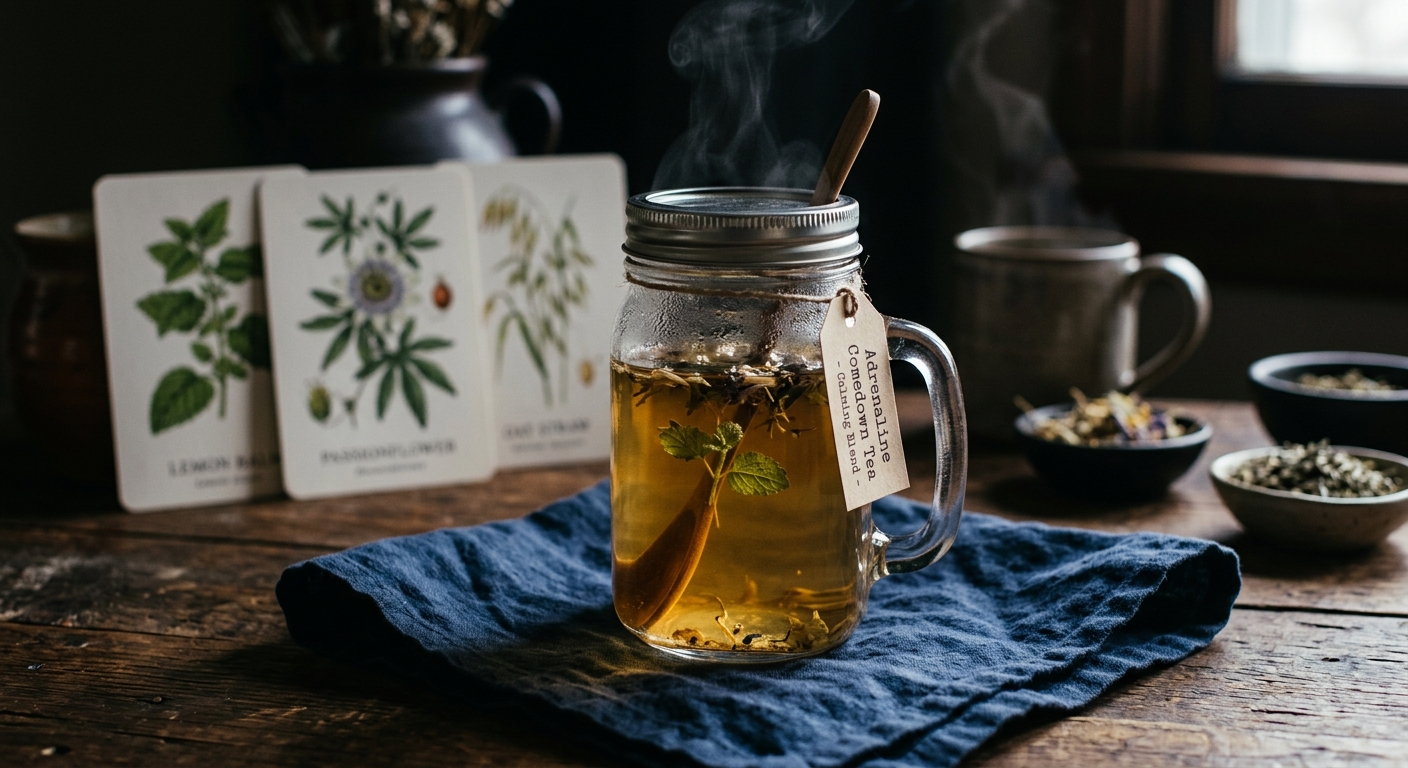
This blend draws on three of the most well-regarded calming herbs in the Western herbal tradition. Lemon balm (Melissa officinalis) has been used since at least the Middle Ages to lift the spirits and calm the heart, earning it the nickname “the gladdening herb” among medieval apothecaries. Passionflower (Passiflora incarnata) was adopted into European medicine after Spanish explorers encountered it in the Americas, where indigenous peoples had long used it for its profound nervine properties. Oat straw (Avena sativa) rounds out the blend as a deep nourishing tonic for the nervous system, valued in traditional Western herbalism for its ability to restore resilience after prolonged stress exposure.
Together, these three herbs address the adrenaline comedown from multiple angles: lemon balm gently lifts mood while calming nervous agitation, passionflower quiets the mental chatter and physical restlessness that follow an adrenaline spike, and oat straw works at a slower, deeper level to replenish the nervous system’s reserves. The result is a tea that tastes as calming as it feels, grassy and gently citrusy with a light floral sweetness, like a deep breath in a sunny meadow.
2
cups
Ingredients
- 2 tspdried lemon balm leaves
- 1 tspdried passionflower herb
- 1 tspdried oat straw
- 480 mlwater (90°C / 194°F)
- —raw honey or maple syrup to taste (optional)
- —a thin slice of fresh lemon (optional)
How to Brew
Click on an item below to shop for the recommended items for this recipe on Amazon.
As an Amazon Associate, we earn from qualifying purchases.
- Heat your water to 90 to 93°C (194 to 199°F). If you do not have a temperature-controlled kettle, bring water to a full boil and allow it to rest for 2 to 3 minutes before using.
- Measure 2 teaspoons of dried lemon balm, 1 teaspoon of dried passionflower, and 1 teaspoon of dried oat straw directly into a tea infuser or teapot. For a stronger nervine effect, you may increase passionflower to 1.5 teaspoons.
- Pour the hot water over the herbs, covering the infuser or closing the teapot lid immediately to trap the volatile aromatic oils that would otherwise escape as steam.
- Steep for 7 to 10 minutes. A longer steep of 10 minutes will draw out more of the bitter flavonoids from passionflower and the silica-rich constituents from oat straw, producing a deeper, more complex cup with a stronger calming effect.
- Remove the infuser or strain the herbs, pressing gently with the back of a spoon to extract the last of the liquid. Sweeten lightly with raw honey if desired, and add a thin slice of fresh lemon to brighten the flavor. Drink slowly, away from screens.
- Combine 3 teaspoons of dried lemon balm, 1.5 teaspoons of dried passionflower, and 1.5 teaspoons of dried oat straw in a clean glass jar. Cold brew extraction is slower and less efficient than hot water extraction, so use 1.5 times the normal herb quantity to achieve a comparable strength.
- Pour 480 ml of cool, filtered room-temperature water over the herbs. Stir gently to ensure all the plant material is fully submerged.
- Seal the jar with a lid and place it in the refrigerator. Allow the herbs to cold-infuse for a minimum of 8 hours and up to 12 hours. Overnight is ideal. Avoid exceeding 12 hours as the flavor can become grassy and overly bitter from the passionflower.
- In the morning, strain the herbs through a fine mesh strainer lined with cheesecloth if available, pressing the herbs firmly to extract all liquid. Discard the spent plant material.
- Pour over a glass of ice, add a squeeze of fresh lemon juice and a drizzle of honey if desired, and enjoy cold. The brewed tea can be stored in a sealed jar in the refrigerator for up to 48 hours.
- Combine 4 teaspoons of dried lemon balm, 2 teaspoons of dried passionflower, and 2 teaspoons of dried oat straw in a small saucepan. This double-strength ratio is intentional and designed for dilution.
- Add 240 ml of filtered water and heat gently over low to medium-low heat until the water reaches 88 to 90°C (190 to 194°F). Do not allow the liquid to boil. Maintain this low temperature for 15 to 20 minutes, stirring occasionally and keeping a lid on the saucepan between stirs to retain volatile compounds.
- Remove from heat and allow the herbs to continue steeping, covered, for an additional 5 minutes as the liquid cools slightly.
- Strain through a fine mesh strainer into a small glass jar or bottle, pressing the herbs to extract all liquid. You will have approximately 180 to 200 ml of concentrate.
- To serve hot, add 60 ml of concentrate to 180 ml of hot water in a mug, sweeten if desired, and drink. To serve cold, add 60 ml of concentrate to a glass of cold water or oat milk over ice. The concentrate keeps in the refrigerator in a sealed jar for up to 3 days.
Health Benefits
Lemon balm’s rosmarinic acid and the flavonoids in passionflower work synergistically to increase GABAergic tone in the brain, effectively countering the hyperexcitable neural state that persists after an adrenaline surge. A 2004 double-blind, placebo-controlled study published in Psychosomatic Medicine found that lemon balm extract significantly reduced stress-induced anxiety and improved mood in healthy volunteers.
Passionflower has demonstrated clinically meaningful reductions in heart rate and physical restlessness in several human trials, including a 2001 randomized controlled trial comparing it favorably to low-dose oxazepam for generalized anxiety disorder. The calming effect on cardiac excitability is particularly relevant for the racing heartbeat that follows intense stress.
Oat straw is classified in traditional Western herbalism as a nervine trophorestorative, meaning it works not merely to suppress symptoms but to rebuild the nutritive and structural integrity of nervous tissue over time. Its high silica, magnesium, and B-vitamin content supports myelin sheath health and neural resilience, making it especially valuable after periods of prolonged or repeated stress exposure.
The combination of GABAergic lemon balm and passionflower has shown promise for shortening sleep latency, the time it takes to fall asleep, in people whose sleep is disrupted by anxiety. A 2011 study in Phytotherapy Research found that a lemon balm and valerian combination significantly improved sleep quality, and passionflower has shown similar effects in separate research.
Adrenaline and cortisol commonly cause gastrointestinal symptoms including cramping, nausea, and a tight or churning sensation in the stomach. Lemon balm is also a well-established carminative and antispasmodic, with European Commission E approval for the treatment of nervous digestive complaints, making this blend doubly useful for the full-body experience of a stress comedown.
🧪 Key Bioactive Compounds
The Science Behind Lemon Balm
The adrenaline comedown has a well-understood physiological basis. During acute stress, the hypothalamic-pituitary-adrenal (HPA) axis and the sympathetic nervous system flood the body with adrenaline (epinephrine) and cortisol. These hormones are designed for short-term use and their aftermath, elevated heart rate, muscle tension, cognitive hypervigilance, digestive disruption, can persist for 20 to 60 minutes after the stressor has resolved. The herbs in this blend primarily address this state through GABAergic modulation, which is the enhancement of gamma-aminobutyric acid (GABA), the brain’s principal inhibitory neurotransmitter.
Lemon balm works primarily through rosmarinic acid, a potent polyphenol that inhibits the enzyme GABA transaminase. This enzyme normally breaks down GABA in the synaptic cleft, so by inhibiting it, rosmarinic acid effectively increases the availability of GABA at receptor sites. Passionflower’s active flavonoids, particularly chrysin, orientin, and isovitexin, take a complementary approach, directly binding to benzodiazepine-sensitive sites on GABA-A receptors and enhancing their response to GABA already present. This dual mechanism, increasing GABA supply and enhancing receptor sensitivity, produces a synergistic calming effect that neither herb achieves as fully alone. Crucially, neither herb appears to cause the tolerance or dependency associated with pharmaceutical GABAergic agents.
Oat straw operates on a longer timescale through a different mechanism. Rich in silica, magnesium, iron, and B vitamins, it is considered a nutritive tonic for the nervous system rather than an acute anxiolytic. Magnesium in particular plays a critical role here: it acts as a natural calcium channel blocker in neurons, reducing overall neural excitability, and chronic stress is known to deplete magnesium stores in the body. The avenanthramides unique to oats also reduce neuroinflammation, a mechanism increasingly recognized as a contributor to anxiety disorders and stress sensitivity. Regular consumption of oat straw over weeks to months has historically been described as building what herbalists call nervous constitution, a greater baseline resilience to stress rather than merely suppressing its symptoms in the moment.
Brewing Tips
- Use freshly dried lemon balm rather than lemon balm that has been stored for more than six months. The volatile oils responsible for its calming aroma and much of its anxiolytic effect degrade significantly with age. Fresh dried herb should be bright green and intensely fragrant when rubbed between your fingers.
- Brew this tea as soon as you notice the adrenaline comedown beginning rather than waiting until you are already exhausted and depleted. The nervous system responds better to herbal support when it is still in a state of activation rather than after a prolonged crash.
- If you find the flavor too grassy from the oat straw, try toasting the dried oat straw lightly in a dry pan for 2 to 3 minutes before brewing. This brings out a warm, slightly nutty, almost oatmeal-like flavor that many people find much more appealing and that adds a comforting dimension to the blend.