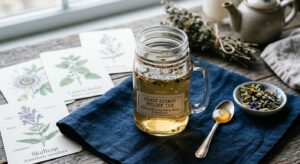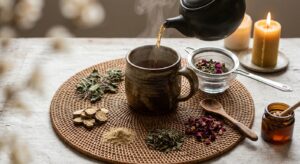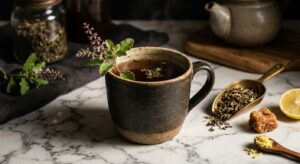
There is a particular kind of exhaustion that comes not from doing too much, but from thinking too much. The mind replays conversations, anticipates problems that may never arrive, and refuses to settle even when the body is still. Herbalists across centuries have recognised this pattern, and they reached for a handful of specific plants in response: lemon balm to lift and calm, passionflower to quiet the mental loop, and lavender to anchor the senses in the present moment. This blend is that ancient remedy made practical for the modern cup.
Lemon balm (Melissa officinalis) has been cultivated in European monastery gardens since at least the Middle Ages, prized by Benedictine monks who made a famous nerve tonic called Carmelite Water from it. Passionflower (Passiflora incarnata) comes from the Americas, where Indigenous healers used it for restlessness and sleeplessness long before European botanists documented it in the 17th century. Lavender (Lavandula angustifolia), native to the Mediterranean, has woven itself into the healing traditions of nearly every culture it has touched, from Roman bathhouses to Victorian smelling salts.
What makes this trio so effective for overthinking specifically is the way the herbs complement one another. Lemon balm gently raises GABA levels and modulates serotonin receptors. Passionflower compounds slow the breakdown of GABA further, deepening the effect. Lavender’s volatile linalool acts simultaneously through inhalation and digestion. The result is a tea that addresses mental hyperactivity from several biological angles at once, without sedating, without clouding, and without dependency.
2
cups
Ingredients
- 2 tspdried lemon balm leaves
- 1 tspdried passionflower herb
- 0.5 tspdried lavender buds (culinary grade)
- 480 mlwater (90°C / 194°F)
- —raw honey or maple syrup to taste (optional)
- —thin lemon slice to garnish (optional)
How to Brew
Click on an item below to shop for the recommended items for this recipe on Amazon.
As an Amazon Associate, we earn from qualifying purchases.
- Heat your water to 90°C (194°F). If you do not have a temperature-controlled kettle, bring water to a full boil and allow it to rest for 2 to 3 minutes before pouring.
- Combine 2 tsp dried lemon balm, 1 tsp dried passionflower, and 0.5 tsp dried lavender buds in a tea infuser or small teapot. The ratio of lemon balm to passionflower to lavender should remain roughly 4:2:1 to keep the lavender from overpowering the blend.
- Pour 480 ml of prepared hot water directly over the herbs and cover immediately with a lid or small saucer. Covering is essential as it traps the volatile aromatic oils that would otherwise escape with the steam.
- Steep for 7 to 10 minutes. Begin with 7 minutes for a lighter, brighter cup. Extend to 10 minutes for a fuller, more sedative effect. Taste at the 7-minute mark and decide.
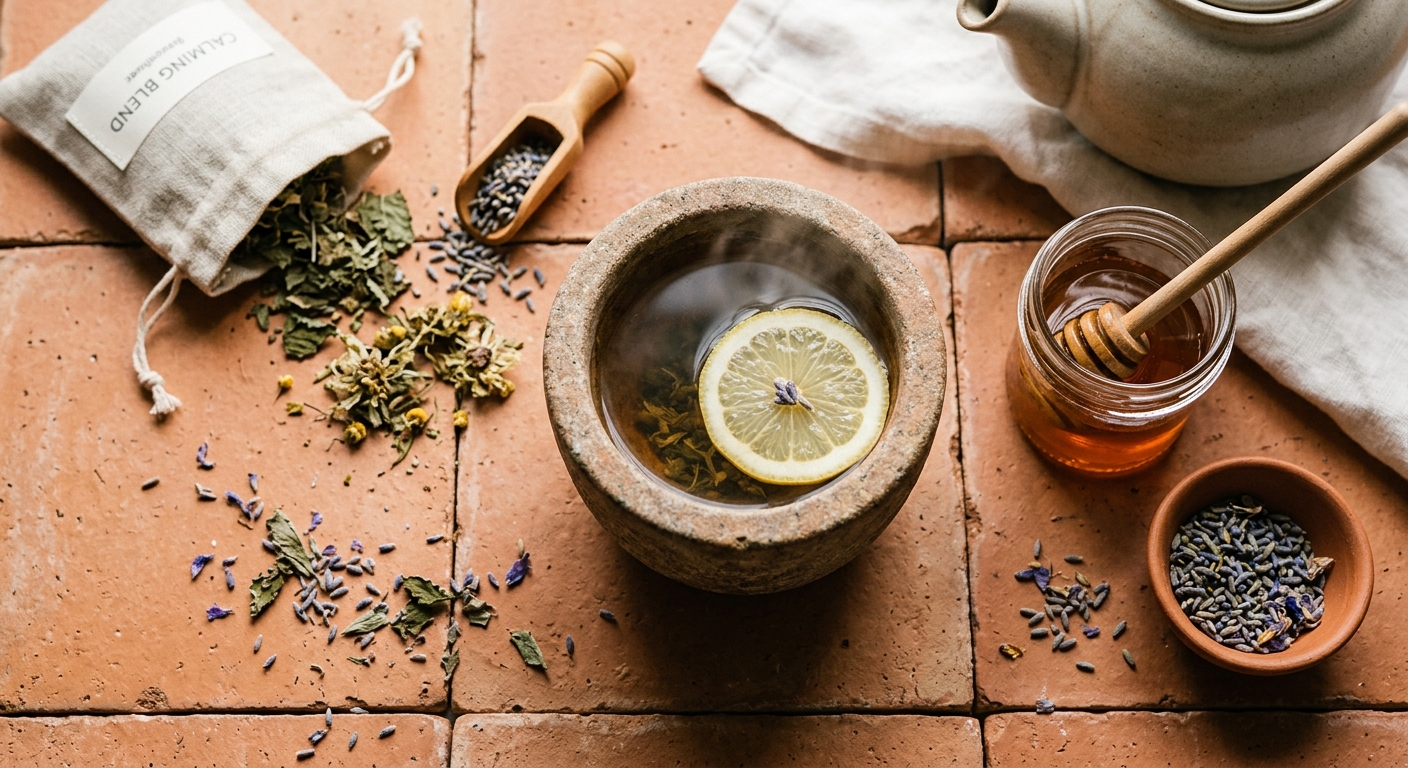
- Remove the infuser and stir gently. Add raw honey if desired, as its sweetness rounds out the herbal bitterness without masking the lemon balm’s citrus brightness. Serve immediately and breathe in the steam before drinking.
- Measure 2.5 tsp dried lemon balm, 1.5 tsp dried passionflower, and 0.5 tsp dried lavender buds into a clean glass jar. Use slightly more herb than you would for a hot brew, as cold water extracts more slowly and you want a flavourful result.
- Pour 480 ml of cold, filtered water over the herbs. Do not use warm or hot water for this method. Stir briefly to ensure all plant material is submerged.
- Cover the jar with a lid or stretch of cloth secured with a rubber band. Leave it at room temperature for the first hour to allow initial extraction to begin, then transfer to the refrigerator.
- Steep in the refrigerator for 8 to 12 hours. Overnight is ideal. The longer steeping time at cold temperatures gently draws out flavonoids and volatile compounds without releasing the harsher, more bitter plant tannins that hot water unlocks.
- Strain the liquid through a fine-mesh strainer into a glass. Serve over ice with a slice of lemon and a small drizzle of honey if desired. The cold brew can be stored in the refrigerator for up to 24 hours.
- Add 2 tsp dried lemon balm, 1 tsp dried passionflower, and 0.5 tsp dried lavender buds to a large, clean glass jar. Use a jar with a tight-fitting lid.
- Fill the jar with 480 ml of cold, filtered water. Seal the lid tightly and swirl gently to wet all the herbs evenly.
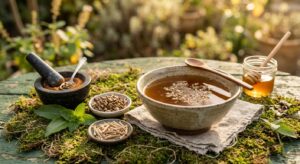
- Place the sealed jar in a spot that receives direct, unobstructed sunlight, such as a sunny windowsill, a garden table, or a porch. The warmth of the sun will slowly raise the water temperature and coax the aromatic oils out of the herbs.
- Leave the jar in the sun for 3 to 5 hours, swirling it gently once or twice during the process. The brew is ready when the liquid has taken on a soft golden-green hue and smells distinctly of lemon and floral herbs.
- Strain through a fine-mesh strainer into a glass. Serve warm as is, or allow it to cool and pour over ice. Add honey and a sprig of fresh lemon balm if you have it. Drink within a few hours of brewing.
Health Benefits
The combination of rosmarinic acid from lemon balm and chrysin and vitexin from passionflower works across multiple GABA pathways simultaneously, reducing the hyperexcitability of neural circuits associated with looping, ruminative thought. A 2004 randomised controlled trial in Psychosomatic Medicine found lemon balm significantly reduced anxiety and insomnia in stressed adults.
Lemon balm has been shown in human studies to reduce cortisol-related stress markers and improve mood scores under conditions of psychological stress. A 2014 study published in Nutrients found that participants who consumed lemon balm extract reported significant improvements in mood and calmness compared to placebo within one to three hours of ingestion.
Passionflower has been studied specifically for its ability to improve sleep quality without causing daytime drowsiness. A randomised, double-blind, placebo-controlled trial published in Phytotherapy Research found that passionflower tea significantly improved subjective sleep quality scores, likely due to GABA-A receptor binding by its flavonoid compounds.
Chronic overthinking often manifests physically as muscle tension, rapid heart rate, and digestive upset. Lavender’s linalool and lemon balm’s rosmarinic acid both have antispasmodic and mild parasympathomimetic effects, helping to shift the body from a sympathetic (fight-or-flight) state toward a parasympathetic (rest-and-digest) state.
Rather than simply sedating, lemon balm has been found in clinical studies to sharpen memory and attention at moderate doses while simultaneously reducing anxiety. This dual action makes it uniquely suitable for overthinkers who need mental quietness without losing mental clarity.
🧪 Key Bioactive Compounds
The Science Behind Lemon Balm
The science behind this blend centres on the GABAergic system, the brain’s primary inhibitory network. Gamma-aminobutyric acid (GABA) is the neurotransmitter responsible for slowing neural activity and promoting feelings of calm. When GABA levels are low or its receptors are underactivated, the brain enters a state of hyperexcitability that manifests as anxiety, racing thoughts, and an inability to mentally disengage. Lemon balm addresses this directly through rosmarinic acid, a polyphenol that inhibits GABA transaminase, the enzyme that breaks GABA down. By blocking its degradation, rosmarinic acid effectively raises available GABA in the synaptic cleft, producing a natural calming effect without exogenous sedative chemicals.
Passionflower approaches the same system from a different angle. Its primary active flavonoids, chrysin and vitexin, are partial agonists at GABA-A receptors, meaning they bind to and gently activate the same receptor sites targeted by benzodiazepine medications. Clinical trials, including a notable 2011 study in Phytotherapy Research comparing passionflower to oxazepam for generalised anxiety disorder, found passionflower comparably effective for anxiety symptoms while producing significantly fewer side effects such as daytime impairment. This makes it particularly valuable for overthinkers who need a quieter mind during the day as well as at night.
Lavender’s contribution to the blend comes primarily through linalool, a monoterpene volatile that acts both aromatically through the olfactory system and orally through gastrointestinal absorption. Research published in Nature Communications demonstrated that linalool’s calming effects are mediated through olfactory neurons that signal directly to the limbic system, the brain’s emotional processing centre, bypassing the need for the compound to even enter the bloodstream to begin working. When consumed as tea, linalool additionally modulates NMDA glutamate receptors, reducing excitatory neural signalling. This dual-pathway action, inhaled and ingested simultaneously, is part of what makes a cup of this tea feel effective almost from the first sip.
Brewing Tips
- Source culinary-grade lavender buds specifically, as ornamental lavender varieties are often treated with pesticides and have a soapy, camphorous edge that is unpleasant in tea.
- Store the blended dry herbs in an airtight dark glass jar away from heat and light. Lemon balm in particular loses its volatile citral compounds quickly when exposed to air, so only grind or crumble the leaves just before brewing.
- If your mind is particularly active at night, brew a cup 45 to 60 minutes before your intended bedtime rather than right before sleep. This gives the passionflower flavonoids time to cross the blood-brain barrier and reach peak effect when you are ready to rest.