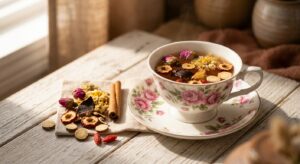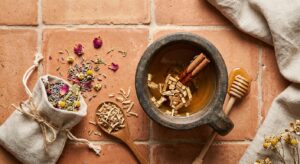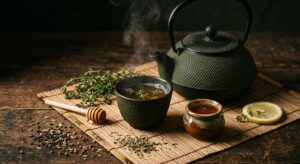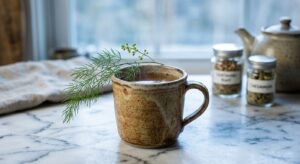
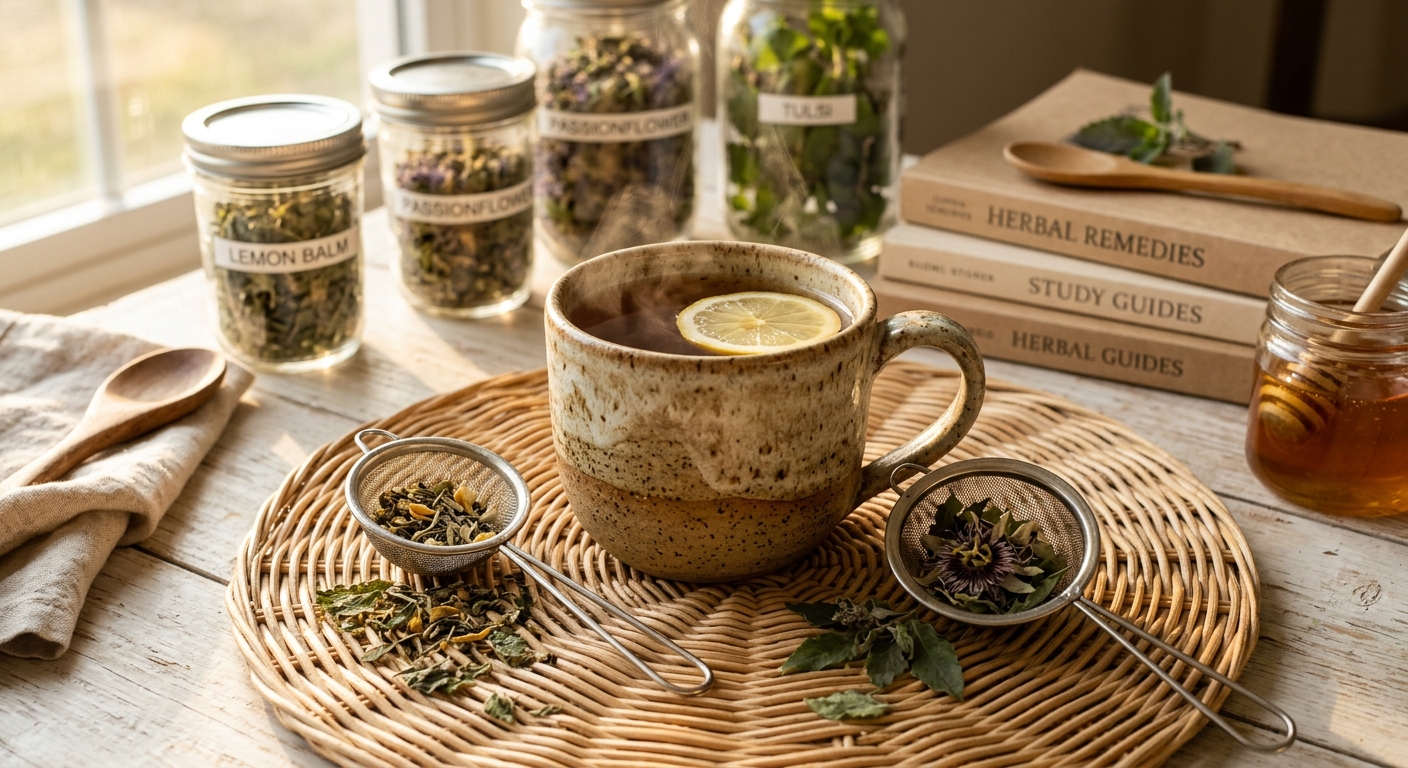
When exam season arrives, the nervous system can take a serious hit. Racing thoughts, shallow breathing, tight shoulders, and a mind that refuses to settle are all signs that the body’s stress response has shifted into overdrive. For centuries, students and scholars across the world have turned to plant medicine to find that elusive middle ground between alert focus and calm steadiness. This blend draws from three of the most respected nervine herbs in Western and Ayurvedic herbalism: lemon balm (Melissa officinalis), passionflower (Passiflora incarnata), and holy basil or tulsi (Ocimum tenuiflorum). Each herb brings its own personality to the cup, and together they create something greater than the sum of their parts.
Lemon balm has been used in European herbal medicine since at least the Middle Ages, when Carmelite monks distilled it into a remedy called Eau de Mélisse for headaches and nervous tension. Passionflower was adopted into European medicine after Spanish explorers encountered it in the Americas in the sixteenth century, where indigenous communities had long used it as a calming and sleep-supporting herb. Tulsi, considered sacred in Hindu tradition and called the Queen of Herbs in Ayurveda, has been cultivated in Indian households for over three thousand years as a daily tonic for resilience and mental clarity. Bringing these three traditions together in one cup feels both ancient and deeply practical.
What sets this blend apart from a simple sleepy-time tea is its balance. Passionflower and lemon balm quiet the noise of anxious thinking, while tulsi acts as an adaptogen, helping the body regulate its cortisol response to stress rather than simply dulling the mind. The result is a tea that eases the white-knuckle tension of deadline pressure without leaving you drowsy over your textbooks. Brewed hot before a study session or chilled into a refreshing cold brew to sip throughout the afternoon, this blend works with your body’s natural rhythms rather than against them.
2
cups
Ingredients
- 2 tspdried lemon balm leaves
- 1.5 tspdried passionflower herb (leaf and flower)
- 1 tspdried tulsi (holy basil) leaves
- 480 mlwater (90°C / 194°F)
- —raw honey or coconut sugar to taste (optional)
- —thin lemon slice for garnish (optional)
How to Brew
Click on an item below to shop for the recommended items for this recipe on Amazon.
As an Amazon Associate, we earn from qualifying purchases.
- Heat filtered water to 90°C (194°F). If you do not have a temperature-controlled kettle, bring water to a full boil, then remove it from the heat and let it rest for 2 to 3 minutes before pouring.
- Add 2 teaspoons of dried lemon balm, 1.5 teaspoons of dried passionflower, and 1 teaspoon of dried tulsi to a tea infuser or a small tea pot with a built-in strainer. This combination is for two servings; halve the quantities for a single cup.
- Place the infuser in your mug or pour the hot water directly into the teapot over the loose herbs. Cover the vessel with a lid or a small saucer to trap the volatile aromatic compounds within the steam.
- Steep for 7 to 10 minutes. For a lighter, more refreshing flavor with subtle calming effects, remove at 7 minutes. For a fuller-bodied, more potent brew aimed at deeper stress relief, steep the full 10 minutes.
- Remove the infuser or strain the herbs through a fine mesh strainer into warmed mugs. Stir in a small amount of raw honey if desired, and garnish with a thin lemon slice. Sip slowly before or during a study session.
- Combine 3 teaspoons of dried lemon balm, 2 teaspoons of dried passionflower, and 1.5 teaspoons of dried tulsi in a clean glass jar. The slightly increased herb ratio compensates for the slower, cooler extraction process.
- Pour 600 ml of cold or room-temperature filtered water over the herbs. Do not use hot water at any stage. Stir gently with a long spoon to ensure all the herbs are fully submerged and saturated.
- Seal the jar with a lid and leave it at room temperature for the first hour to allow initial hydration of the plant material, then transfer it to the refrigerator.
- Steep in the refrigerator for 8 to 12 hours, or overnight. The longer the steep, the more pronounced the passionflower’s earthy depth will become alongside the bright lemon balm notes.
- When ready, pour the cold brew through a fine mesh strainer into a glass filled with ice. Sweeten with a small amount of honey dissolved in a teaspoon of warm water first, as cold honey does not dissolve easily. Serve with a sprig of fresh mint or a lemon wedge.
- Measure out a doubled herb ratio: 4 teaspoons of dried lemon balm, 3 teaspoons of dried passionflower, and 2 teaspoons of dried tulsi. Place all herbs into a small saucepan or a heat-safe pitcher.
- Heat 360 ml of filtered water to 90°C (194°F), then pour it over the herbs. Cover immediately with a tight-fitting lid or a plate to prevent aromatic oils from escaping with the steam.
- Steep for 15 to 20 minutes undisturbed. This longer steep draws out a higher concentration of active compounds, particularly the rosmarinic acid in lemon balm and the flavonoids in passionflower.
- Strain the concentrate through a fine mesh strainer, pressing the herb material gently with the back of a spoon to extract the remaining liquid. Discard the spent herbs and allow the concentrate to cool to room temperature.
- Pour the cooled concentrate into a small glass bottle or jar and refrigerate. To serve, dilute one part concentrate with two parts hot water or pour over a glass of ice and top with cold water. The concentrate keeps refrigerated for up to 48 hours. Stir in honey or a squeeze of lemon before drinking.
Health Benefits
Clinical trials involving lemon balm extract have shown statistically significant reductions in anxiety and stress scores in healthy adults, with participants reporting calmer mood without impaired alertness. This makes the herb particularly suited to exam environments where mental clarity must be preserved alongside emotional calm.
Tulsi is classified as an adaptogen, meaning it helps the body mount a more proportionate hormonal response to stressors. Research published in the Journal of Ayurveda and Integrative Medicine found that regular tulsi consumption significantly reduced cortisol levels and self-reported stress in adults during periods of elevated demand.
Passionflower has been the subject of multiple controlled trials demonstrating improvements in total sleep time and sleep efficiency. Its GABA-modulating flavonoids ease the pre-exam insomnia that many students experience, supporting the memory consolidation that occurs during deep sleep stages.
Lemon balm has been shown in human trials to improve working memory, speed of processing, and accuracy on cognitive tasks at doses achievable through regular tea consumption. Rosmarinic acid’s ability to inhibit GABA transaminase may play a role in creating a calm but cognitively active brain state.
The combination of lemon balm and passionflower addresses not only mental anxiety but also its physical manifestations, including tension headaches, digestive upset from nerves, and elevated heart rate. Both herbs have demonstrated mild antispasmodic activity in research, relaxing smooth and skeletal muscle tension associated with the stress response.
🧪 Key Bioactive Compounds
The Science Behind Lemon Balm
The calming action of this blend operates primarily through the GABAergic system, the brain’s main inhibitory signaling network. When GABA (gamma-aminobutyric acid) binds to its receptors, it slows neural firing, producing feelings of calm and reducing the hyperactivation associated with anxiety. Both lemon balm and passionflower target this pathway, but through different mechanisms. Lemon balm’s rosmarinic acid inhibits GABA transaminase, the enzyme responsible for breaking down GABA, effectively increasing the availability of this calming neurotransmitter in the synaptic cleft. Passionflower’s flavonoids, particularly chrysin and vitexin, bind directly to GABA-A receptor subunits, mimicking the mechanism of benzodiazepine drugs without carrying the same risk of dependency or cognitive impairment.
Tulsi contributes to the blend’s profile through a different biochemical route: the hypothalamic-pituitary-adrenal (HPA) axis, which governs the body’s cortisol stress response. When we experience prolonged stress, such as the weeks of sustained pressure before examinations, the HPA axis can become dysregulated, leading to chronically elevated cortisol that impairs memory formation, disrupts sleep, and weakens immune function. Tulsi’s ursolic acid, eugenol, and a group of compounds called ocimumosides have been shown in animal and human studies to normalize cortisol secretion and reduce stress-induced damage to hippocampal neurons, the very brain cells most critical for learning and memory consolidation.
From a cognitive neuroscience perspective, the ideal state for studying and performing on exams corresponds roughly to the alpha brainwave state: relaxed, focused, and receptive. Acute anxiety pushes the brain toward beta and even gamma states, where attention becomes fragmented and working memory falters. A 2014 double-blind, placebo-controlled crossover study published in Nutrients found that a single dose of lemon balm extract significantly improved both mood and cognitive performance in healthy young adults, with benefits including faster reaction time, improved memory accuracy, and reduced mental fatigue. These effects, combined with tulsi’s adaptogenic cortisol regulation and passionflower’s GABAergic calming, make this blend one of the most scientifically coherent herbal formulas available to students seeking a natural, evidence-informed tool for exam stress.
Brewing Tips
- Prepare a batch of cold brew concentrate the evening before a big exam so you have a ready-to-dilute calming drink available throughout the next day without any morning preparation stress.
- If the earthy, slightly grassy note of passionflower is too prominent for your palate, reduce it to 1 teaspoon and add an extra half teaspoon of lemon balm, which will brighten the cup and soften the overall flavor.
- Store your dried herbs in separate airtight tins or dark glass jars away from heat and light, and blend only what you need for each week. Lemon balm in particular loses its aromatic volatile oils quickly once blended with other herbs, so freshness makes a noticeable difference in both flavor and potency.