Long before modern pharmacology attempted to bottle calm, the islanders of Vanuatu, Fiji, Tonga, and Hawaii were gathering around wooden bowls of kava. For over three thousand years, this earthy, slightly numbing brew has been central to Pacific Island ceremony, diplomacy, and daily ritual. Chiefs drank it to settle disputes. Communities shared it to welcome visitors. Healers prescribed it for restless minds and aching bodies. The word kava itself derives from the Tongan and Marquesan word meaning bitter, a fitting description for a root that asks something of your palate before it gives anything back.
Kava comes from the root and rhizome of Piper methysticum, a member of the pepper family native to the western Pacific. Traditional preparation involved pounding or chewing the fresh root and mixing it with water, then straining the cloudy liquid through fibrous plant material. Today, powdered noble kava root is the most accessible form for home brewing, and the traditional kneading and straining method is still considered the gold standard for extracting the plant’s active compounds. The result is a warm, earthy tea that produces a gentle, grounding body relaxation and a lift in sociability, all without the mental fog or next-day regret that alcohol brings.
What makes kava genuinely special in the world of herbal medicine is how it earns its reputation. Kavalactones, the active compounds concentrated in the root, act on the limbic system, the brain’s emotional regulation center, calming anxiety and promoting a sense of wellbeing through multiple receptor pathways. Kava has been the subject of serious clinical research, with several meta-analyses confirming its efficacy for generalized anxiety disorder. For anyone navigating chronic stress, social anxiety, or tension that settles deep into the muscles, a properly prepared bowl of kava tea offers something rare: relief that feels both ancient and remarkably well understood.
2
cups
Ingredients
- 4 tbspnoble kava root powder (micronized or traditionally milled)
- 480 mlwater (warm, 40 to 60°C / 104 to 140°F)
- —coconut milk (optional, 1 to 2 tbsp per cup to enhance kavalactone extraction)
- —raw honey or agave to taste (optional)
How to Brew
Click on an item below to shop for the recommended items for this recipe on Amazon.
As an Amazon Associate, we earn from qualifying purchases.
- Heat water to 40 to 60°C (104 to 140°F). Use a thermometer to confirm the temperature, as exceeding 70°C risks breaking down kavalactones and weakening the brew significantly.
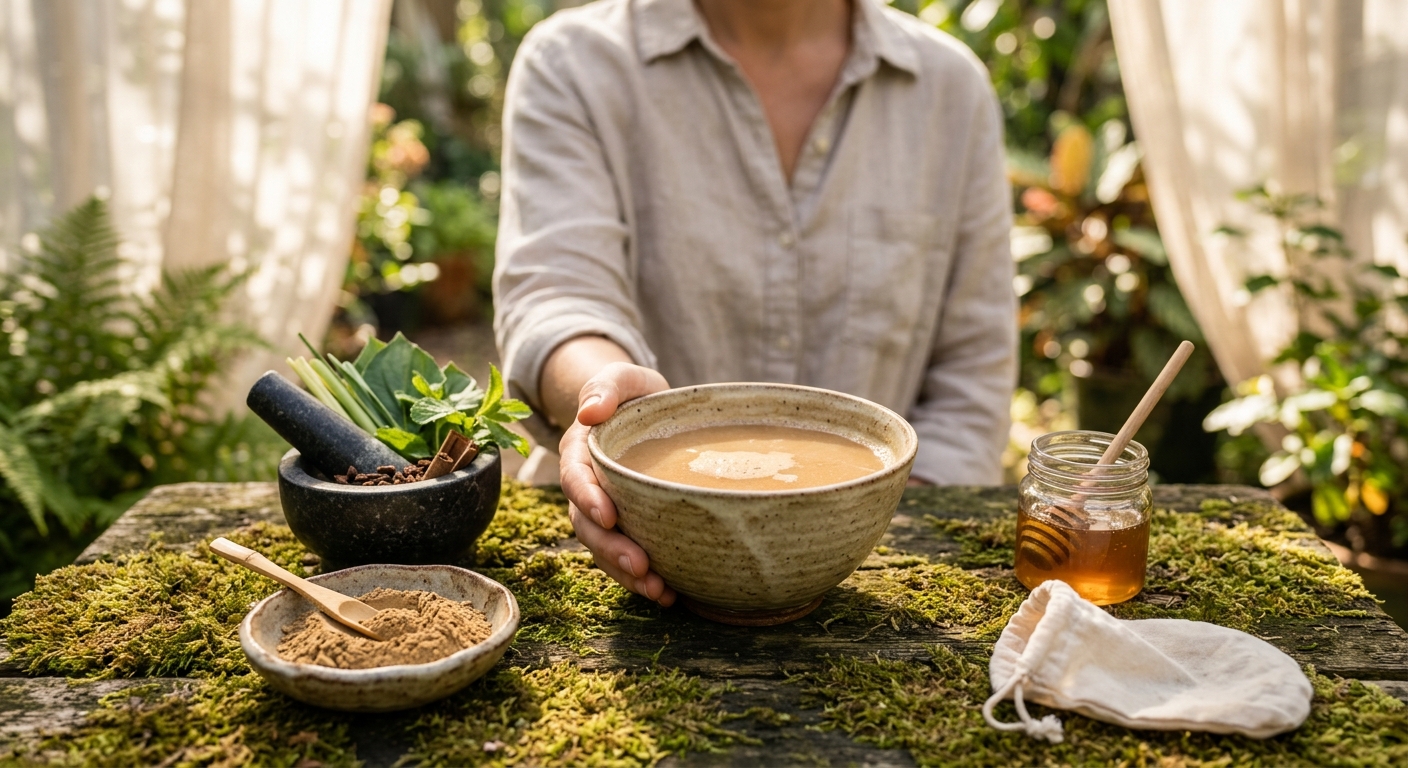
- Place 4 tablespoons of noble kava root powder into a muslin cloth, fine mesh strainer bag, or traditional strainer cloth. Gather the cloth into a bundle and tie or hold it closed.
- Submerge the kava bundle into the warm water in a large bowl or pitcher. Begin kneading, squeezing, and massaging the bundle firmly against the sides of the bowl for 10 to 15 minutes. This physical agitation is essential for extracting kavalactones, which are fat-soluble and require mechanical pressure along with the water to release properly.
- After kneading, squeeze every last drop of liquid from the bundle. Discard the spent root fiber or compost it.
- Optional: add 1 to 2 tablespoons of full-fat coconut milk to each cup. The fats in coconut milk act as a co-solvent, helping your body absorb kavalactones more effectively.
- Pour into a traditional coconut shell bowl or a small cup and drink in one or two steady sips for the most traditional experience. The numbing tingle on the lips and tongue is normal and a sign of an effective brew.
- Measure 4 tablespoons of noble kava powder into a large muslin strainer bag or nylon kava strainer bag. Seal the bag securely.
- Place the bag into a large bowl or mason jar and pour 480 ml of room temperature water directly over it. The water should be at natural room temperature, not refrigerated, as cold water extracts kavalactones less efficiently than warm.
- Let the bag soak undisturbed for 10 minutes to allow the powder to fully hydrate. Then knead and squeeze the bag firmly for 5 minutes, rest for 5 minutes, and repeat this cycle two to three more times over the full 30 to 45 minute steep.
- Once satisfied with the color and extraction (the liquid should appear cloudy and tan), squeeze all remaining liquid from the bag and discard the fiber.
- Stir in coconut milk if desired and pour over ice in a short glass. Cold brew kava over ice has a clean, earthy flavor that is noticeably smoother than hot brew and is particularly good for daytime use when you want calm without any drowsiness.
- Heat 240 ml of water to 50 to 60°C (122 to 140°F). This reduced water volume will produce a concentrated extract that you will dilute before serving.
- Add 6 tablespoons of noble kava powder to a strainer bag, giving you a higher powder-to-water ratio than standard brewing. This concentration is intentional and will be diluted.
- Submerge the bag in the warm water and knead vigorously for 20 minutes, giving more sustained pressure than a standard brew. The concentrate will appear very cloudy and dark tan, noticeably thicker than a regular serving.
- Squeeze out every drop from the bag and discard the spent fiber. You now have roughly 180 to 200 ml of concentrate.
- To serve, dilute one part concentrate with one to two parts warm water at 40 to 50°C (104 to 122°F) depending on your preferred strength. Add coconut milk and a small amount of honey if desired.
- To store, cover the concentrate and keep at room temperature for up to 4 hours, or refrigerate for up to 24 hours. Shake or stir before using from the refrigerator as the sediment will settle.
Health Benefits
Multiple randomized controlled trials and a 2013 meta-analysis published in the Journal of Clinical Psychopharmacology confirmed kava’s significant efficacy in reducing generalized anxiety disorder symptoms compared to placebo, with kavalactones acting on GABA, dopamine, and serotonin pathways simultaneously.
Unlike benzodiazepines and alcohol, kava’s anxiolytic effects do not impair reaction time, memory consolidation, or cognitive processing at moderate doses, a property confirmed in double-blind crossover studies comparing kava to oxazepam.
Kavalactones, particularly methysticin and dihydromethysticin, act as centrally mediated muscle relaxants by inhibiting excessive neuronal firing in motor pathways, making kava tea particularly effective for stress-induced muscle tension in the neck, jaw, and shoulders.
A 2004 study in Psychopharmacology found that kava extract significantly improved sleep quality and reduced nighttime wakefulness in participants with stress-induced insomnia, with dihydromethysticin identified as the primary sleep-promoting kavalactone.
Kavain and yangonin together influence dopaminergic signaling and CB1 receptor activity, producing a gentle uplift in mood and sociability that has been observed consistently in both traditional use and controlled human studies.
🧪 Key Bioactive Compounds
The Science Behind Kava
Kava’s pharmacological profile is unusually complex for a plant medicine, involving at least six distinct kavalactones that act on multiple receptor systems simultaneously. The most studied pathway involves modulation of GABA-A receptors, the same inhibitory receptors targeted by benzodiazepines and barbiturates. However, kavalactones bind to different subunit configurations than pharmaceutical anxiolytics, which is thought to explain why kava calms without producing the sedation, tolerance, and dependence associated with those drugs. Kavain, the dominant kavalactone in most noble varieties, also blocks voltage-gated sodium and calcium channels, reducing the excitability of neurons in the amygdala and limbic cortex, the regions most associated with stress and threat detection.
One of the most pharmacologically fascinating compounds in kava is yangonin, which has been shown to act as a partial agonist at cannabinoid CB1 receptors. This mechanism, entirely absent from other traditional anxiolytic herbs like valerian or passionflower, contributes to kava’s characteristic mood elevation and the gentle sense of contentment that Pacific Islanders describe as a feeling of wellbeing and belonging. Separately, dihydrokavain appears to inhibit monoamine oxidase B (MAO-B), the enzyme responsible for breaking down dopamine, offering yet another biochemical explanation for kava’s mood-brightening effects. This convergence of GABAergic, cannabinoid, dopaminergic, and ion channel mechanisms across just six core compounds makes kava one of the most pharmacologically rich single-herb preparations in traditional medicine.
The critical importance of using warm rather than hot water for kava brewing is also grounded in chemistry. Kavalactones are lipophilic, meaning they are more soluble in fats than in water, and they exist in a delicate resin matrix within the root fiber. Temperatures above 70°C begin to denature the protein structures that hold this matrix together, causing kavalactones to precipitate out of solution rather than remain suspended. The traditional kneading method works precisely because the mechanical action emulsifies the fat-soluble kavalactones into the water in a way that simple steeping cannot achieve. This is also why adding a small amount of fat, such as coconut milk or lecithin, dramatically improves both extraction efficiency and bioavailability, a fact that Pacific Island communities understood empirically long before the chemistry was documented.
Brewing Tips
- Always buy noble kava root powder from a reputable supplier who provides the vanuatu kava origin and chemotype. Words like noble, waka (root-only), and lab-tested for kavalactone content are strong positive signals. Avoid any product that does not specify the kava variety or uses stem peelings.
- Drink kava on an empty stomach for the strongest and cleanest effect. Eating a large meal beforehand slows kavalactone absorption considerably. Many experienced users wait two to three hours after eating before brewing.
- Reverse tolerance is a real phenomenon with kava: new users sometimes feel little to nothing for the first few sessions before the full effect becomes apparent. This is normal and thought to relate to the body’s need to build up specific liver enzymes involved in kavalactone metabolism. Give it three to five sessions before judging the herb’s effectiveness.