Long before modern stress culture made adaptogens a buzzword, Siberian hunters and Chinese imperial physicians were already relying on rhodiola and schisandra to sustain endurance, sharpen the mind, and protect the body from the ravages of exhaustion. Rhodiola rosea, sometimes called golden root or arctic root, thrives in the cold, rocky highlands of Siberia, Scandinavia, and the Tibetan plateau. It was traditionally brewed as a tea by Viking warriors seeking stamina and by Soviet-era researchers who later validated its fatigue-fighting properties in clinical studies. Schisandra chinensis, known in Chinese medicine as wu wei zi, or the five-flavor fruit, earns its poetic name from its remarkable taste profile: simultaneously sour, sweet, salty, bitter, and pungent. It has been prized in Traditional Chinese Medicine for over two thousand years as a tonic for the liver, heart, and nervous system.
What makes this blend genuinely compelling is not just the individual strength of each herb, but the synergy between them. Both rhodiola and schisandra are classified as adaptogens, meaning they help the body modulate its response to physical and psychological stress without overstimulating or sedating. Rhodiola tends to lean toward energizing clarity, making it particularly useful during periods of mental overload or burnout. Schisandra complements this with its grounding, liver-protective, and nervine qualities, smoothing the sharp edges of rhodiola’s stimulating character while adding a layered, tangy complexity to the cup. The result is a tea that feels both invigorating and centering, suited to mornings when you need focus without jitters, or afternoons when mental fog has settled in.
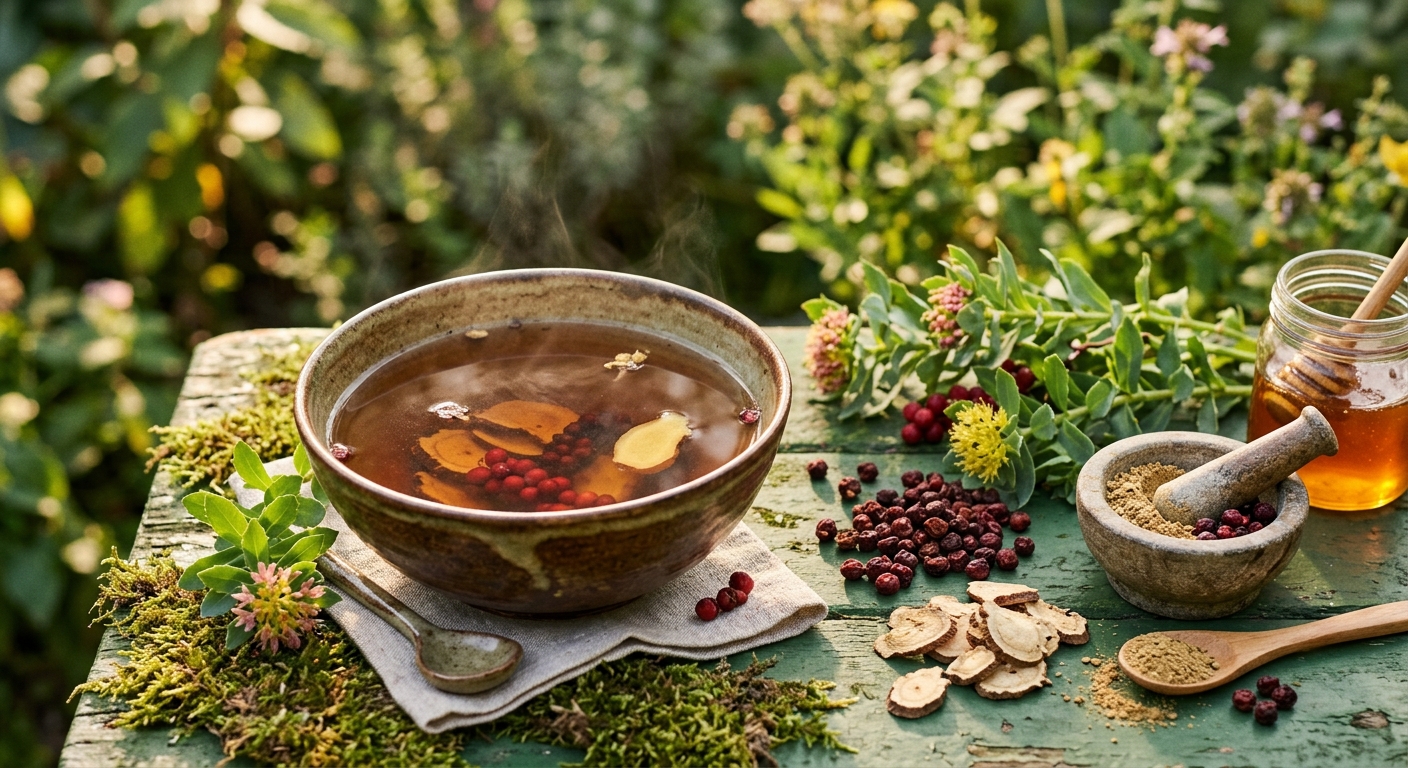
The flavor of this blend is one of its most memorable qualities. Rhodiola root contributes a mildly bitter, slightly astringent, rose-tinged earthiness, while schisandra berries burst forward with a bright tartness that evolves into a warming, almost woody finish. Together, they brew into a deep burgundy-amber infusion that is as striking in the cup as it is on the palate. Whether you are new to adaptogens or a seasoned herbal enthusiast, this blend offers a genuinely satisfying and therapeutic daily ritual.
2
cups
Ingredients
- 1.5 tspdried rhodiola root slices or powder
- 1.5 tspdried schisandra berries
- 500 mlwater (95°C / 203°F)
- —raw honey or maple syrup to taste (optional)
- —a thin slice of fresh ginger (optional, enhances warmth and absorption)
How to Brew
Click on an item below to shop for the recommended items for this recipe on Amazon.
As an Amazon Associate, we earn from qualifying purchases.
- Lightly crush 1.5 tsp of dried schisandra berries using the back of a spoon or a mortar and pestle to break the skin and expose the seeds. This step is important for proper extraction from the whole berry.
- Combine the crushed schisandra berries and 1.5 tsp of rhodiola root slices (or powder) in a small saucepan or teapot with a fine infuser. If using ginger, add your fresh slice now.
- Heat 500 ml of water to 93 to 96°C (200 to 205°F). Avoid a full rolling boil, as excessive heat can degrade some of rhodiola’s more volatile active compounds including salidroside.
- Pour the hot water over the herbs and cover immediately with a lid to trap aromatic volatile compounds and maintain temperature throughout steeping.
- Steep for 10 to 15 minutes. For a milder, more floral cup, stop at 10 minutes. For a deeper, more medicinal extraction with stronger adaptogenic potency, steep the full 15 minutes.
- Strain into warmed mugs, add honey or maple syrup if desired, and serve immediately. Notice how the color shifts from rose-gold to a rich burgundy as you pour.
- Lightly crush 2 tsp of dried schisandra berries to break the skin, then combine with 2 tsp of rhodiola root slices in a clean glass jar. Slightly increase quantities compared to hot brew to compensate for the lower extraction efficiency of cold water.
- Pour 500 ml of cool, filtered water (around 20°C / 68°F) directly over the herbs. Do not use ice-cold water from the refrigerator, as very cold water inhibits initial hydration of the plant material.
- Stir gently to ensure all herb material is fully submerged. Place a small plate or lid over the jar and leave at room temperature for 1 hour to allow the herbs to begin rehydrating and releasing their water-soluble compounds.
- Move the jar to the refrigerator and allow it to cold-brew for a further 9 to 13 hours, ideally overnight. The total infusion time should be 10 to 14 hours.
- Strain through a fine mesh strainer or cheesecloth into a clean pitcher or bottle. The resulting liquid will be a clear, jewel-like ruby-rose color, noticeably lighter and more translucent than the hot brew.
- Serve over ice or chilled in small glasses. Sweeten with a light honey syrup (dissolve honey in a small amount of warm water first, as cold water does not dissolve honey easily). Cold brew keeps refrigerated for up to 48 hours.
- Combine 2 tsp of rhodiola root slices and 2 tsp of lightly crushed schisandra berries in a small saucepan. Add 600 ml of cold, filtered water. Starting in cold water is key for a decoction, as it allows a gradual temperature rise that aids in releasing complex compounds from the root material.
- Place the saucepan over medium heat and bring the water slowly up to a gentle simmer, not a boil. Watch carefully and reduce heat once you see small, consistent bubbles forming at 85 to 90°C (185 to 194°F). A vigorous boil will damage heat-sensitive salidroside and volatile flavor compounds.
- Maintain a gentle simmer, partially covered, for 20 to 25 minutes. Stir occasionally and check that the liquid is reducing slowly. You should see the liquid deepen to a rich mahogany-red over time.
- Remove from heat and allow to rest, covered, for 5 minutes. This resting period allows the temperature to stabilize and lets any remaining particulate matter settle slightly before straining.
- Strain through a fine mesh strainer into a heatproof vessel, pressing the spent herbs gently with the back of a spoon to extract remaining liquid. You should yield approximately 400 to 450 ml of concentrated decoction.
- Pour into mugs and dilute slightly with hot water if the flavor is too intense. Sweeten with raw honey and optionally add a small squeeze of lemon, whose vitamin C can enhance the bioavailability of schisandra’s lignans. This decoction can also be made in a larger batch and refrigerated for up to 3 days, reheating gently as needed.
Health Benefits
Multiple randomized controlled trials have shown rhodiola supplementation significantly reduces symptoms of stress-related burnout, including exhaustion and cognitive impairment. Salidroside and rosavins work by normalizing stress hormone dysregulation in the HPA axis, effectively helping the body respond to stress more efficiently without prolonged cortisol elevation.
Rhodiola has demonstrated in clinical trials an ability to improve attention, processing speed, and accuracy under mentally demanding conditions. Schisandrin B further complements this effect through its capacity to reduce neuroinflammation and support neurotransmitter activity, making this blend particularly suited to periods of cognitive demand or mental fog.
Schisandra is one of the most well-researched hepatoprotective herbs in traditional and modern medicine. Its lignans, particularly schisandrin B and gomisin A, increase hepatic glutathione levels and protect liver cells from oxidative damage, a benefit validated in both clinical trials for chronic hepatitis and laboratory research on toxin-induced liver injury.
A 2015 randomized controlled trial published in Phytomedicine found rhodiola extract significantly improved symptoms of mild to moderate depression compared to placebo. The mechanism involves the inhibition of monoamine oxidase enzymes and the normalization of dopamine and serotonin pathways, offering a gentler mood-lifting action than pharmaceutical antidepressants.
Both herbs have a documented history of use for physical stamina, and research supports this. Rhodiola has been shown to reduce perceived exertion and improve VO2 max markers in athletes, while schisandra’s antioxidant lignans help reduce exercise-induced oxidative stress and support faster muscular recovery.
🧪 Key Bioactive Compounds
The Science Behind Rhodiola And Schisandra
The adaptogenic activity of this blend centers on how its key compounds interact with the hypothalamic-pituitary-adrenal (HPA) axis, the body’s central stress-response system. Under chronic stress, the HPA axis becomes dysregulated, leading to persistently elevated cortisol, disrupted sleep, cognitive impairment, and eventual burnout. Rhodiola’s primary bioactives, salidroside and the rosavins, have been shown in both animal models and human clinical trials to normalize HPA axis activity, reducing excessive cortisol secretion while supporting the body’s energy metabolism at the cellular level through enhanced mitochondrial function and ATP synthesis. This dual action explains why rhodiola is described as producing a clear, fatigue-free energy rather than the stimulant rush associated with caffeine.
Schisandra’s primary bioactives are its dibenzocyclooctadiene lignans, particularly schisandrin B, gomisin A, and schisandrol A. These compounds exert their effects through several converging pathways. As potent antioxidants, they directly scavenge reactive oxygen species generated during stress, protecting neurons and liver cells from oxidative damage. In the liver specifically, schisandra lignans upregulate the production of glutathione, one of the body’s most important endogenous antioxidants, and modulate cytochrome P450 enzyme activity, which is central to the herb’s effect on drug metabolism. In the brain, preliminary research suggests that schisandra lignans interact with GABAergic and cholinergic pathways, contributing to the herb’s calming and nootropic properties.
The synergy between these two herbs is not merely anecdotal. Rhodiola’s rosavins exhibit mild inhibition of monoamine oxidase (MAO), the enzyme responsible for breaking down dopamine, serotonin, and norepinephrine in the brain. By preserving these neurotransmitters, rhodiola supports mood stability, motivation, and cognitive sharpness. Schisandra’s grounding influence through GABAergic modulation acts as a counterbalance, softening any overstimulation from rhodiola’s more activating properties. Together, the blend offers a biochemically coherent approach to stress adaptation: enhancing the brain’s resilience to stress hormones, protecting the liver’s metabolic function, preserving mood-regulating neurotransmitters, and supporting the cellular energy systems that burnout depletes.
Brewing Tips
- Source rhodiola root standardized to at least 3% rosavins and 1% salidroside for consistent potency. Raw, unstandardized material varies considerably in active compound content depending on growing region and harvest timing.
- Schisandra berries should be a deep, glossy red-black when dried. Pale or brownish berries indicate age or poor storage and will yield a significantly weaker infusion with diminished lignan content.
- Avoid drinking this blend after 3 pm if you are sensitive to energizing herbs. Rhodiola’s stimulating action on dopamine and norepinephrine pathways can subtly disrupt sleep onset in sensitive individuals when consumed late in the day.