Blue Cohosh (Caulophyllum thalictroides) is a woodland perennial native to the moist, shaded forests of eastern North America, prized for centuries by Indigenous healers long before European settlers ever set foot on the continent. Cherokee, Ojibwe, Menominee, and Iroquois herbalists relied heavily on its roots and rhizomes to support women through the full arc of reproductive life, from easing menstrual cramps and promoting regular cycles to assisting labor during childbirth. The plant earned common names like squaw root and papoose root, names that, however culturally dated, speak directly to its deep association with women’s medicine and birth traditions.
When European settlers arrived and began documenting Indigenous plant knowledge, Blue Cohosh quickly found its way into the Eclectic physicians’ materia medica of the 19th century. Eclectic practitioners, who favored botanical treatments over the harsh chemical therapies of their era, prescribed Blue Cohosh as a uterine tonic, antispasmodic, and emmenagogue, meaning a remedy used to stimulate or regulate menstrual flow. It was listed in the United States Pharmacopeia and National Formulary as recently as the early 20th century, marking it as one of the more formally recognized herbal medicines of that period. Today, it continues to be used by some midwives and herbalists, though its use is far more cautious and specialized than it once was.
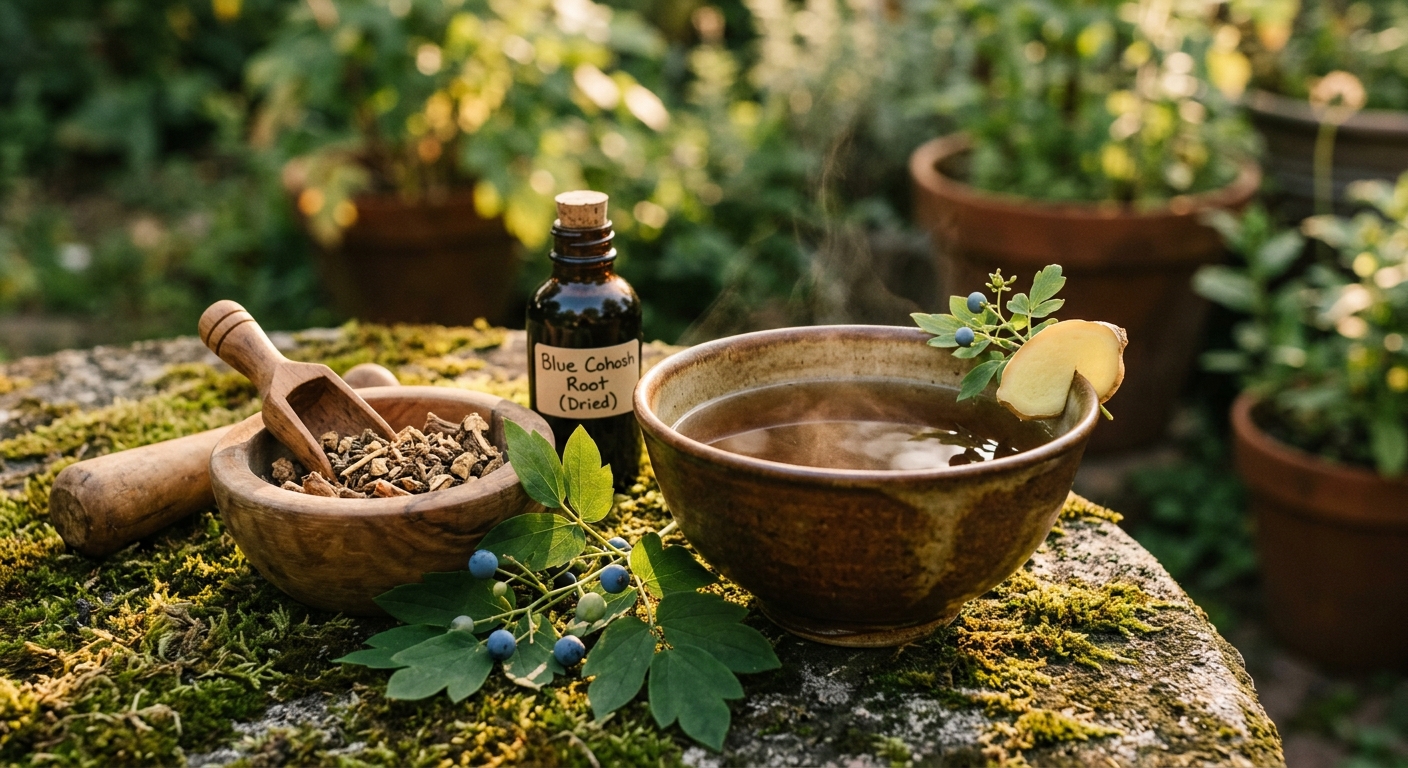
What distinguishes Blue Cohosh from many other women’s herbs is the genuine potency of its chemistry. Unlike the gently soothing chamomile or the mildly adaptogenic ashwagandha, Blue Cohosh contains alkaloids and glycosides with documented pharmacological activity, particularly on uterine muscle tissue. This makes it one of the most fascinating herbs in the women’s health canon, but also one of the most important to approach with full knowledge and professional guidance. Brewed carefully from dried root material, its tea has a deep, bitter, earthy flavor with a faint resinous warmth, a taste that speaks to the seriousness of its medicine.
2
cups
Ingredients
- 2 tspdried blue cohosh root and rhizome, finely chopped or granulated
- 500 mlwater (for hot decoction)
- —raw honey or licorice root to taste (optional, to offset bitterness)
- —a slice of fresh ginger (optional, for warmth and palatability)
How to Brew
Click on an item below to shop for the recommended items for this recipe on Amazon.
As an Amazon Associate, we earn from qualifying purchases.
- Place 1 teaspoon of finely granulated dried blue cohosh root per 250 ml of water into a tea infuser or muslin bag inside your mug or teapot.
- Heat filtered water to approximately 90 to 95°C (194 to 203°F). Do not use a full rolling boil, as excessively high heat can degrade some of the more delicate glycoside compounds.
- Pour the hot water directly over the root material and cover the mug immediately with a lid or small saucer to trap volatile aromatic compounds during steeping.
- Steep for 15 to 20 minutes. A longer steep extracts more of the bitter alkaloids and active glycosides, so start with 15 minutes if you are new to this herb.
- Remove the infuser and allow the tea to cool slightly for 2 to 3 minutes before drinking. Stir in a small amount of raw honey or a piece of licorice root to soften the bitterness if desired.
- Drink no more than one small cup (approximately 150 to 200 ml) per session, and only as directed by a qualified herbalist or healthcare provider.
- Measure 1 teaspoon of finely granulated dried blue cohosh root per 250 ml of cold, filtered water and place both into a clean glass jar with a tight-fitting lid.
- Stir gently to ensure the root material is fully submerged, then seal the jar and leave it at room temperature for the first 1 to 2 hours to begin extraction before transferring to the refrigerator.
- Refrigerate the jar for a total infusion time of 10 to 14 hours, or overnight. The cold environment slows oxidation and limits the extraction of the most pungent bitter alkaloids, producing a milder, earthy brew.
- When ready, strain the liquid through a fine mesh strainer or cheesecloth into a clean glass, pressing the spent root gently to recover the last of the liquid.
- The cold brew can be consumed at room temperature or lightly warmed (do not boil once brewed) with a small amount of raw honey. Consume promptly and do not store for more than 24 hours after straining.
- Add 1 to 1.5 teaspoons of coarsely chopped or granulated dried blue cohosh root per 300 ml of cold, filtered water to a small stainless steel or ceramic saucepan. Starting in cold water allows gradual heat penetration into the dense root fibers.
- Place the saucepan over medium heat and bring the water slowly to a gentle simmer, not a rolling boil. Once you see small, consistent bubbles rising from the bottom of the pan, reduce the heat to maintain this steady simmer.
- Simmer uncovered for 20 to 30 minutes, stirring occasionally. You will notice the liquid deepen in color from pale amber to a rich reddish-brown as the extraction progresses. Some liquid will evaporate, which is expected.
- Remove from heat and allow the decoction to cool in the pan for 5 minutes before straining through a fine mesh strainer into your cup. Press the spent root material firmly against the strainer with the back of a spoon to extract the remaining liquid.
- Taste the decoction before sweetening. It will be notably bitter and resinous. A small amount of raw honey, a slice of fresh ginger simmered in the last few minutes, or a short steep with licorice root can make the flavor more approachable without significantly diluting the active content.
- Consume only a small, measured amount (no more than 150 ml) as a single dose. Decoction is the most potent preparation of blue cohosh and must be used only under the guidance of a trained herbalist, midwife, or healthcare practitioner.
Health Benefits
Blue cohosh has been used for centuries as a uterine tonic to help regulate menstrual cycles and ease cramping. Its active saponins, particularly caulosaponin, act on smooth muscle in the uterine wall, and its antispasmodic alkaloids such as magnoflorine help reduce the spasmodic contractions associated with dysmenorrhea.
Eclectic physicians and Indigenous midwives historically used blue cohosh late in pregnancy to prepare the uterus for labor and, in some cases, to stimulate or strengthen contractions. Its uterotonic compounds are pharmacologically active, and this use, while historically documented, must be undertaken only under the direct supervision of a qualified midwife or physician due to serious documented risks.
The alkaloid magnoflorine and the overall saponin complex in blue cohosh act as antispasmodics on smooth muscle, making the herb traditionally useful not only for menstrual cramps but also for general pelvic tension and lower abdominal spasm. This dual uterotonic and antispasmodic action is what made it a valued herb in 19th-century women’s medicine.
Taspine, an alkaloid found in blue cohosh root, has demonstrated anti-inflammatory activity in preclinical research. Traditional healers also applied preparations of the plant to reduce joint inflammation and rheumatic pain, suggesting a broader systemic anti-inflammatory role that modern phytochemistry is beginning to explore.
Blue cohosh has a long, well-documented history as an emmenagogue, an herb used to stimulate or normalize menstrual flow when periods are delayed or absent due to stress, cold, or mild hormonal imbalance. This action is attributed primarily to caulosaponin and its direct effect on uterine muscle tone, and it underpins the herb’s central place in traditional women’s herbalism across many cultures.
🧪 Key Bioactive Compounds
The Science Behind Blue Cohosh
The pharmacological activity of Blue Cohosh (Caulophyllum thalictroides) centers on two major classes of bioactive constituents: steroidal saponins, primarily caulosaponin and its related furostanol glycosides, and quinolizidine alkaloids, most notably caulophylline (also known as N-methylcytisine) and methylcytisine. These two compound classes act through distinct but complementary mechanisms on uterine smooth muscle. Caulosaponin has been shown in animal studies to directly stimulate uterine contractions, likely through its interaction with smooth muscle cell membranes and its influence on calcium ion transport, the fundamental trigger for muscle contraction. This provides a plausible biochemical basis for the herb’s long-established traditional use as a uterotonic agent.
The alkaloid fraction introduces a second, equally significant mechanism. Caulophylline and methylcytisine are structural analogs of cytisine, a well-known agonist at nicotinic acetylcholine receptors. By binding to these receptors in smooth muscle tissue, these alkaloids can independently stimulate uterine contractility through the autonomic nervous system. This dual-pathway stimulation, both through direct membrane action via saponins and through nicotinic receptor agonism via alkaloids, may explain why blue cohosh has historically been regarded as a more powerful uterine stimulant than single-mechanism herbs. Research has also flagged that methylcytisine’s nicotinic activity extends beyond the uterus to cardiovascular tissue, which accounts for documented cases of tachycardia and elevated blood pressure associated with excessive intake.
Beyond reproductive pharmacology, the isoquinoline alkaloid taspine found in blue cohosh root has attracted attention in the wider phytochemical literature for its anti-inflammatory properties. Taspine has been shown to inhibit the proliferation of certain inflammatory cell lines and has demonstrated wound-healing properties in tissue culture studies, echoing the plant’s historical use for rheumatic and inflammatory conditions. The estrogenic potential of the herb’s saponin fraction has also been investigated, with some early studies suggesting weak binding activity at estrogen receptors, though this remains an area requiring more robust clinical investigation. What is clear is that blue cohosh is a genuinely complex pharmacological agent, deserving of both deep respect in herbal practice and rigorous caution in application.
Brewing Tips
- Always source your blue cohosh root from a reputable, organically grown supplier who can confirm species identity. Caulophyllum thalictroides is sometimes confused with black cohosh (Actaea racemosa) in commercial blends, and these two herbs have entirely different chemistries and risk profiles.
- For palatability, store your brewed decoction or infusion in a small thermos and sip it slowly in small portions over 20 to 30 minutes rather than drinking a full cup at once. This allows your body to respond gradually and reduces the likelihood of digestive discomfort from the bitter alkaloid content.
- Never use blue cohosh in combination with black cohosh, pennyroyal, or any other uterotonic or emmenagogue herbs without professional guidance, as the combined effect on uterine contractility can be dangerously amplified beyond the effect of any single herb.