Estrogen dominance, a condition in which estrogen levels are disproportionately high relative to progesterone, affects a significant number of women during perimenopause, reproductive years, and beyond. Symptoms range from bloating and mood swings to irregular cycles and fatigue. Long before modern endocrinology gave this imbalance a name, herbalists across Europe, Asia, and the Americas were reaching for specific plants to ease what they recognized as signs of a dysregulated feminine cycle. This tea draws on that deep well of traditional plant medicine, combining herbs revered for their hormone-modulating, liver-supporting, and anti-inflammatory properties.
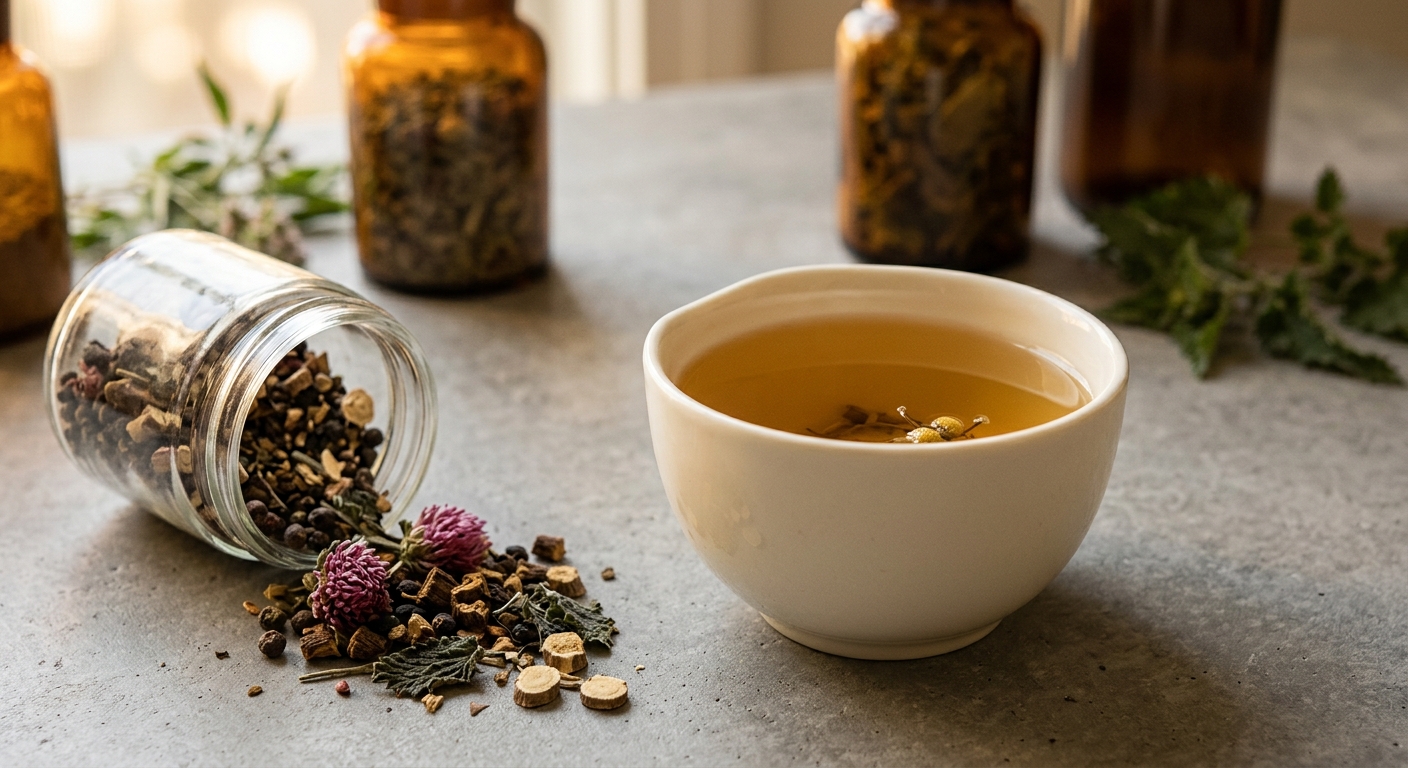
The star of this blend is vitex agnus-castus, also known as chaste tree berry, which has been used since ancient Greece to regulate menstrual cycles and ease premenstrual tension. Paired with red clover, a rich source of isoflavones that interact gently with estrogen receptors, and dandelion root, which supports the liver’s critical role in metabolizing and clearing excess estrogen, this blend addresses hormonal imbalance from multiple angles. Nettle leaf adds a mineral-dense foundation, while licorice root provides a pleasant sweetness and adaptogenic depth. Together, these herbs create a synergistic formula rooted in both tradition and emerging science.
What makes this blend particularly compelling is its approach to hormonal health as a systemic concern rather than an isolated symptom. Excess estrogen must be broken down by the liver and eliminated via the digestive tract, so true balance requires supporting both pathways. This tea does exactly that, offering a ritual of nourishment you can return to daily. The flavor is earthy and mildly sweet with subtle floral and anise-like notes, making it genuinely pleasant to drink as part of a consistent wellness routine.
2
cups
Ingredients
- 1 tspdried vitex berries (lightly crushed)
- 1 tspdried red clover blossoms
- 1 tsproasted dandelion root (chopped)
- 0.5 tspdried nettle leaf
- 0.5 tsplicorice root (sliced or chopped)
- 480 mlwater (95°C / 203°F)
- —raw honey or maple syrup to taste (optional)
- —a slice of fresh lemon (optional)
How to Brew
Click on an item below to shop for the recommended items for this recipe on Amazon.
As an Amazon Associate, we earn from qualifying purchases.
- Lightly crush the dried vitex berries using the back of a spoon or a mortar and pestle. This breaks the hard outer shell and dramatically improves extraction of the active iridoid glycosides.
- Combine the crushed vitex berries, dandelion root, and licorice root in a small saucepan or heatproof teapot. These denser roots and berries benefit from a brief pre-soak or being added first so they receive the longest contact time with hot water.
- Heat filtered water to 95°C (203°F), just below a rolling boil. Pour 480 ml over all the herbs in your teapot or steep directly in the saucepan. Add the red clover blossoms and nettle leaf at this stage.
- Cover the vessel tightly with a lid to trap volatile aromatic compounds and steep for 10 to 15 minutes. The longer end of the range will produce a stronger, more medicinal brew.
- Strain through a fine mesh strainer into two mugs. Add honey, maple syrup, or a slice of lemon if desired. Drink one cup in the morning and one in the early evening for best results.
- Crush the vitex berries thoroughly using a mortar and pestle, breaking them into coarse fragments rather than just cracking the shell. Cold water requires more surface area to extract the active compounds from these hard berries over time.
- Combine all herbs in a clean glass jar. Use a slightly increased ratio of herbs: add an extra half teaspoon of dandelion root and red clover to compensate for the lower extraction efficiency of cold water.
- Pour 500 ml of room temperature filtered water over the herbs. Stir gently to ensure all plant material is fully submerged. If needed, place a small piece of parchment paper on the surface to keep floaters submerged.
- Seal the jar with a lid and place it in the refrigerator. Allow to steep for 10 to 14 hours, ideally overnight. Do not steep for longer than 16 hours as the flavor can become overly astringent.
- Strain the cold brew through a fine mesh strainer lined with a piece of cheesecloth for the clearest result. Serve over ice in tall glasses, and consume within 48 hours. Add a sprig of fresh mint or a squeeze of lemon for brightness.
- Add the crushed vitex berries, chopped dandelion root, and sliced licorice root to a small saucepan with 600 ml of cold filtered water. Starting in cold water and slowly bringing it up to temperature helps extract water-soluble starches and complex polysaccharides from the roots.
- Bring the water to a gentle simmer over medium heat, then reduce to low. Maintain a consistent low simmer at around 85 to 90°C (185 to 194°F) for 20 to 25 minutes. Do not allow it to boil vigorously, as high heat can degrade heat-sensitive flavonoids.
- After 20 minutes of simmering, remove the pot from heat and add the red clover blossoms and nettle leaf directly to the hot liquid. Cover with a lid and allow these more delicate botanicals to infuse in the residual heat for an additional 5 to 7 minutes.
- Strain the decoction through a fine mesh strainer, pressing the spent plant material gently with the back of a spoon to extract the remaining liquid. You should have approximately 400 ml after evaporation.
- Pour into mugs and adjust flavor with a small amount of honey or a slice of fresh ginger if desired. This decoction can also be stored in a sealed glass jar in the refrigerator for up to 3 days and gently reheated before drinking.
Health Benefits
Dandelion root’s bitter compounds stimulate bile flow and upregulate Phase I and Phase II liver detoxification pathways. Since the liver is the primary site of estrogen breakdown, supporting hepatic clearance is foundational to reducing estrogen dominance.
Vitex agnus-castus acts on dopamine D2 receptors in the pituitary gland, which suppresses excess prolactin and promotes a hormonal environment more conducive to luteinizing hormone (LH) release and subsequent progesterone synthesis in the corpus luteum. A 2017 randomized controlled trial published in the journal Phytomedicine found vitex significantly reduced PMS symptoms associated with estrogen dominance.
The isoflavones in red clover, particularly formononetin and biochanin A, act as selective estrogen receptor modulators (SERMs). They occupy estrogen receptors with weaker activity than endogenous estrogen, effectively buffering against the overstimulation caused by excess circulating estradiol.
The prebiotic inulin in dandelion root nourishes gut bacteria that produce beta-glucuronidase in optimal amounts. A well-functioning estrobolome ensures that conjugated estrogens, prepared by the liver for excretion, are not reactivated and reabsorbed in the gut, a key mechanism in reducing estrogen burden.
Nettle leaf is rich in quercetin and beta-sitosterol, both of which inhibit inflammatory pathways including COX-2 and NF-kB signaling. Chronic low-grade inflammation is both a driver and consequence of hormonal dysregulation, making nettle’s anti-inflammatory action an important supportive element in this blend.
🧪 Key Bioactive Compounds
The Science Behind Vitex (Chaste Tree Berry)
The science behind this estrogen-balancing blend centers on three interconnected physiological pathways: estrogenic receptor modulation, hepatic detoxification, and gut microbiome support. Estrogen dominance occurs when circulating estrogen, particularly estradiol, is disproportionately high relative to progesterone. This can result from overproduction, impaired liver clearance, or reabsorption of metabolized estrogen in the gut. The herbs in this blend address all three pathways simultaneously, which is why a multi-herb formula is more effective than any single botanical.
Vitex agnus-castus is the most clinically researched ingredient in this blend. Its iridoid glycosides, particularly agnuside and aucubin, modulate dopamine D2 receptors in the anterior pituitary, which reduces prolactin secretion and supports optimal luteinizing hormone (LH) pulsatility. Higher LH signaling promotes ovulation and stimulates corpus luteum progesterone output. Multiple randomized controlled trials, including a landmark 2013 meta-analysis in the Journal of Psychosomatic Obstetrics and Gynecology, have confirmed vitex’s efficacy in reducing PMS symptoms including mastalgia, mood disturbances, and cycle irregularity. Red clover’s isoflavones, meanwhile, are converted by gut bacteria into active forms such as daidzein and equol, which selectively bind estrogen receptor beta. ERbeta binding tends to have tissue-protective rather than proliferative effects, making these phytoestrogens a nuanced modulator of estrogenic activity rather than a simple stimulant.
The gut-liver axis is increasingly recognized as central to hormonal health, and this blend directly supports it. Dandelion root’s inulin feeds the estrobolome, the community of gut microbes that express the enzyme beta-glucuronidase. In a healthy microbiome, this enzyme activity is calibrated to allow some reabsorption of estrogen metabolites while ensuring the majority is excreted. When the estrobolome is dysbiotic, excessive beta-glucuronidase activity deconjugates estrogens that the liver had prepared for elimination, allowing them to re-enter circulation. Simultaneously, dandelion root’s bitter sesquiterpene lactones stimulate bile secretion and upregulate glucuronidation, a Phase II liver detoxification pathway that tags estrogen molecules for safe elimination. This dual-action on both the liver and the gut makes dandelion root one of the most strategically important herbs in an estrogen-clearing protocol.
Brewing Tips
- Consistency is key with this blend. Vitex in particular requires 2 to 3 months of daily use before its effects on the pituitary-ovarian axis become fully apparent. Treat this tea as a daily ritual rather than an occasional remedy.
- Always crush vitex berries just before brewing. Pre-crushed berries lose volatile compounds quickly. Store the whole dried berries in an airtight glass container away from light and heat.
- Track your cycle while drinking this tea. Noting changes in cycle length, PMS severity, breast tenderness, and mood over 2 to 3 months will help you assess whether the blend is working and whether adjustments to the herb ratios are needed.