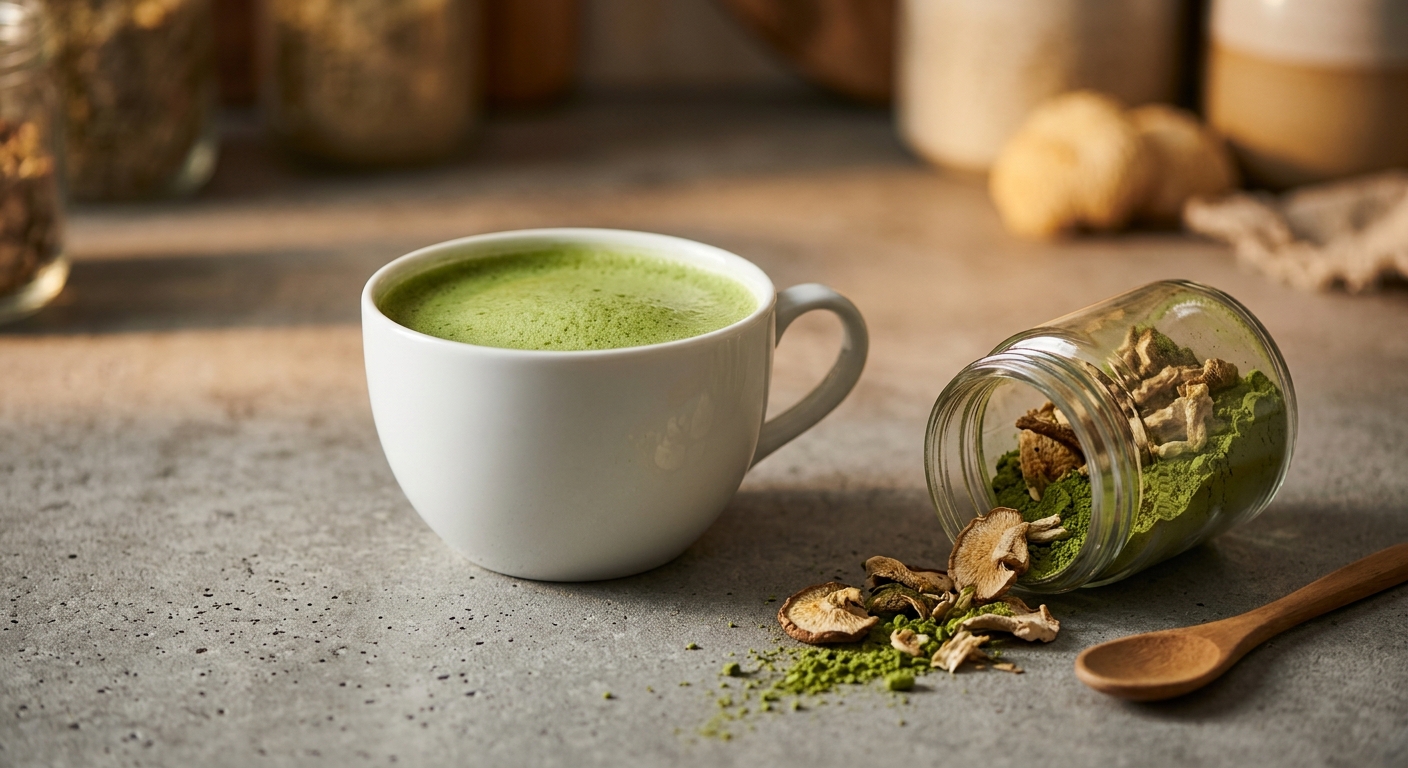
Few botanical pairings capture the imagination quite like matcha and lion’s mane mushroom. Matcha, the finely stone-ground powder of shade-grown Camellia sinensis leaves, has been central to Japanese Zen Buddhist practice for over nine centuries. Monks preparing for long hours of meditation relied on its uniquely balanced energy, a quality modern science now attributes to the synergy between caffeine and L-theanine. Lion’s mane (Hericium erinaceus), meanwhile, has graced the apothecaries of traditional Chinese and Japanese medicine for millennia, prized as a tonic for the mind and the digestive system alike. Together, they form a blend that feels both ancient and absolutely contemporary.
What makes this combination genuinely special is how each ingredient amplifies the other. Matcha provides an immediate, clean lift in alertness and mood, while lion’s mane works on a deeper, more structural level, encouraging the production of nerve growth factor (NGF) and supporting long-term neuroplasticity. The result is a cup that feels focused rather than frantic, and grounding rather than overstimulating. Whether you are settling in for a creative project, a demanding study session, or a sharp morning meeting, this blend meets you with a quality of attention that is hard to achieve through caffeine alone.
The sensory experience is equally rewarding. Whisked into a smooth, frothy emulsion, the tea presents a luminous jade green with a rich, umami-forward depth softened by the earthy, almost seafood-like subtlety of lion’s mane extract. There is a natural sweetness underneath, and a long, clean finish that invites a second, mindful sip. This is a tea to be prepared with intention and savored without distraction, a small ritual that sets the tone for everything that follows.
2
cups
Ingredients
- 2 tspceremonial-grade matcha powder
- 1 tsplion’s mane mushroom extract powder
- 480 mlwater (75°C / 167°F)
- —raw honey or maple syrup to taste (optional)
- —a splash of oat milk or coconut milk (optional)
How to Brew
Click on an item below to shop for the recommended items for this recipe on Amazon.
As an Amazon Associate, we earn from qualifying purchases.
- Heat filtered water to 75 to 80°C (167 to 176°F). If you do not have a temperature-controlled kettle, bring water to a full boil and allow it to rest for 4 to 5 minutes before using.
- Warm your matcha bowl or wide-mouthed mug by filling it with a small amount of hot water. Swirl and discard. This prevents temperature shock and keeps your blend warm longer.
- Sift 1 teaspoon of ceremonial-grade matcha powder and half a teaspoon of lion’s mane extract powder per serving directly into the warmed bowl using a fine-mesh sieve. Sifting eliminates clumps and ensures a perfectly smooth emulsion.
- Add approximately 60 ml (2 oz) of the heated water to the bowl first. Using a bamboo chasen (matcha whisk) or a small electric milk frother, briskly whisk in a rapid W or M motion for 30 to 60 seconds until the mixture becomes a uniform, frothy paste with no visible lumps.
- Pour in the remaining 180 ml (6 oz) of heated water per serving and whisk gently to integrate. Taste and adjust sweetness with raw honey or maple syrup. Serve immediately in the bowl or a warmed mug.
- Measure 2 teaspoons of ceremonial-grade matcha and 1 teaspoon of lion’s mane extract powder into a clean glass jar or pitcher. Use a small whisk or spoon to briefly combine the dry powders.
- Add approximately 100 ml of cold, filtered water to the jar. Whisk or stir vigorously for 60 to 90 seconds until both powders are fully dissolved into a smooth, bright green slurry with no dry clumps remaining.
- Pour in the remaining 380 ml of cold filtered water. Stir gently to incorporate. Seal the jar with a lid or cover with plastic wrap.
- Refrigerate for 8 to 12 hours, or overnight. The slow, cold extraction produces a noticeably smoother, sweeter flavor than hot brewing, with enhanced umami and reduced astringency.
- Before serving, give the jar a gentle shake or stir, as slight settling is natural. Pour over a tall glass of ice. Add oat milk or coconut milk for a creamy cold latte variation. Sweeten lightly with simple syrup if desired.
- Sift 2 teaspoons of ceremonial-grade matcha and 1 teaspoon of lion’s mane extract powder per serving through a fine-mesh sieve into a small bowl or cup. The higher ratio of powder to liquid is what defines this concentrate method.
- Heat filtered water to 75 to 80°C (167 to 176°F). Add only 60 to 80 ml (2 to 2.5 oz) of the hot water per serving directly to the sifted powders. This small volume forces a thick, intensely concentrated paste.
- Whisk briskly with a bamboo chasen or electric frother in a vigorous W motion for 60 to 90 seconds until the concentrate is completely smooth, glossy, and uniformly bright green. No lumps should remain.
- Steam or froth 180 to 200 ml (6 to 7 oz) of your preferred milk, such as oat, coconut, almond, or full-fat dairy, per serving using a steam wand or handheld frother. Aim for a rich, velvety microfoam.
- Pour the warm frothed milk slowly over the back of a spoon into the matcha concentrate, or pour the concentrate into the milk for a more blended result. Drizzle with a half teaspoon of honey and dust lightly with extra matcha powder for presentation. Serve immediately.
Health Benefits
The synergy of matcha’s caffeine and L-theanine creates a uniquely balanced stimulation: alertness is heightened while anxiety and overstimulation are dampened. Studies published in journals including Nutritional Neuroscience confirm this combination improves attention, reaction time, and working memory more effectively than caffeine alone.
Lion’s mane mushroom’s hericenones and erinacines actively stimulate nerve growth factor production, a protein critical for the growth and maintenance of neurons. Human clinical trials, including a 2009 study in Phytotherapy Research, found significant improvements in mild cognitive impairment in older adults who consumed lion’s mane daily over 16 weeks.
Matcha contains up to 137 times more EGCG than standard steeped green tea, since the entire leaf is consumed in powdered form. This concentrated catechin load neutralizes oxidative stress that contributes to cellular aging, inflammation, and neurodegenerative decline.
L-theanine increases serotonin, dopamine, and GABA levels in the brain, contributing to improved mood and reduced perception of stress. Lion’s mane has also demonstrated anxiolytic effects in clinical settings, with one 2010 study in Biomedical Research showing significant reductions in anxiety and irritability in menopausal women who consumed lion’s mane cookies daily for four weeks.
Both matcha and lion’s mane contribute meaningful immune support. EGCG has demonstrated antiviral and antibacterial activity in vitro, while lion’s mane beta-glucans stimulate macrophage activity and enhance mucosal immunity, particularly beneficial for those under chronic stress or cognitive demand.
🧪 Key Bioactive Compounds
The Science Behind Matcha And Lion’S Mane Mushroom
The cognitive benefits of this blend are not simply additive; they are synergistic. Matcha’s caffeine and L-theanine act on complementary neurological pathways. Caffeine works by competitively blocking adenosine A1 and A2A receptors, preventing the accumulation of fatigue signals and keeping dopamine and norepinephrine activity elevated. L-theanine, simultaneously, upregulates alpha brain wave frequency, the same brainwave state associated with relaxed wakefulness during meditation. The result is a quality of attention that is both alert and calm, a state researchers sometimes describe as mindful focus. Multiple randomized controlled trials confirm that this combination outperforms caffeine alone on tasks requiring sustained attention, working memory, and cognitive switching.
Lion’s mane contributes to this blend through an entirely different but complementary mechanism. Its unique diterpenoids, particularly the erinacines found in the mycelium, and the hericenones in the fruiting body, are small enough to cross the blood-brain barrier where they directly stimulate the expression of nerve growth factor (NGF). NGF is a protein that governs the survival, development, and maintenance of neurons, playing a critical role in the hippocampus, a brain region central to memory formation and spatial reasoning. Unlike caffeine, which provides acute functional benefits, lion’s mane operates on a longer timeline, with measurable cognitive improvements typically appearing after four to eight weeks of consistent use. This makes the blend uniquely valuable: matcha delivers the immediate edge you feel this morning, while lion’s mane is quietly building the neural infrastructure that will serve you months from now.
The antioxidant dimension of this pairing should not be understated. EGCG, the predominant catechin in matcha, has been shown in both in vitro and in vivo studies to reduce neuroinflammation, inhibit amyloid-beta aggregation (a hallmark of Alzheimer’s pathology), and protect neurons from oxidative damage. Lion’s mane beta-glucans, meanwhile, modulate the gut-brain axis by supporting a healthy gut microbiome and reducing intestinal permeability, a factor increasingly linked to neuroinflammatory states and mood disorders. Together, matcha and lion’s mane address cognitive health from multiple angles simultaneously: neurotransmitter optimization, neurotrophin synthesis, antioxidant protection, and gut-brain communication, making this blend one of the most scientifically compelling functional teas available.
Brewing Tips
- Always sift your matcha and lion’s mane powder together through a fine-mesh sieve before adding water. Skipping this step results in stubborn clumps that no amount of whisking will fully dissolve, leaving a gritty texture and uneven flavor.
- Source ceremonial-grade matcha from Japanese regions such as Uji, Nishio, or Kagoshima for the highest L-theanine content. Culinary-grade matcha is more oxidized and bitter, and lacks the amino acid density that makes ceremonial matcha cognitively superior.
- For lion’s mane, choose a dual-extract product that specifies hot-water and alcohol extraction from the fruiting body, not mycelium on grain. This ensures you are getting both the water-soluble beta-glucans and the alcohol-soluble hericenones and erinacines that drive the neurological benefits.