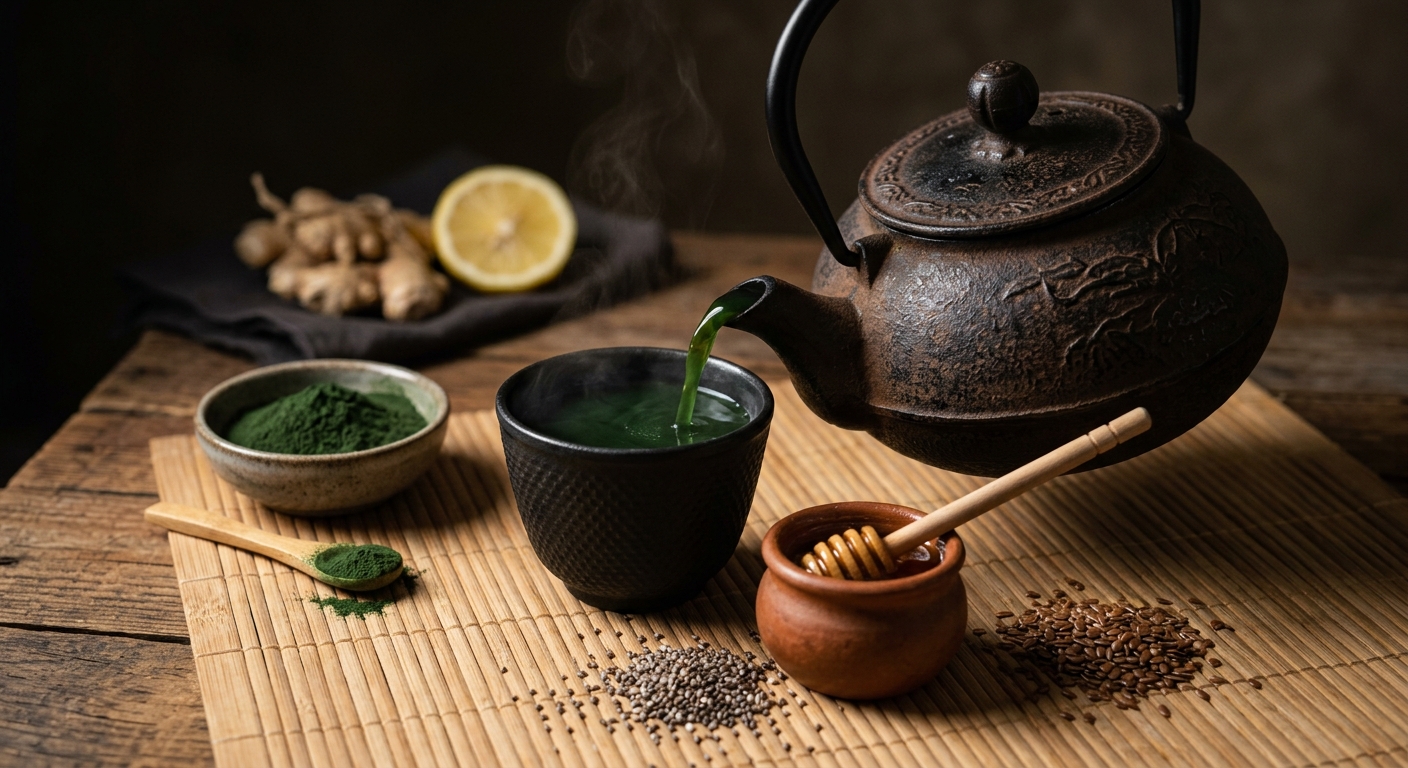
Chlorella is one of the oldest living organisms on Earth, a single-celled freshwater green algae that has thrived for over two billion years. Long before it found its way into powdered supplements and wellness shots, chlorella was cultivated in East Asia, particularly in Japan and Taiwan, where it gained recognition as a nutritional powerhouse in the mid-twentieth century. Following World War II, researchers explored chlorella as a potential solution to global food scarcity, captivated by its extraordinary protein content and its ability to reproduce rapidly in sunlight. While that particular mission evolved, chlorella’s reputation as a concentrated source of nutrients never faded.
In traditional Japanese wellness culture, chlorella has been consumed for decades as a daily tonic to support vitality, detoxification, and immune resilience. Today, blending chlorella powder into a warm or cold beverage has become a morning ritual for those seeking a clean, plant-based energy boost. Unlike matcha or yerba mate, chlorella tea contains virtually no caffeine, making its energizing effect entirely nutrient-driven, a steady lift powered by iron, magnesium, B12, and a dense spectrum of amino acids. The color alone, a vivid emerald green, signals just how much plant energy is packed into every sip.
What makes chlorella genuinely remarkable is its Chlorella Growth Factor (CGF), a nucleotide-peptide complex found only in this algae that supports cellular repair and metabolic energy production. Its exceptionally high chlorophyll content, the highest of any known food, gives the tea its striking appearance and contributes to its reputation as a blood-supporting and detoxifying herb. For those new to green algae beverages, chlorella tea has a savory, oceanic depth that rewards a little culinary creativity, pairing beautifully with citrus, ginger, or mint to round out its bold, earthy character.
2
cups
Ingredients
- 2 tspbroken-cell-wall chlorella powder
- 480 mlwater (70°C / 158°F)
- —fresh lemon juice to taste (optional)
- —raw honey or agave to taste (optional)
- —pinch of ground ginger (optional)
How to Brew
Click on an item below to shop for the recommended items for this recipe on Amazon.
As an Amazon Associate, we earn from qualifying purchases.
- Heat filtered water to 65 to 75°C (149 to 167°F). If you do not have a temperature-controlled kettle, bring water to a boil and allow it to rest for 8 to 10 minutes before using.
- Measure 1 teaspoon of broken-cell-wall chlorella powder per 240 ml of water and place it into a heat-safe mug or small pitcher.
- Pour a small splash of warm water over the chlorella powder first and whisk vigorously with a bamboo whisk or small handheld frother until a smooth, lump-free paste forms. This prevents clumping when the remaining water is added.
- Pour the remaining warm water into the mug and whisk or stir again until the powder is fully incorporated and the liquid is uniformly green.
- Allow the tea to rest for 3 to 5 minutes so the flavors meld and the temperature becomes comfortable to drink.
- Add a squeeze of fresh lemon juice, a small drizzle of honey, or a pinch of ginger to balance the savory, earthy notes before serving.
- Measure 1 teaspoon of broken-cell-wall chlorella powder per 240 ml of cold filtered water. For a batch of two servings, use 2 teaspoons and 480 ml of water in a glass jar.
- Add the chlorella powder to the jar along with your cold water. Seal the lid tightly and shake vigorously for 30 to 45 seconds until the powder disperses evenly. Alternatively, use a small whisk to blend before sealing.
- Place the sealed jar in the refrigerator and allow it to steep for a minimum of 6 hours, though overnight (8 hours) produces the best flavor integration and a noticeably smoother, less grassy taste.
- Remove from the refrigerator and give the jar one more vigorous shake before opening, as the powder can settle slightly during the cold steep.
- Pour over ice in tall glasses and finish with a few slices of cucumber or a sprig of fresh mint to highlight the tea’s natural green freshness. A squeeze of lime works particularly well with cold-brewed chlorella.
- Add 1 teaspoon of broken-cell-wall chlorella powder per serving into a blender along with 240 ml of chilled coconut water or filtered water.
- Add supporting ingredients to balance chlorella’s earthy depth: a 1 cm piece of fresh ginger, the juice of half a lemon or lime, and a teaspoon of raw honey or a few drops of liquid stevia.
- Optional: add a small handful of fresh mint leaves or a few slices of cucumber to amplify the fresh green character of the chlorella.
- Blend on high speed for 20 to 30 seconds until completely smooth and uniformly bright green. The blending action fully disperses the chlorella powder, ensuring no dry pockets remain.
- Pour immediately into a chilled glass over ice or serve straight in a tumbler. Consume within 15 minutes of blending for maximum nutrient integrity, as the increased surface area from blending accelerates oxidation.
Health Benefits
Chlorella’s dense concentration of iron, magnesium, B vitamins including B12, and all nine essential amino acids supports mitochondrial energy production at a cellular level. Unlike stimulant-based energy, this effect is gradual and sustained, without the crash associated with caffeine.
The presence of glycerophosphocholine and B12 in chlorella directly supports acetylcholine synthesis, a neurotransmitter central to attention, memory, and learning. Regular consumption has been associated with improved cognitive performance in several small clinical studies.
Chlorella’s cell wall contains sporopollenin and other compounds that bind to heavy metals such as mercury, lead, and cadmium in the gastrointestinal tract, supporting their elimination before absorption. Multiple studies have confirmed chlorella’s ability to reduce blood heavy metal levels with regular use.
Chlorella Growth Factor and specific polysaccharides in chlorella have been shown in clinical research to enhance natural killer cell activity and increase immunoglobulin A production, two key markers of a well-regulated immune response.
Chlorella is among the richest known sources of chlorophyll, lutein, and zeaxanthin, all of which neutralize reactive oxygen species that contribute to cellular aging and inflammation. Studies show that daily chlorella supplementation significantly raises plasma antioxidant capacity.
🧪 Key Bioactive Compounds
The Science Behind Chlorella
The energizing reputation of chlorella rests on one of the most complete nutritional profiles found in any single-ingredient botanical. Chlorella is composed of approximately 50 to 60 percent protein by dry weight, containing all nine essential amino acids in proportions comparable to eggs. This amino acid density directly supports neurotransmitter synthesis, including dopamine and serotonin precursors, which influence mood, motivation, and mental stamina. Its iron and magnesium content supports hemoglobin production and ATP synthesis respectively, meaning chlorella contributes to energy at the most fundamental biochemical level, within the mitochondria themselves.
Chlorella Growth Factor (CGF) is perhaps the most scientifically intriguing compound unique to this algae. CGF is a water-soluble nucleotide-peptide complex, rich in RNA, DNA, amino acids, and polysaccharides, that forms during the intense reproductive phase of chlorella’s growth cycle. Research has shown that CGF can stimulate cellular regeneration, support immune cell proliferation, and enhance the activity of natural killer cells. In a landmark 2012 randomized controlled trial published in Nutrition Journal, daily chlorella supplementation significantly improved natural killer cell activity in healthy adults after just eight weeks, a finding consistent with CGF’s known immunostimulatory mechanisms.
Chlorella’s detoxification capacity is supported by a compelling body of research. The rigid, multi-layered cell wall of chlorella contains sporopollenin, a chemically inert biopolymer with a remarkable structural affinity for heavy metals and persistent organic pollutants. When broken-cell-wall chlorella passes through the gastrointestinal tract, this compound acts as a molecular sponge, binding to mercury, lead, cadmium, and dioxins before they can be absorbed into systemic circulation. A 2013 study in Evidence-Based Complementary and Alternative Medicine demonstrated that chlorella supplementation significantly reduced urinary heavy metal concentrations in pregnant women, underscoring the real-world clinical relevance of this detoxification mechanism.
Brewing Tips
- Always choose certified broken-cell-wall chlorella powder, as the intact cell wall is indigestible to humans and blocks absorption of up to 80 percent of the nutrients inside.
- Start with half a teaspoon per serving for your first week and gradually increase to a full teaspoon, allowing your digestive system to adjust and minimizing the mild detox symptoms some first-time users experience.
- Store opened chlorella powder in an airtight container away from direct light and heat, as chlorophyll and B vitamins degrade quickly when exposed to UV radiation and warmth.