
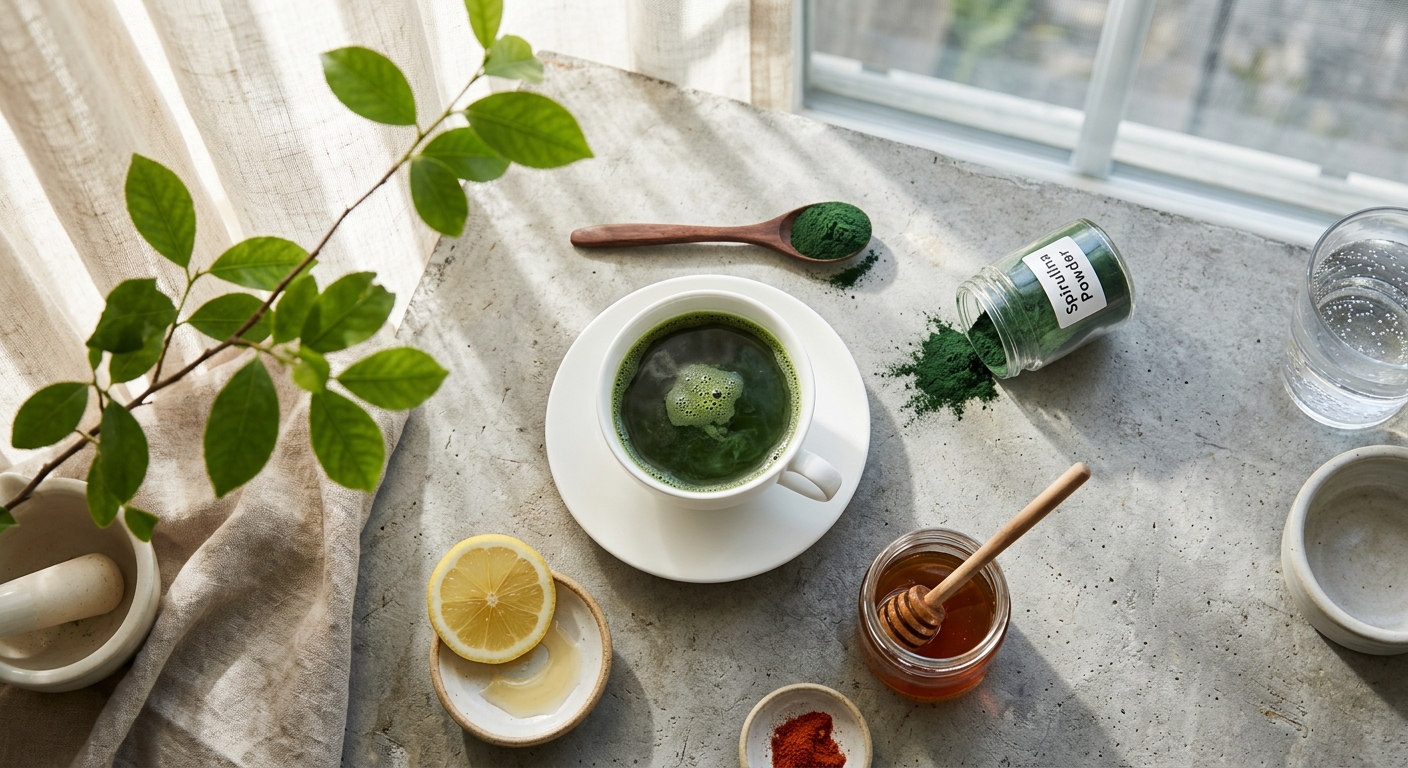
Long before modern supplement shelves were stocked with green powders, spirulina was already feeding civilizations. The Aztecs harvested this spiral-shaped cyanobacterium from Lake Texcoco, pressing it into cakes called tecuitlatl that sustained warriors and laborers alike. In the Lake Chad region of central Africa, the Kanembu people have harvested dihé, a spirulina-based product, for centuries, drying it into cakes used to flavor meals and fortify the body. This is not a wellness trend born in a laboratory. It is a food as ancient as the civilizations that relied on it.
What makes spirulina remarkable is its extraordinary concentration of nutrients in a single organism. Gram for gram, it delivers more complete protein than most plant foods, along with iron, B vitamins, gamma-linolenic acid, and a pigment called phycocyanin that gives it that unmistakable blue-green hue. When dissolved into warm or cold water and prepared thoughtfully, spirulina transforms into a deeply nourishing tea that supports energy production at the cellular level, without the cortisol spike and crash associated with caffeine.
Preparing spirulina as a tea is one of the gentlest and most bioavailable ways to consume it. Unlike capsules or smoothies, a warm spirulina brew is absorbed quickly, allowing its iron and B12-analogues to enter the bloodstream with minimal digestive effort. The flavor is earthy, faintly oceanic, and grounding, a taste that takes a little adjustment but becomes deeply satisfying once your palate associates it with how good you feel afterward. With the right temperature, pairings, and a little patience, spirulina tea becomes a daily ritual that is as energizing as it is restorative.
2
cups
Ingredients
- 2 tspspirulina powder (high-quality, food-grade)
- 480 mlwater (60 to 70°C / 140 to 158°F)
- 1 tspfresh lemon juice
- —raw honey or agave syrup to taste (optional)
- —pinch of cayenne pepper (optional, for circulation support)
How to Brew
Click on an item below to shop for the recommended items for this recipe on Amazon.
As an Amazon Associate, we earn from qualifying purchases.
- Heat filtered water to 60 to 70°C (140 to 158°F) using an electric kettle with temperature control. If you do not have a temperature-controlled kettle, bring water to a boil and allow it to cool for 4 to 5 minutes before using.
- Measure 1 teaspoon of spirulina powder per cup into your mug. For a milder flavor, start with half a teaspoon and increase gradually as your palate adjusts.
- Pour a small amount of the warm water (about 30 ml) over the spirulina powder and use a small whisk or bamboo matcha whisk to form a smooth paste, breaking up any clumps before adding more liquid.
- Pour the remaining warm water into the mug in a slow, steady stream while continuing to whisk in a circular motion until fully dissolved and a uniform teal-green color is achieved.
- Add a squeeze of fresh lemon juice to brighten the flavor and improve iron absorption. Sweeten with raw honey or agave if desired. Serve immediately and drink within 10 minutes for optimal nutrient freshness.
- Measure 2 teaspoons of spirulina powder into a glass jar or shaker bottle. Add 480 ml of room-temperature filtered water.
- Seal the jar tightly and shake vigorously for 30 to 45 seconds until the powder is fully dispersed. Alternatively, use a milk frother or immersion blender for a completely smooth result with no clumping.
- Open the jar and add the juice of half a lemon plus a small drizzle of agave syrup or honey. Stir briefly, then seal again.
- Refrigerate for 6 to 8 hours or overnight. The cold temperature allows the nutrients to hydrate fully without any heat degradation.
- Before serving, give the jar a good shake as some settling may occur. Pour over a glass of ice, taste and adjust sweetness, and enjoy within 24 hours of preparation for best flavor and potency.
- Heat 60 ml of filtered water to 50 to 60°C (122 to 140°F), using lower heat than the standard hot brew to further protect thermosensitive compounds during the more concentrated preparation.
- Add 1 teaspoon of spirulina powder to a small bowl or shot glass. Pour the warm water over it in a thin stream and immediately whisk briskly using a small matcha whisk or mini frother until a completely smooth, dense concentrate forms with no visible powder clumps.
- Stir in half a teaspoon of fresh lemon juice and, if desired, a tiny pinch of black pepper to enhance the bioavailability of the chlorophyll and carotenoid compounds.
- Allow the concentrate to rest for 2 to 3 minutes so the nutrients fully hydrate into the liquid, then consume immediately as a shot or stir the entire concentrate into 200 ml of coconut water or cold-pressed orange juice for a more palatable energy drink.
Health Benefits
Spirulina’s dense concentration of iron, B vitamins, and complete protein supports mitochondrial energy production at the cellular level. Unlike stimulants, this effect builds over consistent use and does not cause adrenal fatigue or a rebound crash.
Phycocyanin has demonstrated neuroprotective properties in animal studies, reducing oxidative damage to brain cells. Combined with spirulina’s iron content, which supports oxygen delivery to the brain, regular consumption may help lift mental fog and improve cognitive clarity.
Multiple clinical trials have shown that spirulina enhances production of cytokines and stimulates natural killer cell activity, helping the immune system respond more efficiently to pathogens. A 2016 randomized trial found significant improvements in immune markers among spirulina consumers compared to placebo groups.
Spirulina’s combination of phycocyanin, beta-carotene, and GLA gives it a multi-pathway approach to fighting inflammation. Studies show it lowers markers of oxidative stress including malondialdehyde (MDA) and increases antioxidant enzyme activity in the body.
A meta-analysis of clinical trials published in the journal Nutrients found that spirulina supplementation significantly reduced LDL cholesterol, triglycerides, and systolic blood pressure. These cardiovascular benefits make it a particularly valuable daily addition for those focused on long-term vitality.
🧪 Key Bioactive Compounds
The Science Behind Spirulina
Spirulina’s most celebrated compound, phycocyanin, is responsible for its blue-green color and much of its therapeutic reputation. This biliprotein pigment is a potent free-radical scavenger and has demonstrated the ability to inhibit lipid peroxidation, a process by which unstable free radicals damage cell membranes throughout the body. Research published in the Journal of Medicinal Food has linked phycocyanin to anti-inflammatory effects via inhibition of the cyclooxygenase-2 (COX-2) enzyme, the same pathway targeted by common non-steroidal anti-inflammatory drugs, suggesting a natural, gentler means of managing systemic inflammation over time.
On the energy front, spirulina’s complete amino acid profile (it contains all nine essential amino acids) supports the synthesis of neurotransmitters including dopamine and serotonin, which influence motivation, mood, and mental focus. Its iron content is particularly relevant for those experiencing fatigue related to mild iron deficiency. Because iron is a core component of hemoglobin, the protein that carries oxygen in the blood, even small improvements in iron status can produce noticeable increases in energy and cognitive performance. Adding lemon juice to a spirulina brew is not just a flavor trick. The vitamin C in lemon juice converts non-heme plant iron into a more bioavailable form, significantly improving the amount your body can absorb from each cup.
The immune-modulating effects of spirulina have been studied in multiple human clinical trials. A landmark study published in Cellular and Molecular Immunology found that spirulina polysaccharides stimulated macrophage activity and increased production of interleukin-1 beta (IL-1β), a key signaling molecule in the body’s first-line immune response. Meanwhile, the carotenoids in spirulina, particularly beta-carotene, are converted to Vitamin A in the body and support the integrity of mucosal barriers in the respiratory and digestive tracts, the first physical defenses against environmental pathogens. Taken together, spirulina’s bioactive compounds create a comprehensive, evidence-supported profile of cellular energy, neuroprotection, and immune support that few single-ingredient teas can match.
Brewing Tips
- Always use water below 75°C (167°F) when preparing spirulina hot tea. Temperatures above this threshold begin to degrade phycocyanin and heat-sensitive B vitamins, reducing the brew’s nutritional potency and turning the color from vibrant teal to a dull olive green.
- Start with half a teaspoon per cup if you are new to spirulina tea. The flavor is assertive and acquired. Increasing the dose gradually over one to two weeks allows your palate and digestive system to adapt without discomfort.
- Always buy spirulina that is certified organic and third-party tested for microcystins, heavy metals, and microbial contamination. Wild-harvested spirulina from uncontrolled water sources carries real contamination risks. Reputable brands will display their testing certifications clearly on the label or their website.