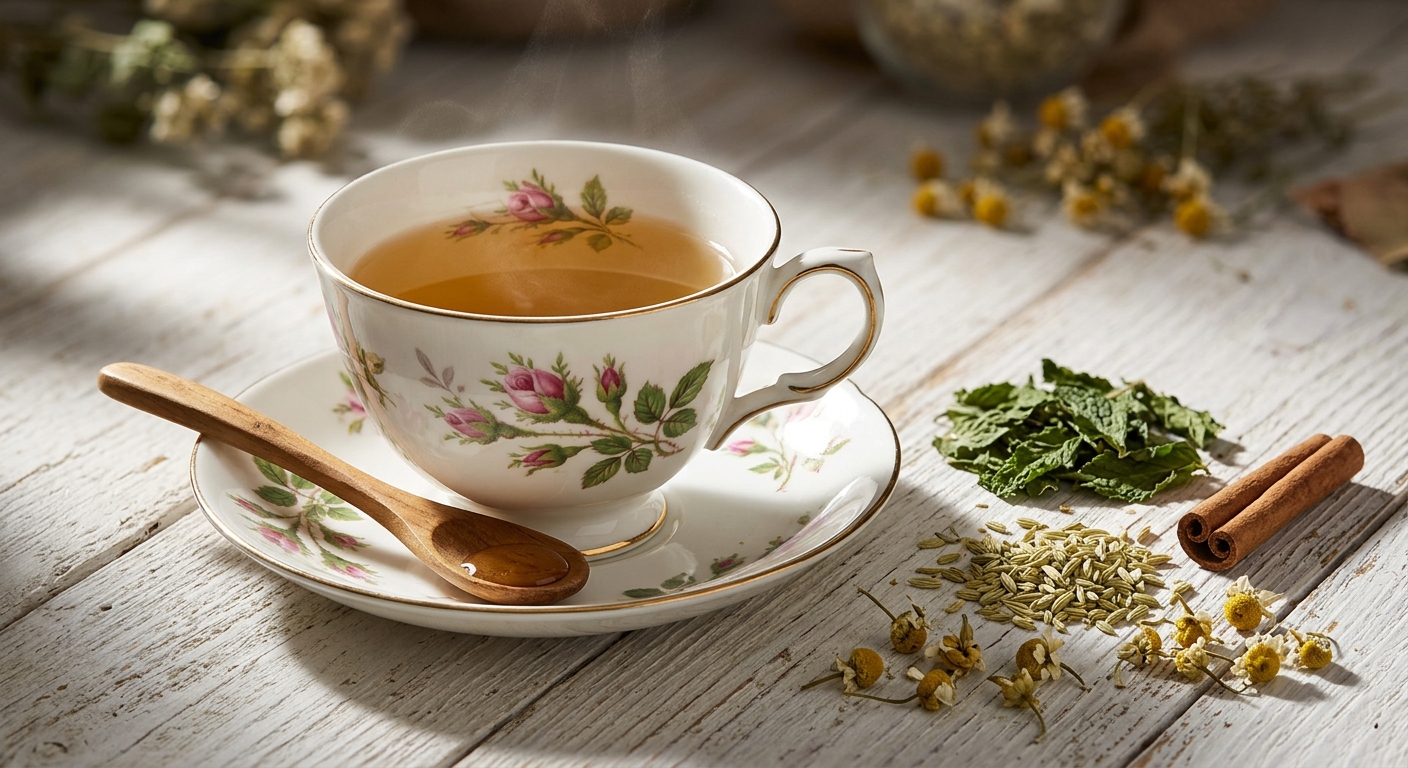
Irritable bowel syndrome affects roughly one in ten people worldwide, yet conventional treatments often leave sufferers searching for gentler, more holistic options. For centuries, herbalists across Europe, the Middle East, and Asia have reached for the same small group of plants to calm a troubled gut: peppermint for its antispasmodic action, fennel for its carminative relief of trapped gas, and chamomile for its ability to ease both intestinal inflammation and the anxiety that so frequently triggers IBS flares. Together, these three herbs form one of the most time-tested and well-researched digestive tea blends in the herbal canon.
Peppermint has been prized since ancient Egypt, where it was found in tombs dating to 1000 BCE, and it remains one of the most clinically studied herbs for IBS today. Fennel seeds were chewed after meals throughout ancient Rome and medieval Europe to settle the stomach and freshen the breath, a practice still common across South Asia. Chamomile, revered by ancient Egyptians as a gift from the sun god Ra, has never fallen out of favor as a nervine digestive herb. The convergence of these three traditions into a single cup is not accidental: each herb addresses a different dimension of IBS, and they work in genuine synergy.
What makes this blend particularly powerful is the way it addresses the gut-brain axis, the bidirectional communication network linking the enteric nervous system of the gut to the central nervous system of the brain. IBS is now understood to involve dysregulation of this axis, with stress amplifying gut sensitivity and gut discomfort worsening anxiety. Peppermint directly relaxes smooth muscle in the intestinal wall, fennel disperses gas and reduces distension, and chamomile acts simultaneously on gut inflammation and the nervous system. Brewed as a warm, aromatic tea, this blend delivers its active compounds directly to where they are needed most.
2
cups
Ingredients
- 2 tspdried peppermint leaves
- 1 tspfennel seeds, lightly crushed
- 1 tspdried chamomile flowers
- 480 mlwater (90°C / 194°F)
- —raw honey to taste (optional)
- —fresh lemon slice to taste (optional)
How to Brew
Click on an item below to shop for the recommended items for this recipe on Amazon.
As an Amazon Associate, we earn from qualifying purchases.
- Lightly crush the fennel seeds using the back of a spoon or a mortar and pestle. This breaks the seed coat and allows the essential oils, particularly anethole and fenchone, to release fully into the water.
- Combine the crushed fennel seeds, dried peppermint leaves, and dried chamomile flowers in your tea infuser or teapot. The ratio of 2:1:1 (peppermint to fennel to chamomile) balances the blend so no single herb dominates.
- Heat your water to 90 to 95°C (194 to 203°F). If you do not have a temperature-controlled kettle, bring water to a full boil and let it rest for 60 to 90 seconds before pouring.
- Pour the hot water over the herbs and cover the mug or teapot immediately with a lid or small saucer. This is critical: peppermint and chamomile are both rich in volatile aromatic compounds that will evaporate into steam if left uncovered, reducing both the therapeutic potency and the flavor of the finished tea.
- Steep for 7 to 10 minutes. Taste at 7 minutes; if you prefer a stronger medicinal quality, extend to 10 minutes. Longer steeping intensifies the fennel and chamomile notes.
- Remove the infuser, add honey or lemon if desired, and sip slowly 20 to 30 minutes before or after a meal for best digestive support.
- Lightly crush 2 teaspoons of fennel seeds and combine with 4 teaspoons of dried peppermint and 2 teaspoons of dried chamomile in a clean glass jar. The herb quantities are doubled compared to the hot brew because cold water extracts compounds more slowly and less completely.
- Pour 1 liter of cold, filtered room-temperature water over the herbs. Stir briefly to ensure all plant material is submerged.
- Seal the jar with a lid and leave it at room temperature for 1 hour to allow the initial infusion to begin, then transfer to the refrigerator.
- Steep in the refrigerator for 8 to 12 hours (overnight is ideal). The cold environment slows extraction, gently drawing out volatile oils and flavonoids without releasing the sharper bitter compounds that emerge under heat.
- Strain through a fine mesh strainer or cheesecloth into a pitcher, pressing lightly on the herb solids to recover the infused liquid.
- Serve over ice or chilled in a glass. The cold brew keeps in the refrigerator for up to 48 hours. Sip throughout the day between meals to provide continuous, low-level digestive support.
- Triple the standard herb quantities: use 6 teaspoons of peppermint, 3 teaspoons of crushed fennel seeds, and 3 teaspoons of chamomile. Lightly crush all the fennel seeds before combining the blend.
- Bring 480 ml of water to 90 to 95°C (194 to 203°F) and pour over the herbs in a small saucepan or large heatproof teapot. Cover immediately to trap volatile oils.
- Steep covered for 15 to 20 minutes, checking at 15 minutes. The concentrate will be noticeably more intense in color (a deeper amber-green) and flavor than a standard brew.
- Strain carefully through a fine mesh strainer into a clean glass jar or bottle, pressing the herbs firmly to extract maximum liquid. Discard the spent plant material.
- To serve, dilute 1 part concentrate with 2 to 3 parts hot or cold water, depending on your preferred strength and whether you are treating an active flare (stronger, 1:2) or taking a maintenance dose (milder, 1:3).
- Store the concentrate in the refrigerator for up to 4 days. Reheat gently without boiling, or add cold water for a room-temperature digestive drink.
Health Benefits
Peppermint oil is one of the best-studied natural remedies for IBS, with multiple randomized controlled trials and a 2014 meta-analysis in the Journal of Clinical Gastroenterology confirming its superiority to placebo for abdominal pain. The menthol in peppermint blocks calcium channels in intestinal smooth muscle cells, preventing the sustained contractions responsible for cramping.
Fennel is classified as a carminative herb, meaning it prevents the formation of gas in the gastrointestinal tract and helps expel existing gas by relaxing the intestinal walls. The compound anethole is responsible for this action, and clinical studies in both adults and infants with colic have demonstrated fennel’s effectiveness for gas and bloating relief.
Chamomile’s apigenin acts on GABA receptors in both the central nervous system and the enteric nervous system, simultaneously reducing anxiety and directly soothing gut hypersensitivity. Since psychological stress is a well-documented IBS trigger, chamomile’s dual action on the mind-gut connection makes it a uniquely valuable herb in this blend.
All three herbs in this blend contain anti-inflammatory compounds: chamomile’s bisabolol and apigenin, peppermint’s rosmarinic acid, and fennel’s anethole have all demonstrated the ability to inhibit pro-inflammatory pathways including COX-2 and NF-kB in laboratory and animal studies, helping to calm the low-grade inflammation associated with IBS.
Rather than uniformly slowing or speeding transit, this blend helps normalize gut motility, making it useful for both IBS-C (constipation-predominant) and IBS-D (diarrhea-predominant) subtypes. Peppermint reduces hypermotility during flares while fennel’s carminative action prevents stagnation, together encouraging a more balanced and regular digestive rhythm.
🧪 Key Bioactive Compounds
The Science Behind Peppermint
The science behind this IBS blend centers on its multi-targeted action on the gastrointestinal system. Peppermint’s primary active compound, menthol, is a potent calcium channel antagonist in intestinal smooth muscle. When menthol is absorbed through the intestinal mucosa, it inhibits the influx of calcium ions into muscle cells, preventing the sustained contractions that manifest as the cramping pain of an IBS episode. This is the same mechanism exploited by enteric-coated peppermint oil capsules, which have achieved strong clinical endorsement for IBS from the American College of Gastroenterology. While tea delivers a lower concentration of menthol than pharmaceutical capsules, the consistent daily use of peppermint tea still provides meaningful antispasmodic support, particularly for mild to moderate symptoms.
Fennel’s anethole and fenchone act as carminatives by relaxing the circular smooth muscle of the lower intestinal tract, which allows trapped gas pockets to move through and be expelled rather than causing the painful distension characteristic of IBS bloating. Importantly, anethole also demonstrates antimicrobial properties against several gut bacteria implicated in small intestinal bacterial overgrowth (SIBO), a condition that frequently underlies or co-exists with IBS and contributes to excessive gas production. Chamomile brings a different but complementary mechanism: its flavonoid apigenin inhibits the release of histamine and pro-inflammatory prostaglandins from mast cells in the gut lining. Mast cell activation is now recognized as a key driver of visceral hypersensitivity in IBS, and chamomile’s ability to stabilize these cells may help reduce the exaggerated pain response to normal gut sensations that defines the condition.
Perhaps the most compelling aspect of this blend is its action on the gut-brain axis. Modern gastroenterology understands IBS as a disorder of gut-brain interaction, where bidirectional signaling between the enteric and central nervous systems becomes dysregulated. Chamomile’s apigenin and peppermint’s rosmarinic acid both interact with GABAergic and serotonergic pathways that govern this axis. Since roughly 95 percent of the body’s serotonin is produced in the gut and plays a central role in regulating intestinal motility and pain perception, herbs that modulate serotonin signaling hold genuine promise for IBS management. This is an emerging area of research, and while human trials specifically on herbal teas for gut-brain modulation remain limited, the mechanistic evidence for each individual compound in this blend is substantial and continues to grow.
Brewing Tips
- Always cover your mug while steeping this blend. Peppermint and chamomile lose a significant portion of their therapeutic volatile oils to steam evaporation in as little as two minutes of uncovered steeping, leaving you with tea that tastes flat and delivers less of its medicinal benefit.
- Drink this tea warm and slowly during or after a meal rather than gulping it down cold. Warmth itself has a direct spasmolytic effect on the gut wall, and slow sipping gives the menthol and anethole time to coat and interact with the intestinal mucosa as they pass through.
- Source whole fennel seeds rather than pre-ground fennel tea. The volatile oils in fennel degrade rapidly once the seed coat is broken, so pre-ground or old fennel powder will deliver a fraction of the carminative benefit. Crush seeds fresh immediately before each brew for maximum potency.