Long before neuroscience had words for neuroplasticity or alpha brain waves, meditating monks and Ayurvedic physicians were already working with the plants that supported them. Brahmi (Bacopa monnieri) has been prescribed in Ayurvedic medicine for over three thousand years as a medhya rasayana, a category of herbs specifically chosen to sharpen intellect and support memory. Gotu kola (Centella asiatica) was so revered in Sri Lanka that an old proverb held that two leaves a day kept old age away, and it was routinely used by yogis to sustain long hours of seated meditation. These are not trendy adaptogens – they are ancient allies with serious botanical credentials.
What makes this blend exceptional is the convergence of three distinct nervous system strategies in a single cup. Brahmi calms mental chatter through its effect on serotonin pathways. Gotu kola supports cerebral circulation and reduces anxiety without sedation. Lion’s mane mushroom (Hericium erinaceus), a prized ingredient in traditional Chinese medicine, contributes compounds that actively support the growth and maintenance of nerve cells. Brewed together, they produce a tea that settles the mind without dulling it, making the inward turn of meditation feel less like effort and more like arrival.
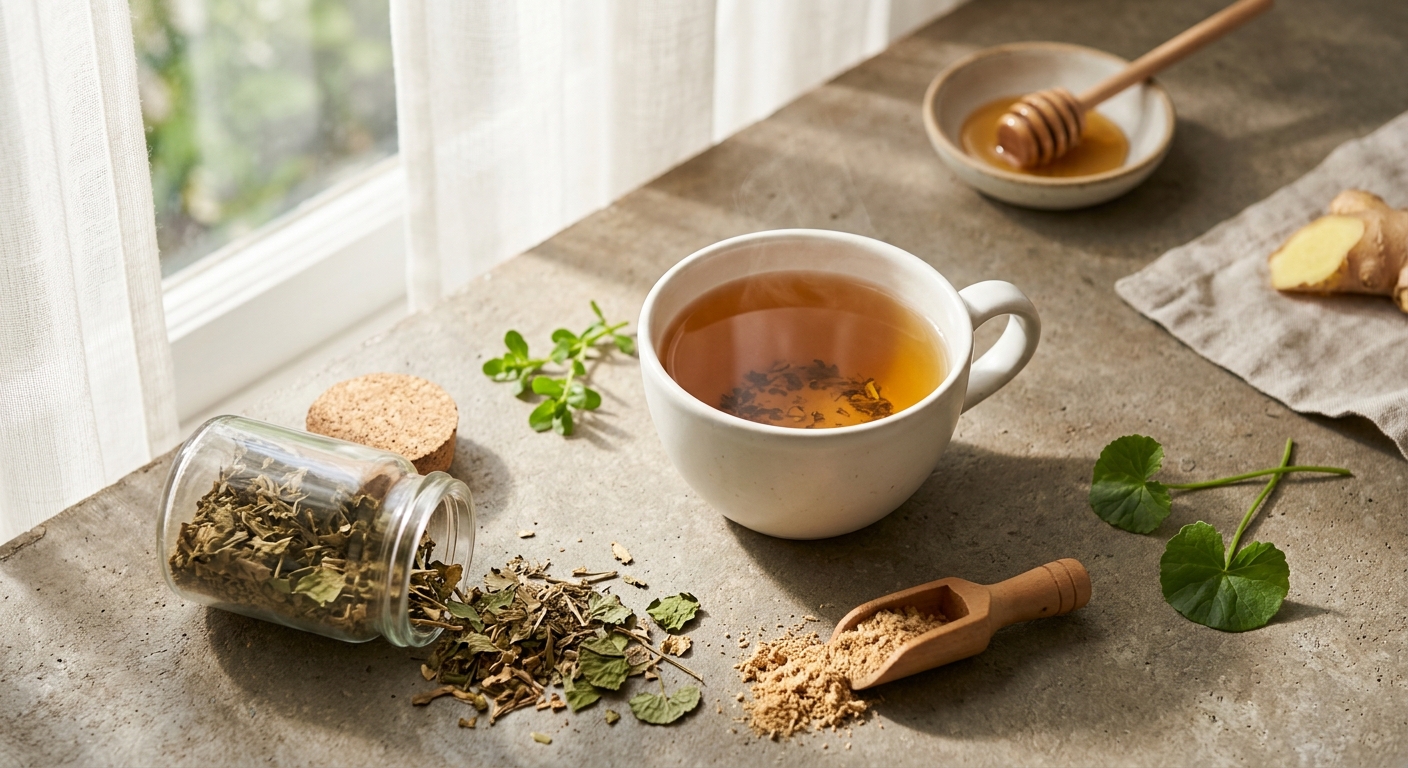
The flavor of this blend is earthy and gently bitter, with a green, almost foresty depth from the gotu kola and a mild mushroomy warmth from the lion’s mane. Brahmi adds a faint herbaceous note that rounds the cup. It is not a tea you drink for sweetness – it is a tea you drink with intention. A small amount of raw honey or a sliver of fresh ginger can soften the bitterness beautifully, and many practitioners find that the ritual of preparing it is itself part of the meditative practice.
2
cups
Ingredients
- 1.5 tspdried brahmi leaf (Bacopa monnieri)
- 1 tspdried gotu kola leaf (Centella asiatica)
- 1 tspdried lion’s mane mushroom powder
- 480 mlwater (85°C / 185°F)
- —raw honey or a sliver of fresh ginger (optional)
How to Brew
Click on an item below to shop for the recommended items for this recipe on Amazon.
As an Amazon Associate, we earn from qualifying purchases.
- Heat filtered water to 85°C (185°F). If you do not have a temperature-controlled kettle, bring water to a boil and allow it to rest uncovered for 3 to 4 minutes before using.
- Measure 1.5 tsp dried brahmi leaf, 1 tsp dried gotu kola leaf, and 1 tsp lion’s mane mushroom powder into a tea infuser or empty tea bag. Place the infuser in your mug or teapot.
- Pour 240 ml of the heated water slowly over the herbs, covering the infuser fully. Place a small saucer or lid over the mug to trap volatile aromatic compounds during steeping.
- Steep for 8 to 10 minutes. The longer end of this range extracts more bacosides and asiaticoside, the key active compounds – taste at 8 minutes and decide based on your tolerance for bitterness.
- Remove the infuser, pressing it gently against the side of the mug to extract the remaining liquid. Add raw honey or a thin slice of fresh ginger if desired, and sip slowly before or during meditation.
- Combine 2 tsp dried brahmi leaf, 1.5 tsp dried gotu kola leaf, and 1.5 tsp lion’s mane powder in a clean glass jar. Use slightly more herb than the hot brew ratio to compensate for the slower, gentler extraction.
- Pour 500 ml of cold, filtered water over the herbs. Stir briefly with a long spoon to ensure the powder is dispersed and no dry clumps remain at the bottom.
- Cover the jar with a lid or cloth secured with a rubber band. Leave at room temperature for 30 minutes, then transfer to the refrigerator.
- Allow the blend to steep in the refrigerator for 10 to 12 hours. Overnight is ideal – this window allows full extraction of beta-glucans from lion’s mane and the slower-releasing bacosides from brahmi.
- Strain the cold brew through a fine mesh strainer or a coffee filter into a clean jar or glass. Discard the spent herbs. Serve over a small amount of ice, or drink it straight from the refrigerator. Cold brew keeps well for up to 48 hours sealed in the fridge.
- Measure double the standard amount of herbs into a small saucepan or teapot: 3 tsp dried brahmi leaf, 2 tsp dried gotu kola leaf, and 2 tsp lion’s mane powder.
- Heat 480 ml of filtered water to 85°C (185°F) and pour it over the herbs in the saucepan. Do not bring the mixture to a boil – maintain a very gentle heat (or remove from the heat source entirely) to hold the temperature steady.
- Allow the herbs to steep uncovered for 15 to 20 minutes, stirring once halfway through to redistribute the lion’s mane powder and ensure even extraction.
- Strain the concentrate through a fine mesh strainer lined with cheesecloth or a coffee filter to remove all particulate matter, especially the lion’s mane powder. Press the herbs firmly to extract the full yield.
- Pour the concentrate into a clean glass jar and allow it to cool. Seal and refrigerate for up to 3 days. When ready to use, dilute one part concentrate with one part hot or cold water and add honey or ginger to taste.
Health Benefits
Bacosides in brahmi improve signal transmission between neurons, while NGF stimulation from lion’s mane supports the structural integrity of nerve fibers involved in sustained attention. Clinical trials on Bacopa monnieri show significant improvements in attention, cognitive processing, and working memory after 8 to 12 weeks of consistent use.
Madecassoside and asiaticoside from gotu kola have demonstrated anxiolytic effects in both animal and human studies, lowering anxiety scores without the drowsiness associated with sedative herbs like valerian. This makes the blend ideal for meditation, where calm wakefulness is the goal.
Lion’s mane mushroom is one of very few natural substances shown to stimulate Nerve Growth Factor production in humans. NGF is critical for the growth, maintenance, and survival of neurons, and elevated NGF is associated with improved learning capacity and long-term cognitive resilience.
Brahmi’s bacopaside compounds slow the breakdown of acetylcholine, a neurotransmitter essential for encoding and retrieving memories. This mechanism mirrors that of some pharmaceutical memory drugs, but with a significantly more favorable safety profile at typical tea doses.
Gotu kola has traditionally been used to improve circulation, and modern research supports its ability to strengthen capillary walls in the brain and improve cerebral blood flow, delivering more oxygen and nutrients to neurons during prolonged mental effort.
🧪 Key Bioactive Compounds
The Science Behind Brahmi (Bacopa Monnieri)
The cognitive effects of this blend are grounded in three distinct but complementary biological mechanisms. Brahmi’s primary actives, the bacosides, are triterpenoid saponins that enhance the activity of kinases responsible for repairing damaged neurons and improving the transmission efficiency of synaptic signals. Studies published in the Journal of Ethnopharmacology and Neuropsychopharmacology have demonstrated that standardized Bacopa extract improves both the speed and accuracy of visual information processing, with the most significant gains appearing after 8 weeks of daily use. Importantly, brahmi appears to modulate the balance between serotonin and acetylcholine pathways simultaneously, explaining both its anxiolytic and memory-enhancing effects within the same dose.
Gotu kola contributes a separate but synergistic layer of neurological support. Its key compounds, asiaticoside and madecassoside, work partly by reducing neuroinflammation via inhibition of NF-kB signaling pathways, and partly by stimulating hippocampal neurogenesis in animal models. The hippocampus is the brain region most associated with forming new memories and spatial navigation, and increased neurogenesis there correlates directly with improved learning capacity and stress resilience. A 2016 randomized controlled trial found that gotu kola extract significantly reduced anxiety and improved mood in healthy older adults, with effects appearing within 30 to 60 days, making it a slow but reliable cognitive adaptogen.
Lion’s mane brings a third and particularly remarkable mechanism: the direct stimulation of Nerve Growth Factor (NGF) synthesis in the brain. NGF is a protein that regulates the growth, maintenance, and survival of neurons, and its decline is strongly associated with age-related cognitive deterioration and neurodegenerative conditions. The hericenones found in lion’s mane fruiting bodies are small enough to cross the blood-brain barrier directly, while the erinacines in the mycelium stimulate NGF production through a different molecular pathway. A 2009 double-blind clinical trial published in Phytotherapy Research found that adults aged 50 to 80 who consumed lion’s mane daily for 16 weeks showed significantly improved cognitive function scores compared to placebo, with no adverse effects reported. Together, these three ingredients address mental focus from three different angles: synaptic efficiency, neuroinflammation, and structural neuronal health.
Brewing Tips
- Brew this tea 20 to 30 minutes before your meditation session rather than immediately before – the active compounds in brahmi and gotu kola need a brief absorption window to begin modulating neurotransmitter activity.
- If the bitterness of brahmi is too pronounced, reduce the steep time to 6 minutes and add a few fresh mint leaves to the infuser – mint does not diminish the cognitive actives but significantly lifts the palatability of the cup.
- For best long-term results, drink this blend consistently for at least 4 to 6 weeks. Brahmi in particular is an adaptogen whose nootropic effects are cumulative and dose-dependent, building meaningfully over weeks rather than delivering a single-session effect like caffeine.