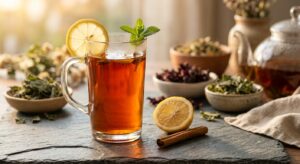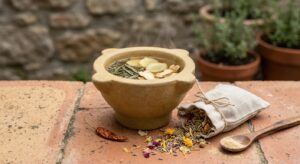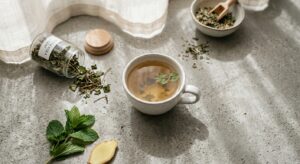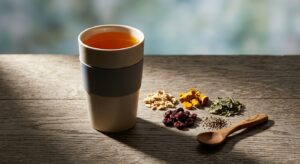
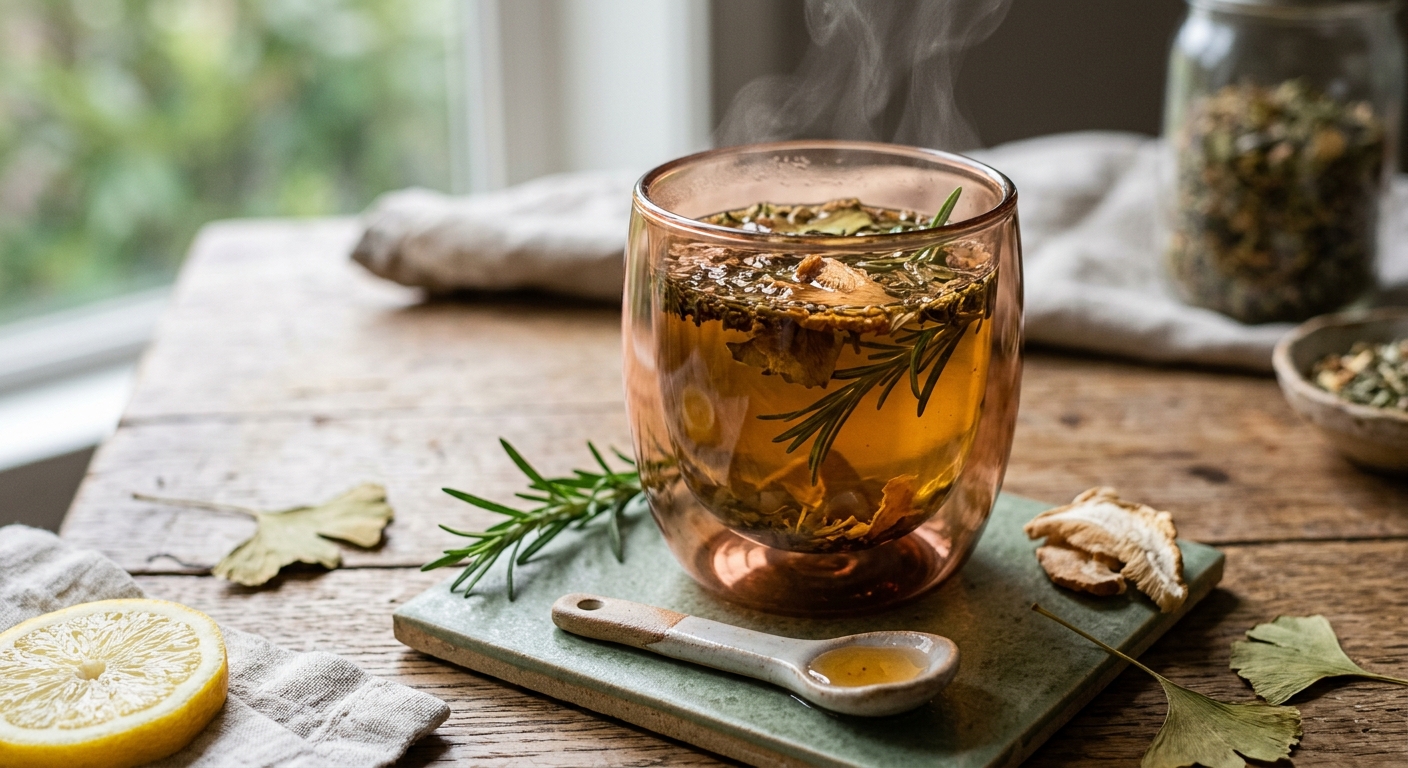
If you have emerged from COVID-19 feeling like your thoughts move through thick fog, you are not alone. Post-COVID cognitive symptoms, commonly called brain fog, affect an estimated 20 to 30 percent of long COVID sufferers, manifesting as poor concentration, word-finding difficulties, memory lapses, and persistent mental fatigue. While medical care remains the cornerstone of recovery, centuries-old plant medicine traditions offer gentle, complementary support for the healing mind. This brain fog tea brings together three of history’s most revered cognitive herbs into a single, purposeful cup.
Lion’s mane mushroom (Hericium erinaceus) has been brewed as a medicinal tea in Traditional Chinese Medicine for over a thousand years, prized as a tonic for the brain and nervous system. Ginkgo biloba, often called a living fossil, has appeared in Chinese herbal pharmacopeias since the 11th century and remains one of the most widely studied botanicals for cognitive support in the world. Rosemary, meanwhile, was draped over scholars in ancient Greece to sharpen memory during examinations, and modern aromatherapy and phytotherapy research has begun to validate what those early students intuitively understood. Together, these three herbs form a synergistic trio that addresses brain fog from multiple angles: neurogenesis support, cerebrovascular circulation, and cholinergic enhancement.
What makes this blend genuinely compelling is not any single dramatic compound but rather the layered way it works. Lion’s mane stimulates nerve growth factor production in the brain. Ginkgo improves microcirculation to cortical tissue. Rosemary inhibits acetylcholinesterase, the enzyme that breaks down your brain’s primary learning and memory neurotransmitter. Brewed together, they produce a cup that is earthy, gently piney, and faintly resinous, grounding and invigorating at the same time. It is a tea that asks you to slow down, breathe deeply, and give your recovering brain exactly what it needs.
2
cups
Ingredients
- 2 tspdried lion’s mane mushroom (sliced or powdered)
- 1 tspdried ginkgo leaf (certified herbal grade, not raw seeds)
- 1 tspfresh or dried rosemary leaves
- 480 mlwater (95°C / 203°F)
- —raw honey or maple syrup to taste (optional)
- —a slice of fresh lemon (optional, brightens flavor and adds vitamin C)
How to Brew
Click on an item below to shop for the recommended items for this recipe on Amazon.
As an Amazon Associate, we earn from qualifying purchases.
- Heat filtered water to 93 to 95°C (200 to 203°F). Avoid a full rolling boil, which can degrade some of ginkgo’s delicate flavonoids. A kettle with temperature control is ideal.
- Measure 2 teaspoons of dried lion’s mane mushroom, 1 teaspoon of dried ginkgo leaf, and 1 teaspoon of rosemary into a tea infuser or mesh strainer set over a heatproof teapot or mug. If using powdered lion’s mane, place it directly in the pot and plan to pour through a fine-mesh strainer at the end.
- Pour 480 ml of hot water slowly over the herbs, ensuring all plant material is fully saturated. Cover the vessel with a lid or small saucer to trap volatile aromatic compounds, especially from the rosemary.
- Steep for 10 to 15 minutes. For a milder, less bitter cup, remove at 10 minutes. For maximum extraction of lion’s mane beta-glucans and ginkgo flavonoids, steep the full 15 minutes.
- Strain thoroughly into your cups. If you used powdered lion’s mane, pour through a fine-mesh strainer lined with a small piece of cheesecloth. Add honey and a squeeze of lemon if desired, and sip slowly while still warm.
- Combine 2 teaspoons of dried lion’s mane, 1 teaspoon of dried ginkgo leaf, and 1 teaspoon of rosemary in a clean glass jar. Use slightly cooler, filtered water at room temperature (around 20°C / 68°F) to begin the process.
- Pour 600 ml of room-temperature filtered water over the herbs. The slightly increased volume compensates for the lower extraction efficiency of cold brewing and dilution from any ice used later when serving.
- Stir gently with a long spoon to ensure all herbs are submerged. Loosely cover the jar with a lid or a small plate and allow it to sit at room temperature for 1 hour to begin initial extraction.
- Transfer the jar to the refrigerator and steep for an additional 12 to 16 hours, or overnight. The slow, cold extraction draws out the milder, sweeter compounds from each herb while leaving behind much of the sharp tannin bitterness.
- Strain through a fine-mesh strainer into a clean pitcher or directly into glasses filled with ice. Taste before sweetening, as the cold brew version is naturally smoother and may need no addition. Serve over ice with a sprig of fresh rosemary as garnish.
- Add 2.5 teaspoons of dried lion’s mane mushroom to a small saucepan with 600 ml of cold filtered water. Start cold and bring to temperature gradually, this slow rise helps extract a fuller range of water-soluble compounds from the mushroom.
- Bring the water with lion’s mane to a gentle simmer over medium-low heat (85 to 90°C / 185 to 194°F). Do not boil vigorously. Maintain a soft, steady simmer where small bubbles rise gently from the bottom.
- After 10 minutes of simmering the lion’s mane alone, add 1 teaspoon of dried ginkgo leaf and 1 teaspoon of rosemary to the saucepan. Adding these later prevents the more delicate compounds in ginkgo and rosemary from being destroyed by prolonged heat.
- Continue simmering gently for another 10 to 15 minutes with the lid slightly ajar to allow some water to evaporate and concentrate the liquid. The decoction will reduce by roughly 20 percent, intensifying flavor and potency.
- Remove from heat and allow to rest, covered, for 5 minutes. Strain through a fine-mesh strainer into cups, pressing the mushroom pieces lightly with the back of a spoon to extract remaining liquid. Add honey and lemon to balance the deep, earthy bitterness, and sip slowly.
Health Benefits
Lion’s mane mushroom is the only known food source of hericenones and erinacines, compounds that stimulate Nerve Growth Factor synthesis. A 2009 randomized controlled trial published in Phytotherapy Research found that participants taking lion’s mane showed significantly improved cognitive function scores compared to placebo, with effects diminishing after supplementation stopped, suggesting a direct neurological mechanism.
Ginkgo biloba’s terpene lactones, particularly ginkgolide B, inhibit platelet-activating factor and improve blood flow through the brain’s smallest vessels. Research suggests this mechanism may be particularly relevant to post-COVID cognition, as microvascular dysfunction in cerebral capillaries has been identified as one of the leading hypotheses for why brain fog persists after the acute infection resolves.
Rosemary contains 1,8-cineole, a volatile monoterpene shown in human clinical studies to measurably increase plasma concentrations of acetylcholine by inhibiting the enzyme acetylcholinesterase. A 2012 study by Moss and Oliver found that participants exposed to rosemary aroma had significantly better working memory and alertness scores, supporting the herb’s long folkloric association with memory enhancement.
Post-COVID brain fog is increasingly understood as a neuroinflammatory condition, with elevated cytokines and activated microglia disrupting normal neural signaling. All three herbs in this blend carry anti-inflammatory properties: beta-glucans from lion’s mane modulate microglial activation, ginkgo flavonoids reduce oxidative inflammatory cascades, and rosmarinic acid in rosemary suppresses pro-inflammatory prostaglandin synthesis.
Lion’s mane has demonstrated anxiolytic and antidepressant effects in several animal and small human studies, potentially through NGF-mediated hippocampal neurogenesis. A 2010 clinical study found that women consuming lion’s mane cookies reported significantly lower levels of anxiety, concentration difficulties, and irritability compared to placebo, suggesting the mushroom supports emotional as well as cognitive resilience.
🧪 Key Bioactive Compounds
The Science Behind Lion’S Mane Mushroom
The scientific case for this brain fog blend rests on three converging mechanisms, each targeting a different aspect of the neurological disruption underlying post-COVID cognitive symptoms. Lion’s mane mushroom acts upstream at the level of neural repair. Its bioactive hericenones and erinacines stimulate the synthesis of Nerve Growth Factor, a critical signaling protein that supports the survival, maintenance, and regrowth of neurons in the hippocampus and frontal cortex, the regions most associated with memory and executive function. Importantly, NGF also promotes remyelination, the restoration of the myelin sheath around nerve fibers that is thought to be disrupted in some post-COVID neurological presentations. Emerging research has further shown that lion’s mane beta-glucans modulate the activity of microglia, the brain’s resident immune cells, which are known to enter a hyperactivated, pro-inflammatory state during and after COVID-19 infection.
Ginkgo biloba works primarily at the vascular level. Its unique terpene lactones, particularly ginkgolide B and bilobalide, antagonize platelet-activating factor, a lipid mediator that promotes platelet aggregation and vasoconstriction in cerebral microvessels. By inhibiting this pathway, ginkgo improves blood flow through the fine capillaries that supply cortical tissue, increasing the delivery of oxygen and glucose to neurons that may be functionally impaired by hypoperfusion. This mechanism is supported by functional neuroimaging studies showing measurable improvements in regional cerebral blood flow following standardized ginkgo supplementation. Ginkgo’s flavonol glycosides add a complementary layer of neuroprotection through potent free-radical scavenging, protecting neuronal membranes from the oxidative stress that accompanies both viral infection and the subsequent inflammatory response.
Rosemary closes the loop at the synaptic level. The volatile compound 1,8-cineole, which becomes bioavailable through both ingestion and inhalation during brewing, is a reversible inhibitor of acetylcholinesterase, the enzyme responsible for breaking down acetylcholine in the synaptic cleft. By slowing this degradation, rosemary effectively prolongs the availability of acetylcholine, the neurotransmitter most directly linked to attention, working memory, and learning. This is the same mechanism exploited by first-line pharmacological treatments for Alzheimer’s disease, though at a far gentler and non-toxic level. Rosmarinic acid, a polyphenol abundant in rosemary, further supports cognitive health by inhibiting beta-amyloid aggregation and suppressing neuroinflammatory cytokine signaling, providing a multi-target anti-inflammatory action that complements the vascular and neurogenic effects of the other two herbs in the blend.
Brewing Tips
- Source lion’s mane as dried slices or a dual-extract powder from a reputable supplier that specifies both fruiting body content and confirmed beta-glucan percentage. Products made from mycelium grown on grain substrate often contain far less of the active hericenones than fruiting body preparations.
- Use certified herbal-grade dried ginkgo leaf purchased from a reputable herb supplier or health food store. Never brew tea from fresh ginkgo seeds or the fleshy outer fruit of the ginkgo nut, as these contain ginkgolic acid and 4-O-methylpyridoxine, which are toxic and can cause severe reactions.
- Brew this tea in the morning or early afternoon rather than in the evening. While none of these herbs contain caffeine, rosemary has a noticeably stimulating, clarifying quality that some individuals find activating, and the overall energizing intent of the blend is best aligned with daytime use when mental performance matters most.