Vitex agnus-castus, better known as chaste tree or chasteberry, has been used for more than two thousand years. Ancient Greek and Roman writers, including Hippocrates and Dioscorides, mention it in connection with women’s cycles. Monastic communities in medieval Europe used the peppery berries, which earned the plant its name, and today it remains one of the most widely studied herbs for premenstrual complaints.
Evening primrose (Oenothera biennis) has its own storied past. Indigenous peoples of North America used the whole plant as food and medicine, applying poultices from the leaves and roots and eating the young shoots. Settlers who carried it back to Europe nicknamed it the ‘king’s cure-all.’ Its pale yellow flowers open at dusk in a soft, almost theatrical unfurling, which makes it a fitting companion for an evening ritual.
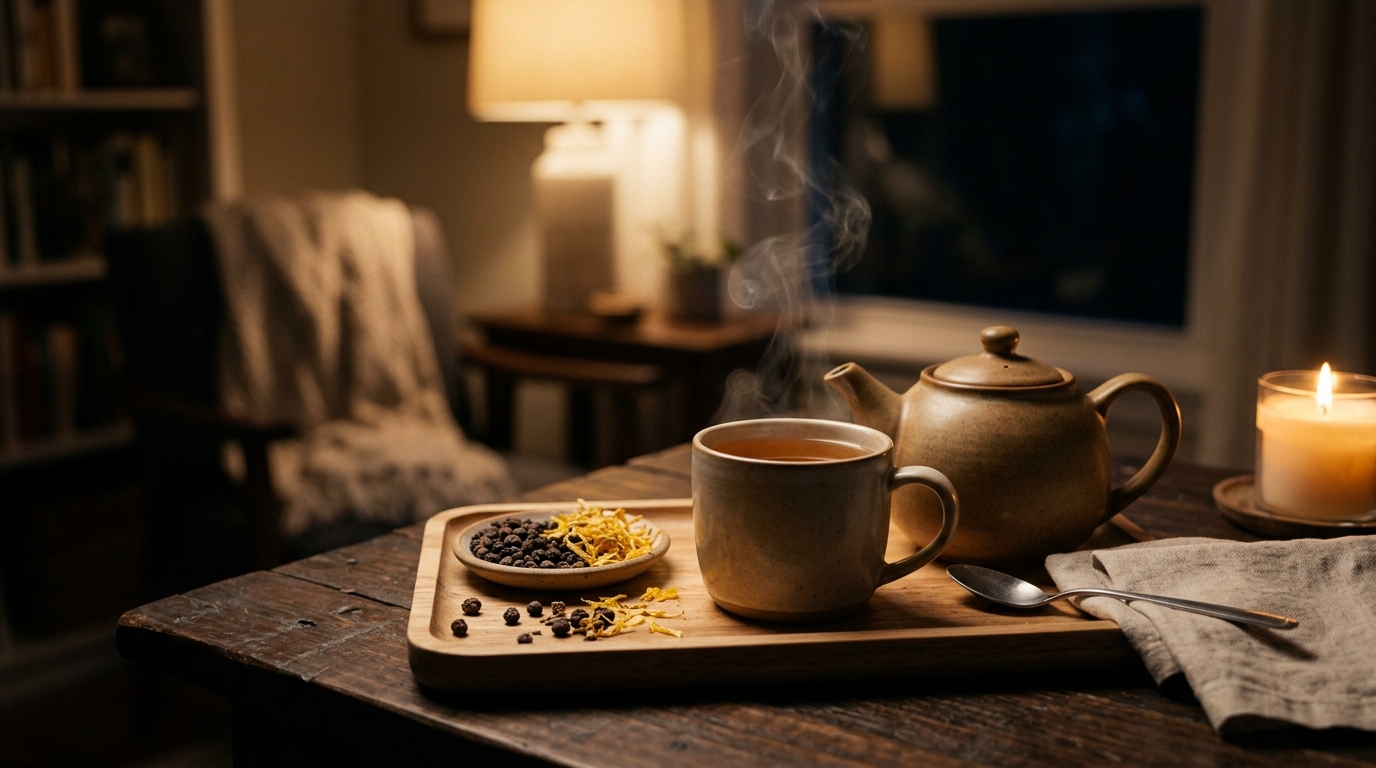
Together, the two herbs create a tea that is deeply grounding and gently spiced. Vitex brings a peppery, slightly bitter backbone, while evening primrose leaf and flower soften the cup with mild, earthy sweetness. Brewed nightly in the days leading up to your period, or throughout the cycle with a break as needed, it becomes a small act of self-care that signals the body to slow down.
2
cups
Ingredients
- 1 tspdried vitex berries, lightly crushed
- 1 tbspdried evening primrose leaf and flower
- 480 mlwater (95°C / 203°F)
- —raw honey or a slice of fresh ginger to taste (optional)
How to Brew
Click on an item below to shop for the recommended items for this recipe on Amazon.
As an Amazon Associate, we earn from qualifying purchases.
- Measure 1 teaspoon of dried vitex berries and press them lightly with the back of a spoon or a mortar and pestle to crack the outer skins without turning them to powder.
- Add the crushed vitex and 1 tablespoon of dried evening primrose leaf and flower to a teapot or French press.
- Bring fresh water to just below a boil, around 95°C (203°F), and pour 480 ml over the herbs.
- Cover the pot immediately to trap the aromatic oils and steep for 10 to 12 minutes.
- Strain through a fine mesh strainer into two mugs, pressing the herbs gently to release any remaining liquid.
- Sweeten with a little raw honey if the peppery bitterness feels strong, and sip slowly about an hour before bed.
- Lightly crush 1 teaspoon of vitex berries and combine them with 1 tablespoon of dried evening primrose in a clean glass jar.
- Pour in 480 ml of cold, filtered water and stir once to wet all of the herbs.
- Seal the jar and refrigerate for 8 to 10 hours, or overnight, giving it a gentle shake once or twice if you remember.
- Strain through a fine mesh strainer or a nut milk bag to remove all berry fragments.
- Serve over ice with a thin lemon slice, or let it come to cool room temperature if you prefer less chill.
- Store any extra in a sealed jar in the refrigerator and drink within 48 hours.
- Add 1 teaspoon of lightly crushed vitex berries and 480 ml of cold water to a small stainless steel or enameled saucepan.
- Bring to a boil over medium heat, then reduce immediately to the lowest simmer and cover with a lid.
- Simmer gently for 15 minutes, keeping the lid on to prevent the aromatic oils from escaping with the steam.
- Remove the pan from the heat, add 1 tablespoon of dried evening primrose leaf and flower, cover again, and steep for 5 minutes. The delicate leaf and flower do not need prolonged heat.
- Strain through a fine mesh strainer into a mug, pressing the berries to extract the last of the liquid.
- Add a small slice of fresh ginger or a drizzle of honey if desired and drink warm.
Health Benefits
Clinical trials, including randomized studies, suggest standardized vitex extracts can reduce PMS symptoms such as irritability, mood swings, headache, and breast fullness. Results come mostly from concentrated extracts, so a tea is a gentler version of this effect.
Vitex is thought to act on dopamine receptors in the pituitary, which can lower excess prolactin and help regulate the luteal phase of the cycle. This mechanism is the basis for its long use in cycle irregularities.
Cyclic breast pain (mastalgia) has been shown to improve with vitex in several trials. Evening primrose has a traditional reputation for the same complaint, though research on it is mixed and concerns the oil rather than the tea.
The warm, ritualistic nature of a nightly cup helps lower stress and signals the body to wind down. Flavonoids like vitexin may add a mild calming effect.
Both herbs contain polyphenols and flavonoids that neutralize free radicals in laboratory studies, supporting general cellular health.
🧪 Key Bioactive Compounds
The Science Behind Vitex
The most studied aspect of vitex is its influence on the dopaminergic system. Compounds in the berries, particularly diterpenes and flavonoids such as casticin, appear to bind to dopamine D2 receptors in the pituitary gland. This binding can reduce the release of prolactin, a hormone that, when slightly elevated in the second half of the cycle, is linked to breast tenderness and mood changes. By nudging this system toward balance, vitex may help normalize the luteal phase, which is why it is often taken consistently for several cycles.
Evening primrose is best known for gamma-linolenic acid (GLA), an omega-6 fatty acid that the body converts into anti-inflammatory prostaglandins such as PGE1. However, GLA is concentrated in the seeds and their oil, not in the leaves and flowers used for tea. The tea therefore offers a more modest contribution, mainly polyphenols such as gallic acid and ellagic acid, along with a soft, mucilaginous quality that makes the cup feel soothing. Readers seeking the GLA-related effects studied in research should know those findings apply to the oil, not the infusion.
It is worth being honest about the evidence. The best trials for vitex use standardized extracts at defined doses, which are more concentrated and consistent than a homemade tea. A nightly cup is best understood as a supportive, traditional practice that combines mild herbal activity with the proven benefits of ritual, rest, and warmth. Many people find that this combination, practiced consistently over a few months, helps them feel more settled as their cycle approaches.
Brewing Tips
- Be patient and consistent. Vitex is a slow-acting herb, and most people need to drink it daily for at least two to three cycles before judging its effects.
- Crush the vitex berries lightly just before brewing to open the hard skins and release more flavor and compounds, but avoid grinding to a fine powder.
- Drink the tea in the evening, about an hour before bed, to make it part of a wind-down routine alongside dim lights and screen-free time.
- Buy whole dried berries from a reputable supplier and store them in an airtight, dark container to protect their aromatic oils.
- Keep a simple symptom journal across your cycle so you can notice gradual changes and share them with a healthcare provider.