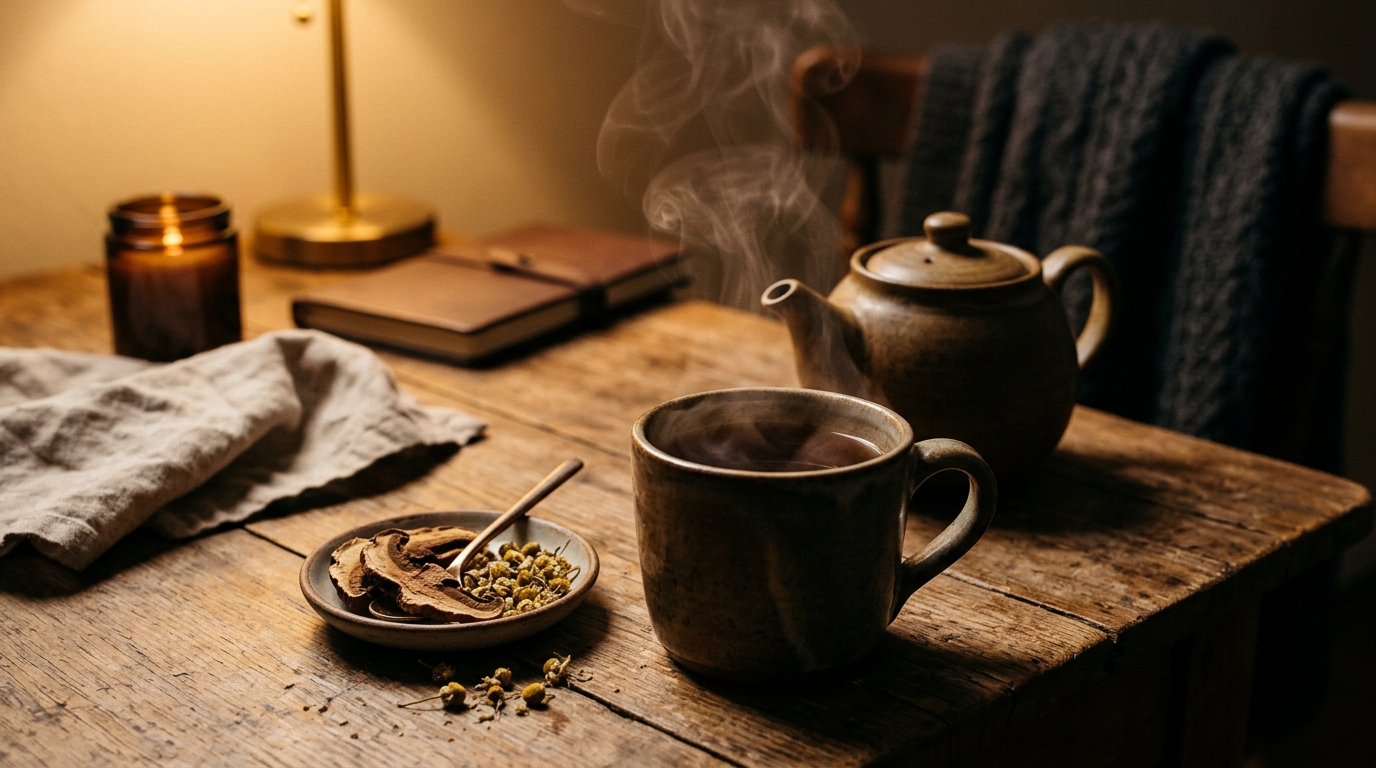
For more than two thousand years, reishi has held a place of honor in Chinese and Japanese herbal traditions. Known as lingzhi, the “spirit plant,” and mannentake, the “ten-thousand-year mushroom,” it appeared in the earliest Chinese materia medica texts and was long associated with longevity, tranquility, and a settled mind. Imperial courts prized it, and Taoist practitioners reportedly used it to quiet the spirit during meditation.
Unlike the soft mushrooms in your kitchen, reishi is a tough, lacquered bracket fungus that grows on aging hardwood trees. It is far too fibrous and bitter to eat, which is why it has traditionally been prepared as a long decoction, simmered patiently until its constituents release into the water. The resulting tea is dark, earthy, and subtly bitter, with a lingering savory depth that many drinkers come to find deeply comforting.
Today, reishi is classed as an adaptogen, a term for substances thought to help the body adapt to stress. Its reputation as an evening tea comes from both tradition and emerging research suggesting it may support relaxation and sleep quality. It will not knock you out the way a sedative might. Instead, think of it as a gentle, cumulative companion to a calming bedtime ritual.
2
cups
Ingredients
- 10 gdried reishi slices
- 600 mlfiltered water
- 1 tspraw honey or maple syrup (optional, per cup)
- —a few slices of fresh ginger or a cinnamon stick (optional)
- —a splash of oat milk (optional, for a creamier nightcap)
How to Brew
Click on an item below to shop for the recommended items for this recipe on Amazon.
As an Amazon Associate, we earn from qualifying purchases.
- Rinse the dried reishi slices briefly under cool running water to remove any surface dust.
- Add the slices and 600 ml of filtered water to a small saucepan, using a ratio of about 10 g of reishi to 600 ml of water.
- Bring the water to a boil over medium-high heat, then immediately reduce to the lowest setting so it holds a barely bubbling simmer.
- Partially cover the pot and simmer for 30 to 45 minutes. The water will reduce by about one third and turn a deep amber-brown.
- Strain the tea through a fine mesh sieve into mugs, reserving the reishi slices for a second, weaker simmer.
- Sweeten with honey or maple syrup if desired, and sip slowly about an hour before bed.
- Add 2 teaspoons of finely ground reishi (or 1 teaspoon of reishi extract powder) to a clean glass jar.
- Pour in 500 ml of cool filtered water and stir well, scraping the bottom of the jar to break up any clumps.
- Seal the jar and shake vigorously for 20 to 30 seconds, then place it in the refrigerator.
- Steep for 10 to 12 hours, giving the jar a gentle shake once or twice when you remember.
- Strain through a fine mesh sieve lined with a coffee filter or muslin cloth to remove the very fine particles.
- Serve over ice with a squeeze of lemon or a drizzle of honey, and drink within 48 hours.
- Combine 30 g of dried reishi slices with 1.5 liters of filtered water in a large, heavy-bottomed pot.
- Bring to a boil, then reduce the heat to the lowest setting and cover loosely with the lid slightly ajar.
- Simmer for 2 to 3 hours, stirring occasionally, until the liquid has reduced by roughly half and is nearly opaque and dark brown.
- Strain through a fine mesh sieve and let the concentrate cool completely to room temperature.
- Transfer to a sealed glass bottle and refrigerate for up to 5 days. You can also freeze portions in ice cube trays for up to 3 months.
- To serve, dilute 1 part concentrate with 1 to 2 parts hot water or warm oat milk, and sweeten to taste.
Health Benefits
Animal studies suggest reishi extracts may increase non-REM sleep time, and small human trials report improved sleep quality and reduced fatigue. Evidence is promising but still preliminary.
As an adaptogen, reishi is thought to help regulate the body’s stress response. Some research notes reduced fatigue and improved well-being, though larger trials are needed.
Beta-glucans and triterpenes in reishi interact with immune cells, and the mushroom has been studied for its ability to balance rather than simply boost immune activity.
Reishi’s polysaccharides and triterpenoids show free-radical scavenging activity in laboratory studies, which may contribute to its traditional reputation for longevity.
Traditional use and early research suggest reishi may help soften feelings of tension, making it a fitting addition to a wind-down ritual.
🧪 Key Bioactive Compounds
The Science Behind Reishi Mushroom
Reishi’s reputation rests on two main families of compounds: polysaccharides and triterpenoids. The polysaccharides, especially beta-glucans, are water-soluble, which is why a long simmer is the traditional preparation. These large molecules interact with receptors on immune cells and are responsible for much of reishi’s studied immunomodulating activity. The triterpenoids, including the ganoderic and lucidenic acids, are responsible for the mushroom’s characteristic bitterness and are linked in laboratory research to anti-inflammatory and calming effects.
The sleep connection is intriguing but still developing. In rodent studies, certain reishi extracts increased total sleep time and non-REM sleep, possibly through effects on neurotransmitter pathways and inflammatory signaling. A few small human studies have found improvements in perceived fatigue, well-being, and sleep quality, but these trials are limited in size and duration, and results vary by preparation and dose.
It is worth being honest about what this means for your evening cup. Reishi is not a sedative, and its effects are subtle and cumulative rather than immediate. Many people find its greatest value lies in the ritual itself: the slow simmering, the earthy aroma, and the deliberate pause it creates before bed. Combined with good sleep habits, a warm cup of reishi tea can be a meaningful part of a wind-down routine.
Brewing Tips
- Save your used reishi slices and simmer them a second time with fresh water, since the tough fruiting body still has plenty to give. Expect a lighter but still useful second batch.
- Choose reishi sold as whole dried slices or high-quality extract powder, and look for products labeled as fruiting body rather than mycelium on grain, which contains less of the beneficial compounds.
- Drink your reishi tea 60 to 90 minutes before bed, consistently, for at least two to three weeks to give its cumulative effects a fair chance to show.