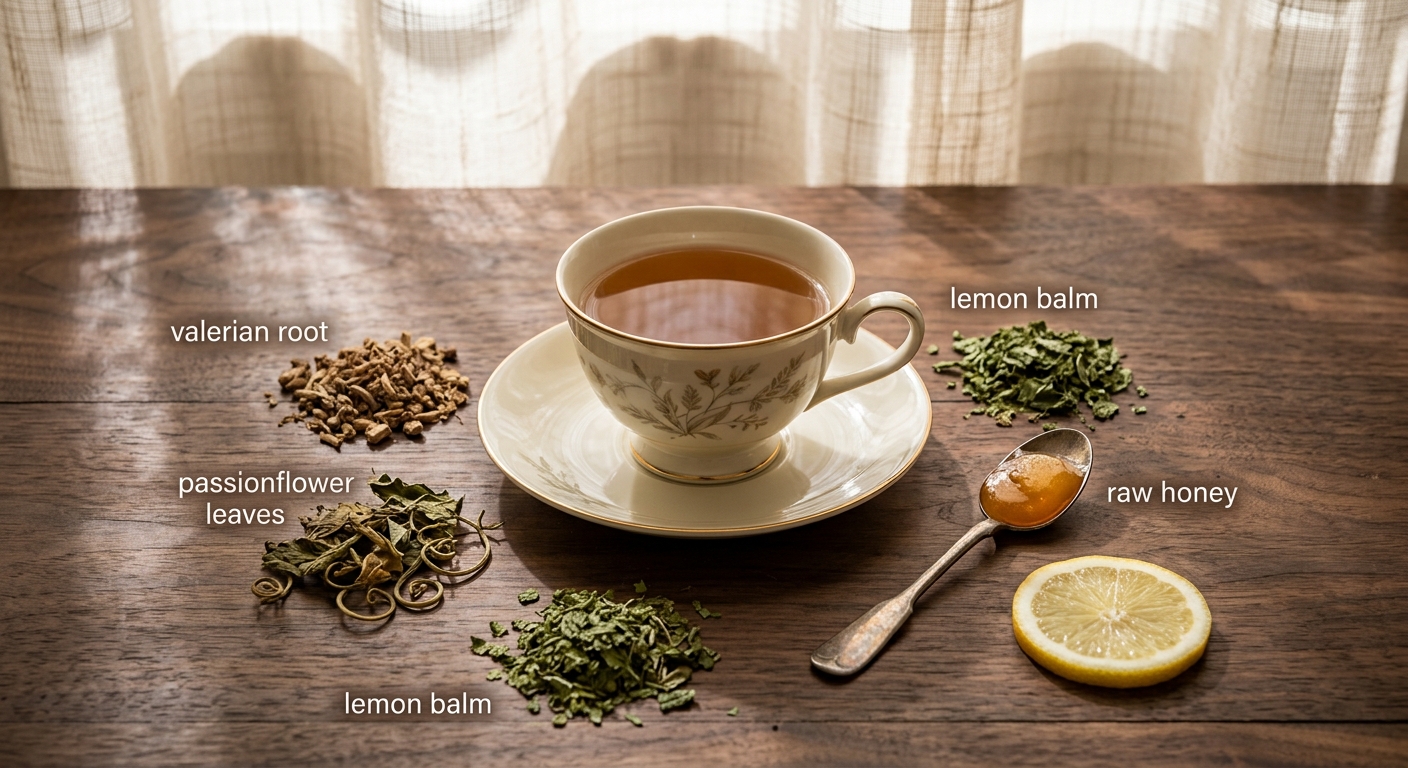
Long before pharmaceutical sleep aids existed, healers across Europe, Asia, and the Americas turned to the plant world for relief from sleepless nights. Valerian root was prescribed in ancient Greece by Hippocrates himself, passionflower was used by Indigenous peoples of the Americas to calm anxiety and induce sleep, and lemon balm has been a staple of European monastic medicine since the Middle Ages. This insomnia relief blend draws on centuries of botanical wisdom, uniting three of the most well-studied sleep herbs into a single, deeply calming cup.
What makes this blend particularly effective is the way each herb addresses a different dimension of sleeplessness. Valerian root targets the nervous system directly, promoting sedation and reducing the time it takes to fall asleep. Passionflower quiets the mind, making it especially useful for people who lie awake with anxious or looping thoughts. Lemon balm brings a gentle, brightening lift to the blend, softening the earthy depth of valerian and reducing the stress hormones that can keep the body in a state of alertness at bedtime. Together, they form a synergistic, well-rounded sleep formula that is both pleasant to drink and genuinely effective.
The sensory experience of this tea is part of its medicine. The warm, slightly woody aroma of valerian mingles with the grassy sweetness of lemon balm and the faintly floral notes of passionflower to create something that smells unmistakably like calm. Brewing this tea can itself become a sleep ritual, a deliberate slowing down that signals to your body and mind that the day is done and rest is on its way.
2
cups
Ingredients
- 2 tspdried valerian root
- 1.5 tspdried passionflower herb
- 1.5 tspdried lemon balm leaves
- 500 mlwater (90°C / 194°F)
- —raw honey or stevia to taste (optional)
- —a slice of fresh lemon (optional)
How to Brew
Click on an item below to shop for the recommended items for this recipe on Amazon.
As an Amazon Associate, we earn from qualifying purchases.
- Measure 2 tsp dried valerian root, 1.5 tsp dried passionflower, and 1.5 tsp dried lemon balm into a tea infuser or teapot. If using a teapot, add the herbs directly and plan to strain before pouring.
- Heat 500 ml of filtered water to 90 to 95°C (194 to 203°F). If you do not have a temperature-controlled kettle, bring water to a full boil and allow it to rest for 90 seconds before pouring.
- Pour the hot water over the herbs, cover the teapot or mug with a lid or small plate to trap the aromatic volatile oils, and steep for 10 to 15 minutes. The longer you steep, the more potent and sedating the result.
- Remove the infuser or strain the tea through a fine mesh strainer into your mug. The tea should appear a rich amber-gold with warm earthy tones.
- Sweeten lightly with raw honey or stevia if desired. A small squeeze of lemon brightens the flavor and slightly reduces any bitterness from the valerian. Drink slowly 30 to 60 minutes before bedtime.
- Combine 2 tsp dried valerian root, 1.5 tsp dried passionflower, and 1.5 tsp dried lemon balm in a clean glass jar. Use a slightly heaped measure since cold water extracts more slowly than hot.
- Pour 500 ml of cold, filtered water over the herbs at room temperature. Stir briefly to ensure all the dried material is submerged and moistened.
- Seal the jar with a lid and let it rest at room temperature for 1 hour to allow initial extraction to begin, then transfer to the refrigerator.
- Steep in the refrigerator for a total of 8 to 12 hours, ideally overnight. The resulting tea will be noticeably less earthy and more delicate in flavor than the hot-brewed version.
- Strain through a fine mesh strainer or cheesecloth into a glass. Serve over ice for a cool evening drink, or gently warm in a small saucepan on low heat (do not simmer) for a warm nighttime cup. Sweeten to taste with honey dissolved in a small splash of warm water.
- Place 2 tsp dried valerian root into a small saucepan with 600 ml of cold, filtered water. Starting in cold water allows the root fibers to soften gradually and improves extraction of active compounds.
- Bring the water to a gentle simmer over medium heat, then reduce the heat to maintain a steady simmer at approximately 85 to 90°C (185 to 194°F). Avoid a vigorous rolling boil, which can destroy some heat-sensitive compounds.
- Simmer the valerian root uncovered for 20 to 25 minutes. The liquid will reduce by roughly 100 ml and deepen in color to a dark amber. The aroma will be earthy and pronounced.
- Remove the saucepan from heat. Add 1.5 tsp dried passionflower and 1.5 tsp dried lemon balm directly to the hot decoction, then cover the saucepan with a lid. Allow the blend to rest and infuse for 10 minutes.
- Strain the decoction through a fine mesh strainer into mugs, pressing gently on the herbs to extract remaining liquid. You should yield approximately 400 to 450 ml of concentrated, potent tea across two servings. Sweeten with honey if desired and drink 45 to 60 minutes before bed for maximum effect.
Health Benefits
Multiple randomized controlled trials have found that valerian root supplementation significantly reduces sleep latency, the time it takes to fall asleep, compared to placebo. A 2002 study published in Pharmacology, Biochemistry and Behavior found that a combination of valerian and lemon balm was as effective as the prescription sedative triazolam at 0.125 mg for improving sleep quality.
Passionflower has been shown in clinical trials to reduce generalized anxiety symptoms comparably to low-dose oxazepam, a pharmaceutical anxiolytic, making it particularly useful for sleep that is disrupted by an overactive mind. Lemon balm complements this effect by reducing the activity of the stress-response HPA axis.
Unlike many pharmaceutical sleep aids, the compounds in this herbal blend, particularly the flavonoids from passionflower, modulate rather than suppress GABA activity. This produces a more natural quality of sleep that does not impair next-morning alertness or cognitive function, as supported by several small human trials.
Rosmarinic acid in lemon balm has demonstrated measurable reductions in cortisol-related stress markers in clinical studies. Regular evening use of this blend may help regulate a chronically overactivated stress response, making sustained sleep improvement more achievable over time.
A combination study of valerian and hops, a botanical relative in the sedative herb family, found significant improvements in sleep consolidation. The synergistic GABA-modulating activity of valerian and passionflower in this blend similarly supports uninterrupted sleep architecture through the night.
🧪 Key Bioactive Compounds
The Science Behind Valerian Root
The sedative power of this blend is rooted in its multi-pronged action on the GABAergic system, the brain’s primary inhibitory signaling network. Gamma-aminobutyric acid, or GABA, is the neurotransmitter responsible for calming neural activity, and insufficient GABA function is one of the key physiological drivers of insomnia and anxiety. Valerian root’s valerenic acid inhibits the enzyme that breaks GABA down, while rosmarinic acid from lemon balm blocks the enzyme GABA transaminase, and the flavonoid glycosides from passionflower bind directly to GABA-A receptor sites. The result is a coordinated, gentle amplification of the brain’s own calming chemistry without the receptor suppression or dependency associated with pharmaceutical GABA modulators like benzodiazepines.
Beyond GABA, the herbs in this blend also act on the hypothalamic-pituitary-adrenal (HPA) axis, the central stress regulation system. Elevated evening cortisol is one of the most common physiological barriers to sleep onset, and chronic stress keeps the HPA axis dysregulated long after immediate stressors have passed. Luteolin, a flavonoid present in both lemon balm and passionflower, has demonstrated the ability to downregulate cortisol production and reduce neuroinflammation, which is increasingly recognized as a contributing factor in insomnia. By addressing the hormonal side of sleeplessness as well as the neurological, this blend works on a broader level than single-herb preparations.
Research on the individual herbs in this blend is encouraging, and studies examining synergistic combinations are particularly compelling. A pivotal double-blind, placebo-controlled trial published in Phytomedicine found that a standardized combination of valerian and lemon balm significantly improved sleep quality, reduced sleep latency, and decreased nocturnal awakenings in participants with mild-to-moderate insomnia. A separate randomized trial found passionflower tea to be superior to placebo in improving subjective sleep quality as measured by the Pittsburgh Sleep Quality Index. While most clinical studies use standardized extracts rather than whole-herb teas, traditional use spanning centuries across multiple cultures, combined with growing pharmacological evidence, supports this blend as a meaningful and evidence-informed approach to natural sleep support.
Brewing Tips
- Use filtered water whenever possible. Chlorine and mineral impurities in tap water can interfere with the delicate volatile compounds in lemon balm and passionflower, dulling the aroma and flavor of the finished tea.
- Prepare your tea as part of a dedicated wind-down ritual. Dim the lights, put your phone away, and drink the tea slowly and mindfully. The behavioral cue of a consistent pre-sleep routine amplifies the physiological effects of the herbs by reinforcing your body’s circadian associations with sleep.
- Store dried herbs in airtight glass jars away from light and heat. Valerian root in particular loses potency quickly when exposed to air and moisture. Properly stored, this blend will retain full efficacy for up to 12 months.