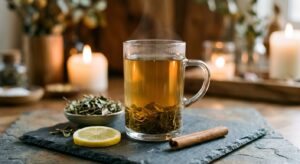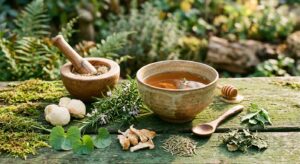
For more than three thousand years, holy basil (Ocimum tenuiflorum, also called tulsi) has held a place of honor in India. Grown in courtyards and temple gardens, it is revered as a sacred plant and used in Ayurvedic medicine as an adaptogen, a plant believed to help the body adapt to stress. Traditional texts describe it as a tonic for the mind, the breath, and the spirit, and many households still brew a cup of tulsi at dusk.
Rosemary (Salvia rosmarinus, formerly Rosmarinus officinalis) has an equally storied reputation in the West. Ancient Greek students were said to wear rosemary garlands while studying, and Shakespeare’s Ophelia declared, “There’s rosemary, that’s for remembrance.” For centuries, the herb has been tied to memory, alertness, and mental clarity, a reputation that modern research on its aroma and compounds has begun to explore.
Together, these two herbs create a rare evening tea: one that does not sedate you into sleep, nor jolt you with caffeine, but instead holds you in a state of calm attention. Holy basil softens the edges of a stressful day with its clove-like warmth, while rosemary adds a resinous, pine-bright lift. It is a ritual cup for the writer finishing a chapter, the student reviewing notes, or anyone who needs to stay clear-headed after sunset without disrupting the night ahead.
2
cups
Ingredients
- 2 tspdried holy basil (tulsi) leaves
- 1 tspdried rosemary leaves
- 480 mlwater (95°C / 203°F)
- —1 thin slice of fresh lemon (optional)
- —raw honey to taste (optional)
How to Brew
Click on an item below to shop for the recommended items for this recipe on Amazon.
As an Amazon Associate, we earn from qualifying purchases.
- Measure the dried holy basil and rosemary into a teapot or infuser basket. Lightly crush the rosemary needles between your fingers first to release their aromatic oils.
- Bring fresh water to a full boil, then let it rest for about 30 seconds so it settles near 95°C (203°F). Rosemary is sturdy and tolerates heat, and tulsi needs it to release its volatile compounds.
- Pour the water over the herbs and cover immediately with a lid or saucer. Covering traps the aromatic steam, which carries much of the herbs’ character and would otherwise escape.
- Steep for 5 to 7 minutes. Five minutes yields a gentle, floral cup; seven brings out more of the rosemary’s resinous, camphor-like edge.
- Strain into two mugs. Add a thin slice of lemon or a little raw honey if you like, and inhale the steam before the first sip.
- Combine the dried holy basil and rosemary in a clean glass jar. Add 480 ml of cold, filtered water and stir gently to wet all of the leaves.
- Seal the jar and let it sit on the counter for 30 minutes, then transfer it to the refrigerator. This brief start at room temperature gets extraction going before the cold slows it.
- Steep in the refrigerator for 8 to 12 hours, or overnight. Shake the jar gently once or twice if you pass by it.
- Strain through a fine mesh sieve into a clean pitcher or glass, pressing lightly on the leaves to release the last of the liquid.
- Serve over ice or straight from the fridge. Drink within 48 hours for the best flavor, keeping the jar sealed and chilled.
- Add the rosemary and 480 ml of cold water to a small saucepan. Starting the rosemary in cold water allows the sturdy, woody needles to release their compounds gradually as the water warms.
- Bring the pan slowly to a gentle simmer over medium-low heat, with small bubbles just breaking the surface rather than a rolling boil. Simmer uncovered for 5 minutes.
- Remove the pan from the heat and stir in the holy basil. Tulsi’s leaves are more delicate and are added off the heat so their volatile oils are preserved.
- Cover the pan and let it rest for 5 minutes while the tulsi steeps in the hot rosemary-infused water.
- Strain through a fine sieve into a warmed mug. The tea will be slightly deeper in color and more robust than the hot brew. Sweeten lightly with honey if desired.
Health Benefits
Holy basil is a well-known adaptogen, and small human trials suggest it may reduce feelings of stress and lower perceived anxiety, likely by modulating cortisol and stress-related pathways.
Rosemary’s aroma compound 1,8-cineole has been associated with improved attention and working memory in small studies, supporting its long-standing use as an herb of focus.
Both herbs are rich in rosmarinic acid, eugenol, and flavonoids that neutralize free radicals, which may help protect tissues from everyday oxidative stress.
Traditionally, both tulsi and rosemary are used to soothe bloating and settle the stomach after meals, which can make an evening cup a comfortable ending to dinner.
Because neither herb contains caffeine, this tea can support evening concentration without interfering with sleep, making it a gentle alternative to coffee or black tea after dark.
🧪 Key Bioactive Compounds
The Science Behind Holy Basil
The appeal of this blend lies in how its two herbs work on the mind from different directions. Holy basil contains a rich mix of phenolic compounds, including eugenol, rosmarinic acid, apigenin, and ursolic acid. Clinical research on tulsi, though still limited and often small in scale, has pointed to reductions in self-reported stress, anxiety, and fatigue. Researchers believe these effects may come from the plant’s influence on the hypothalamic-pituitary-adrenal axis, the body’s central stress-regulation system, which is why tulsi is classed as an adaptogen.
Rosemary approaches focus from the aromatic side. Its essential oil is dominated by 1,8-cineole, a compound that is inhaled with every sip of a hot cup. In a frequently cited 2012 study from Northumbria University, participants exposed to rosemary aroma showed improved performance on memory and attention tasks, and higher blood levels of 1,8-cineole correlated with better results. Rosemary also contains carnosic acid and rosmarinic acid, antioxidants being investigated for their potential to protect brain cells from oxidative damage.
It is worth noting that much of the evidence for both herbs comes from small studies, animal research, and traditional use rather than large clinical trials. A cup of this tea is best viewed as a supportive daily ritual rather than a treatment. Still, the combination of calming adaptogenic compounds and alertness-linked aromatics, without any caffeine, gives this blend a thoughtful logic for evening work.
Brewing Tips
- Crush the rosemary needles lightly before brewing to release more of their essential oils and deepen the aroma.
- Always cover your cup or pot while steeping so the volatile aromatic compounds stay in the tea rather than drifting away as steam.
- Use rosemary sparingly, as one teaspoon is plenty. Too much makes the tea overly resinous and camphor-sharp, which can overwhelm the gentler tulsi.
- If you grow either herb, fresh leaves work beautifully: use a small handful of tulsi and one 5 cm (2 inch) sprig of rosemary in place of the dried amounts.
- Pour the tea into a favorite mug and take a moment to inhale before sipping. The aroma itself is part of the focus ritual.