Valerian (Valeriana officinalis) has been used as a calming remedy for well over a thousand years. Hippocrates described it, Galen recommended it for insomnia, and by the Middle Ages it was a staple of European folk medicine. Its pungent, earthy aroma, often compared to well-worn wool socks, is part of its character, and cats famously adore it. Herbalists classify valerian as a nervine sedative, a plant that acts on the nervous system to reduce tension and encourage sleep.
Skullcap (Scutellaria lateriflora), also called American skullcap, is a native North American mint-family herb. It was used by Eclectic physicians in the 19th century as a nervine tonic for restlessness, nervous tension, and the kind of frazzled wakefulness that comes from an overactive mind. Its flavor is mild, slightly bitter, and green, which makes it a gentle partner for valerian’s stronger personality.
Brewed together, the two herbs complement each other well. Valerian provides the deeper sedative pull, while skullcap softens mental chatter and nervous agitation. A touch of orange peel or mint rounds out the cup, making this evening blend more pleasant to sip than valerian alone. Drink it about 30 to 60 minutes before bed as part of a wind-down ritual.
2
cups
Ingredients
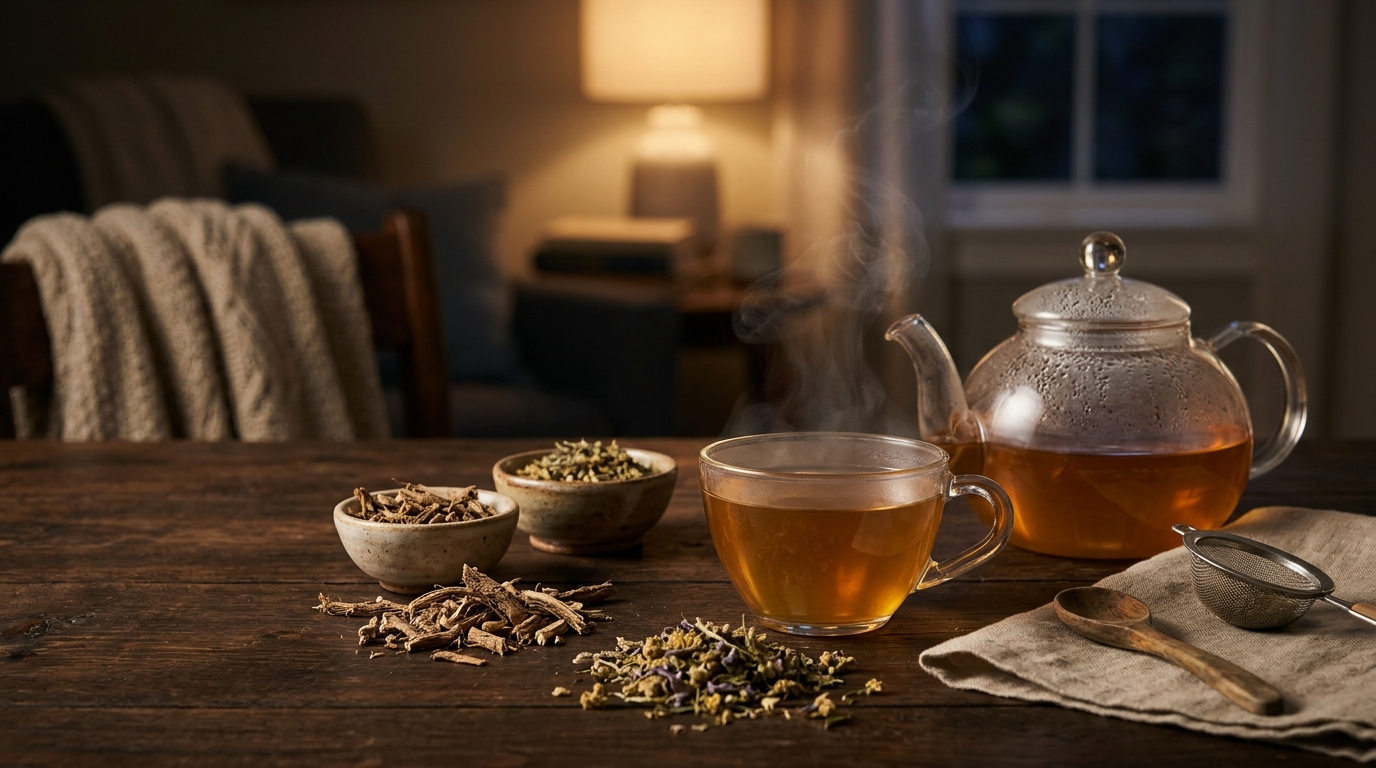
- 2 tspdried valerian root, cut and sifted
- 2 tspdried skullcap aerial parts
- 1 tspdried orange peel or dried peppermint (to improve flavor)
- 480 mlwater (95°C / 203°F)
- —raw honey or a slice of lemon to taste (optional)
How to Brew
Click on an item below to shop for the recommended items for this recipe on Amazon.
As an Amazon Associate, we earn from qualifying purchases.
- Measure the valerian root, skullcap, and orange peel into a teapot or large mug fitted with a fine mesh infuser.
- Bring fresh water to a boil, then let it rest for about 30 seconds so it settles near 95°C (203°F).
- Pour the hot water over the herbs, making sure all the plant material is submerged.
- Cover the vessel immediately with a lid or small saucer to hold in the volatile oils and steam.
- Steep for 10 to 15 minutes. The longer end of the range gives a stronger, more sedative cup, but also a more bitter and earthy one.
- Strain thoroughly, stir in honey or a squeeze of lemon if desired, and sip slowly 30 to 60 minutes before bed.
- Combine 2 tablespoons of valerian root, 2 tablespoons of skullcap, and 1 tablespoon of dried orange peel in a glass jar.
- Pour in 1 liter of cool, filtered water and stir gently so all the herbs are wetted.
- Seal the jar and refrigerate for 8 to 12 hours, ideally overnight.
- Strain through a fine mesh sieve lined with muslin to catch the small root particles.
- Serve over ice or at cool room temperature, with a slice of orange or a mint sprig if you like.
- Drink within 48 hours and keep refrigerated, as cold herbal infusions spoil more quickly than hot ones.
- Add 1 tablespoon of dried valerian root to a small saucepan with 500 ml of cold water.
- Bring to a gentle simmer over medium heat, then reduce the heat to low and cover with a lid.
- Simmer gently for 15 minutes, keeping the lid on to retain the aromatic compounds.
- Remove the pan from the heat, add 2 teaspoons of skullcap and 1 teaspoon of orange peel, then replace the lid.
- Let everything steep off the heat for 10 minutes.
- Strain through a fine sieve into a mug, sweeten if desired, and drink while warm. This method yields the strongest, most robust cup of the three.
Health Benefits
Valerian’s interaction with the GABA system may shorten the time it takes to fall asleep. Clinical evidence is mixed, but several reviews suggest modest benefits for subjective sleep quality, particularly with consistent use over several weeks.
Skullcap has a long history as a nervine for restlessness and anxious thoughts. Early human studies suggest it may improve mood and reduce anxiety, though larger trials are needed.
Valerian has traditionally been used as an antispasmodic. Its calming action on the nervous system may help release physical tightness that keeps the body from settling at night.
The pairing targets both physical and mental restlessness. Valerian provides sedation while skullcap is traditionally used for the looping, overactive thoughts that interfere with sleep.
Beyond the plant chemistry, preparing and sipping a warm cup at a consistent time each evening cues the body that rest is coming, which strengthens sleep habits.
🧪 Key Bioactive Compounds
The Science Behind Valerian Root
Valerian’s sedative reputation rests largely on its effects on the GABA system, the brain’s primary inhibitory neurotransmitter pathway. Valerenic acid appears to bind to a specific site on GABA-A receptors, enhancing inhibitory signaling, while other constituents may reduce the enzymatic breakdown of GABA. Valerian also contains flavonoids such as linarin and hesperidin that may act on adenosine and serotonin receptors, adding further layers to its calming action. Because valerian is a complex mixture, no single compound fully explains its effects.
Clinical results for valerian have been inconsistent. Some trials and meta-analyses show improvements in sleep latency and self-reported sleep quality, while others find no significant difference from placebo. Differences in preparation, dose, and study design likely contribute. Many users report that benefits build gradually over two to four weeks rather than appearing after a single cup.
Skullcap’s activity is attributed mainly to flavonoids including baicalin, baicalein, and scutellarin, which have shown GABAergic and antioxidant activity in laboratory and animal studies. A small human trial found that skullcap improved mood without reducing alertness, but the overall clinical evidence base is limited. Herbalists value it as a gentle partner to stronger sedatives, taking the edge off nervous tension without heavy sedation.
Brewing Tips
- Choose cut-and-sifted or coarsely chopped valerian root rather than powder, which turns the tea cloudy and increases bitterness.
- Store valerian root in an airtight, opaque container away from heat and light, as its aromatic compounds fade over time.
- Drink the tea 30 to 60 minutes before bed and keep the lights low while you sip to support the relaxation response.
- If the smell is off-putting, increase the orange peel or add a few mint leaves, which mask the earthiness without changing the effect.
- Give it consistent use for a couple of weeks before judging its effect, since valerian often works better with regular evening use than as a one-off.