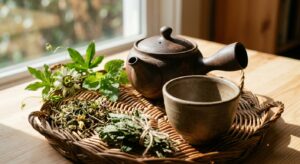
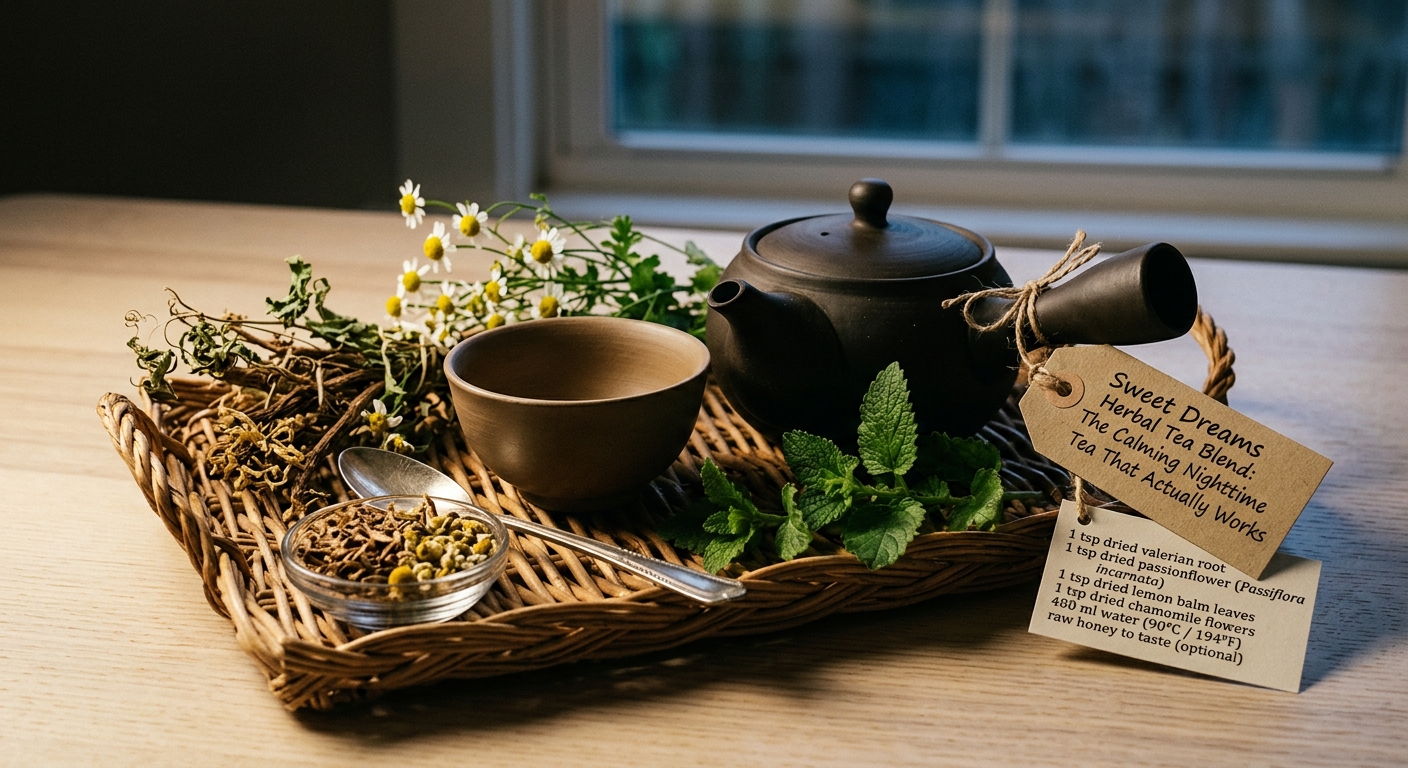
Long before pharmaceutical sleep aids existed, healers across Europe, Asia, and the Americas turned to the plant world for help winding down at the end of the day. Valerian root was prescribed by Greek physicians as far back as the second century, passionflower was used by Indigenous peoples of the Americas to calm nervous tension, lemon balm was grown in monastery gardens as a remedy for restless minds, and chamomile was brewed by Egyptian healers who considered it sacred to the sun god Ra. The Sweet Dreams blend brings these four time-honored herbs together into a single cup that is greater than the sum of its parts.
What makes this blend so effective is the way each herb targets a slightly different pathway in the nervous system. Valerian root works deeply on GABA receptors to quiet neural overactivity, passionflower soothes racing thoughts and anxious rumination, lemon balm lifts mood while reducing cortisol, and chamomile provides gentle muscle relaxation and digestive calm. Together, they create a layered, whole-body unwinding that eases you toward sleep naturally and without the grogginess associated with synthetic sleep aids.
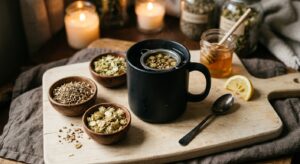
Sensory experience matters at bedtime, and this blend delivers. The earthy, slightly musky depth of valerian root is beautifully balanced by the floral sweetness of chamomile and passionflower, while lemon balm contributes a clean, citrusy brightness that keeps the cup feeling refreshing rather than heavy. A spoonful of raw honey and a thin slice of fresh lemon can transform it into something genuinely luxurious, a cup you will actually look forward to as the final ritual of your evening.
2
cups
Ingredients
- 1 tspdried valerian root
- 1 tspdried passionflower (Passiflora incarnata)
- 1 tspdried lemon balm leaves
- 1 tspdried chamomile flowers
- 480 mlwater (90°C / 194°F)
- —raw honey to taste (optional)
- —thin slice of fresh lemon (optional)
How to Brew
Click on an item below to shop for the recommended items for this recipe on Amazon.
As an Amazon Associate, we earn from qualifying purchases.
- Heat filtered water to 90 to 93°C (194 to 200°F). If you do not have a temperature-controlled kettle, bring water to a full boil, then remove from heat and let it rest for 2 to 3 minutes before pouring.
- Combine the dried valerian root, passionflower, lemon balm, and chamomile in a tea infuser or a heatproof teapot. Use 2 teaspoons of the blend per 240 ml of water, so 4 teaspoons total for two servings.
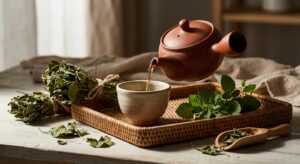
- Pour the hot water over the herbs, covering the infuser completely. Place a small saucer or lid over the top of the mug or teapot to trap the aromatic steam, which carries a significant portion of the calming volatile oils.
- Steep for 7 to 10 minutes. The longer end of this range will produce a deeper, more sedative cup. Start with 7 minutes if you are new to valerian root, as its earthy potency can be strong.
- Remove the infuser or strain the loose herbs using a fine mesh strainer. Stir in raw honey if desired, and add a squeeze of lemon to brighten the cup. Drink 30 to 45 minutes before bedtime for best results.
- Combine 4 teaspoons of the dried blend (1 teaspoon each of valerian root, passionflower, lemon balm, and chamomile) in a glass jar. Use 2 teaspoons per 240 ml of cold filtered water, so add 480 ml total for two servings.
- Pour cold, filtered water directly over the herbs. There is no need to heat the water. Stir gently to ensure all the herbs are fully submerged and saturated.
- Seal the jar with a lid and let it steep at room temperature for 1 hour to begin extraction. Then transfer the jar to the refrigerator and steep for a further 7 to 11 hours, ideally overnight.
- In the morning or before your intended use, strain the cold brew through a fine mesh strainer or cheesecloth into a clean jar or pitcher, pressing the herbs gently to extract the remaining liquid.
- Serve over ice or gently warmed in a small saucepan (do not boil). Sweeten with honey or a few drops of vanilla extract if desired. Store any unused portion in the refrigerator for up to 48 hours.
- Combine 8 teaspoons of the dried blend in a heatproof glass jar or small saucepan. Use a higher herb-to-water ratio than you would for a standard cup, adding only 480 ml of water heated to 90 to 93°C for a concentrated result.
- Pour the hot water over the herbs, stir to submerge, then cover tightly and steep for 15 to 20 minutes. The extended steep time draws out a fuller spectrum of active compounds from all four herbs, especially the valerenic acids in the valerian root.
- Strain the concentrate through a fine mesh strainer or cheesecloth into a clean glass jar with a lid. Press the spent herbs firmly to extract every drop. Allow the concentrate to cool completely before sealing.
- Store the sealed jar in the refrigerator for up to 5 days. Each evening, measure approximately 60 to 80 ml of concentrate into a mug and dilute with 160 to 180 ml of hot water, warm oat milk, or warm almond milk to taste.
- Add raw honey, a pinch of cinnamon, or a drop of pure vanilla extract to the diluted cup if desired. The milk-based version creates a particularly luxurious, latte-like nighttime drink reminiscent of a traditional herbal moon milk.
Health Benefits
Valerian root has been shown in multiple clinical studies to reduce sleep latency (the time it takes to fall asleep) and improve sleep quality, particularly in people with mild insomnia. When combined with lemon balm, as in a well-known German clinical trial, the effect is significantly stronger than either herb alone.
Passionflower has demonstrated anxiolytic effects in clinical trials comparable to low-dose oxazepam for generalized anxiety disorder, but without the side effects or dependency risk. Lemon balm further amplifies this by elevating mood and reducing cortisol levels, making the blend effective for calming pre-sleep worry.
Chamomile contains antispasmodic compounds including apigenin and bisabolol that relax smooth muscle in the gastrointestinal tract, relieving bloating, cramping, and indigestion that can interfere with comfortable sleep. Lemon balm also has carminative properties that reduce gas and stomach tension.
Regular evening consumption of lemon balm has been shown in controlled studies to reduce perceived stress and improve mood in healthy adults. The herb modulates the hypothalamic-pituitary-adrenal axis, helping to lower elevated cortisol associated with chronic stress and disrupted sleep cycles.
Both passionflower and lemon balm have mild hypotensive properties, helping to lower mildly elevated blood pressure through vasodilation and nervous system calming. This makes the blend especially useful for people whose inability to sleep is tied to cardiovascular tension or stress-related hypertension.
🧪 Key Bioactive Compounds
The Science Behind Valerian Root, Passionflower, Lemon Balm, And Chamomile
The sedative and anxiolytic power of the Sweet Dreams blend rests on a shared biochemical mechanism across all four herbs: the potentiation of gamma-aminobutyric acid (GABA), the brain’s primary inhibitory neurotransmitter. When GABA activity is high, neuronal firing slows, anxiety decreases, muscle tension releases, and the transition into sleep becomes far easier. Valerian root’s signature compound valerenic acid directly inhibits GABA-T, the enzyme responsible for breaking GABA down, causing it to accumulate in synaptic gaps. Simultaneously, rosmarinic acid in lemon balm performs a similar enzyme-inhibiting role. The result is a double-action GABA amplification that outperforms either herb working alone, a synergy confirmed in a 2006 randomized controlled trial published in Phytotherapy Research that found the combination significantly more effective for sleep than valerian root used without lemon balm.
Passionflower adds a third dimension to this GABA-boosting strategy. Its flavonoid glycosides, particularly vitexin and isovitexin, act as partial agonists at the GABA-A receptor, the same receptor family targeted by benzodiazepine drugs. Unlike pharmaceutical benzodiazepines, however, these plant compounds bind at a different site on the receptor and do not produce tolerance, dependency, or rebound insomnia with regular use. A double-blind clinical trial published in Phytotherapy Research in 2001 found that passionflower tea was as effective as low-dose oxazepam for treating generalized anxiety disorder over a four-week period, with significantly fewer side effects related to impaired job performance. Chamomile’s apigenin rounds out this receptor-based activity by binding to benzodiazepine receptor sites with a mild affinity, contributing to gentle muscle relaxation and reduced sleep onset time.
Beyond GABA, the blend also engages the serotonergic system. Lemon balm’s rosmarinic acid has been shown in animal models to modulate serotonin receptor subtypes involved in mood regulation and sleep-wake cycling. Citronellal, the compound responsible for lemon balm’s distinctive citrus scent, has demonstrated anxiolytic activity in inhalation studies, meaning that even breathing in the steam from your mug contributes measurably to the calming effect. This is why covering your mug during steeping is not merely a temperature-preservation trick but a genuine way to maximize the therapeutic value of the cup you are about to drink.
Brewing Tips
- Pre-measure your nightly blend into small reusable tins or paper envelopes at the start of each week so your bedtime ritual requires zero effort and preparation does not disrupt your wind-down mood.
- The earthy, slightly musty smell of valerian root is normal and does not mean the herb has gone bad. If the aroma is too strong for your liking, reduce the valerian to half a teaspoon and increase the chamomile or lemon balm to compensate.
- Drink your Sweet Dreams tea as part of a consistent pre-sleep routine at the same time each evening. The herbs work best when the body learns to associate the ritual, the aroma, and the warmth of the cup with the signal that sleep is approaching, creating a powerful conditioned relaxation response over time.