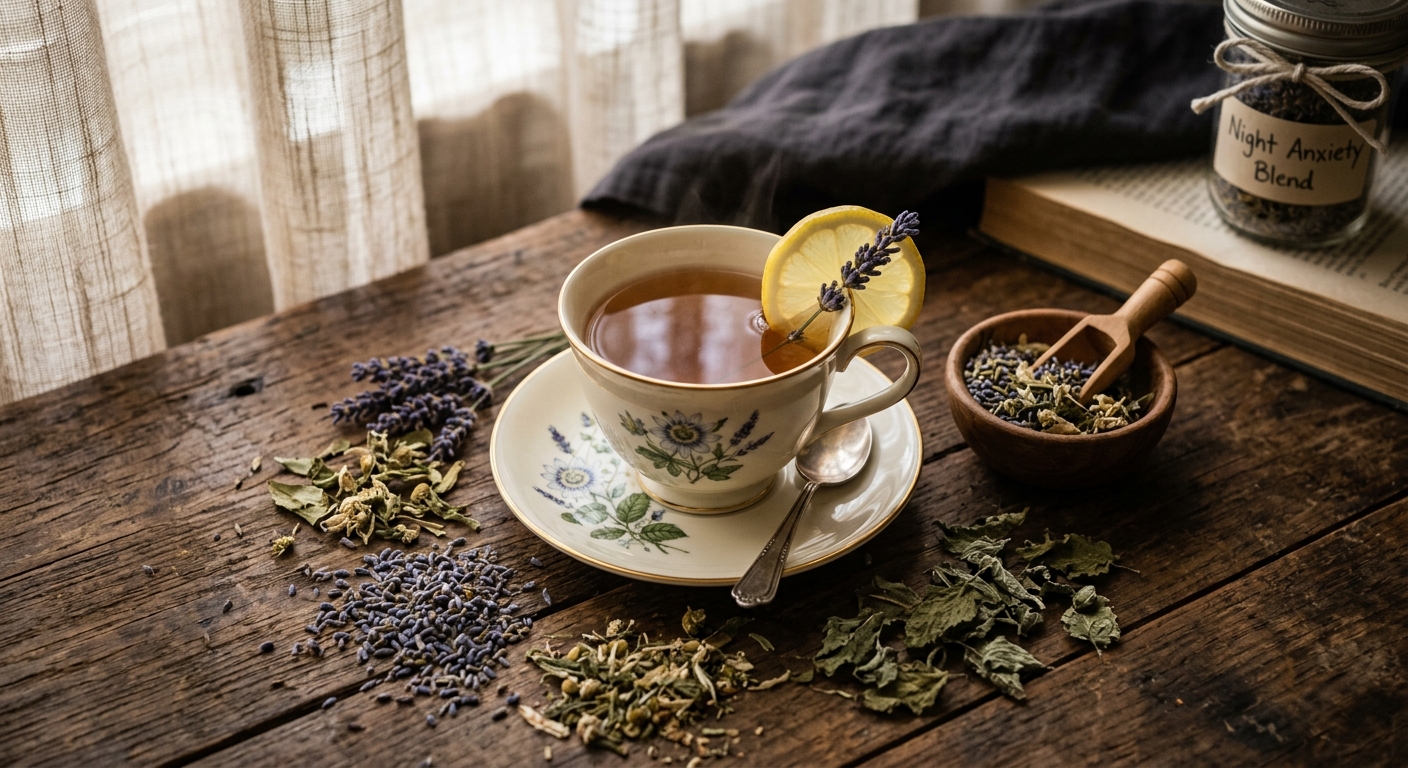
When the day winds down but the mind refuses to follow, a carefully crafted herbal tea can act as a gentle bridge between waking anxiety and deep, restorative sleep. Night anxiety tea draws on centuries of plant medicine tradition, combining passionflower, lemon balm, and lavender into a blend that herbalists across Europe and the Americas have long trusted to calm the nervous system without the grogginess of pharmaceutical sleep aids. Each herb in this blend has its own rich story, its own constellation of bioactive compounds, and its own quiet way of telling the body it is safe to let go.
Passionflower (Passiflora incarnata) has been used since the 16th century, when Spanish explorers encountered it among indigenous communities in the Americas who brewed it for its calming properties. Lemon balm (Melissa officinalis) appears in the writings of Paracelsus and was a prized ingredient in Carmelite water, a renowned Renaissance-era remedy for nervous complaints and melancholy. Lavender (Lavandula angustifolia), beloved across Mediterranean traditions, has been tucked under pillows and dissolved into evening bathwater for its ability to slow a racing pulse and ease the tight grip of worry.
Together, these three herbs create a tea that is more than the sum of its parts. The flavor is a layered, aromatic experience: fresh and citrusy from the lemon balm, softly floral from the lavender, and gently earthy from the passionflower. Brewed as a warm cup in the hour before bed, or cold-brewed overnight for a silky, subtly sweet infusion, this blend invites you to slow down, breathe deeply, and let the night do its quiet, necessary work.
2
cups
Ingredients
- 2 tspdried passionflower herb
- 2 tspdried lemon balm leaves
- 1 tspdried lavender flowers (culinary grade)
- 480 mlwater (90°C / 194°F)
- —raw honey to taste (optional)
- —lemon slice to garnish (optional)
How to Brew
Click on an item below to shop for the recommended items for this recipe on Amazon.
As an Amazon Associate, we earn from qualifying purchases.
- Heat filtered water to 88 to 92°C (190 to 198°F). If using a standard kettle, bring water to a boil and then allow it to rest for 2 to 3 minutes before using.
- Combine 2 teaspoons dried passionflower, 2 teaspoons dried lemon balm, and 1 teaspoon dried lavender in a tea infuser, muslin bag, or teapot strainer basket. This ratio yields 2 servings.
- Place the infuser in your teapot or divide the blend between two infuser mugs. Pour the measured hot water directly over the herbs, ensuring all plant material is fully submerged.
- Cover the teapot or mug with a lid or small plate. This traps the aromatic volatile oils that would otherwise escape with the steam, preserving both the therapeutic aroma and the flavor.
- Steep for 7 to 10 minutes. Taste at 7 minutes for a lighter cup. Allow the full 10 minutes for a more potent, earthy brew that is better suited for deeper anxiety relief before bed.
- Remove the infuser, add raw honey if desired, and sip slowly in a dimly lit space at least 30 to 45 minutes before sleep.
- Measure out 2.5 teaspoons dried passionflower, 2.5 teaspoons dried lemon balm, and 1.5 teaspoons dried lavender into a clean glass jar or cold brew pitcher. Slightly increasing the herb ratio compensates for the slower cold extraction process.
- Pour 500 ml of cold, filtered water directly over the herbs. Stir gently to ensure all the plant material is saturated and none is floating dry at the surface.
- Seal the jar or pitcher with a lid and allow it to steep at room temperature for 30 minutes to begin the extraction, then transfer to the refrigerator.
- Refrigerate for a further 8 to 12 hours, or overnight. The long, cool steep gently draws out the water-soluble calming compounds without the heat that can cause bitterness.
- Strain the infusion through a fine mesh strainer or cheesecloth into two glasses filled with ice. Discard the spent herbs.
- Sweeten lightly with honey or a small splash of chamomile syrup if desired, and serve immediately. For the best sleep-supporting effect, drink within 45 to 60 minutes of going to bed.
- In a small saucepan, combine 4 tablespoons dried passionflower, 4 tablespoons dried lemon balm, and 2 tablespoons dried lavender with 500 ml of filtered water. This produces a concentrated blend intended to be diluted 1:1 with hot water before drinking.
- Gently heat the water to 88 to 92°C (190 to 198°F) over medium-low heat. Do not allow the mixture to reach a rolling boil, as this will drive off the volatile aromatic oils responsible for lavender’s and lemon balm’s calming effects.
- Once at temperature, remove the saucepan from the heat, cover with a tight-fitting lid, and allow the herbs to steep for 15 to 20 minutes. The longer steep time extracts a fuller spectrum of the passionflower’s anxiolytic flavonoids.
- Strain the concentrate through a fine mesh strainer lined with cheesecloth, pressing the herbs gently to extract all of the liquid. Discard the spent plant material.
- Allow the concentrate to cool to room temperature, then transfer to a sealed glass jar or bottle. Refrigerate for up to 5 days.
- Each evening, measure approximately 80 to 100 ml of concentrate into a mug and top with 80 to 100 ml of freshly heated water at 88°C (190°F). Stir in honey if desired and enjoy as part of your nightly wind-down routine.
Health Benefits
Multiple small randomized controlled trials have found passionflower extract to be effective in reducing generalized anxiety, with one study published in Phytotherapy Research finding it comparable to oxazepam for generalized anxiety disorder with fewer side effects. Lemon balm compounds reinforce this effect by raising GABA availability in the brain.
A 2011 randomized crossover trial found that drinking passionflower tea nightly for one week significantly improved sleep quality scores compared to placebo. The GABAergic activity of both passionflower and lemon balm helps reduce the time it takes to fall asleep by calming the nervous system in the pre-sleep window.
Linalool in lavender has been shown to reduce salivary cortisol levels, slow heart rate, and decrease systolic blood pressure in multiple human studies, making this blend effective not just for the anxious mind but for the physically tense body that often accompanies nighttime stress.
Lemon balm is well-documented as a carminative and antispasmodic herb that relaxes smooth muscle in the gut. Anxiety frequently manifests as stomach tightness, nausea, or cramping at night, and lemon balm specifically addresses this gut-brain pathway of anxious tension.
Beyond the biochemical effects, the routine of preparing and drinking a warm herbal tea activates parasympathetic nervous system responses through sensory cues. Research on behavioral interventions for insomnia confirms that consistent pre-sleep rituals reduce cognitive hyperarousal, one of the primary drivers of night anxiety.
🧪 Key Bioactive Compounds
The Science Behind Passionflower
The calming power of this night anxiety blend is rooted in its collective action on the GABAergic system, the brain’s primary inhibitory signaling network. GABA (gamma-aminobutyric acid) is the neurotransmitter responsible for quieting overactive neural circuits, and anxiety is strongly associated with insufficient GABAergic tone. Passionflower’s key flavonoids, particularly vitexin and chrysin, have been shown in receptor-binding studies to act as partial agonists at the GABA-A receptor, the same receptor targeted by pharmaceutical anxiolytics like benzodiazepines, though with a much gentler and non-habit-forming mechanism. Lemon balm’s rosmarinic acid and other polyphenols inhibit GABA transaminase, the enzyme that breaks down GABA after it is released, effectively increasing its concentration and duration of action in the synaptic space. These two complementary mechanisms working together explain why this particular combination has been more effective in clinical observations than either herb used alone.
Lavender introduces a third, distinct pathway into the blend, one that operates through the olfactory and dermal routes as much as through direct ingestion. Linalool, the dominant terpene in lavender essential oil and a component present in lavender tea, has been shown to modulate the autonomic nervous system by reducing sympathetic activation, the fight-or-flight response that keeps anxiety sufferers alert and hypervigilant at night. A 2014 study published in Phytomedicine found that inhalation of linalool significantly reduced anxiety behaviors in animal models by acting on glutamate NMDA receptors, a separate mechanism from the GABAergic pathway and one that broadens the neurological scope of this blend. Human clinical trials using oral lavender preparations have confirmed reductions in heart rate, blood pressure, and self-reported anxiety scores, supporting the traditional use of lavender as a physical as well as emotional calming agent.
Luteolin, present in both passionflower and lemon balm, adds a neuroprotective dimension to the blend that is particularly relevant for chronic nighttime anxiety. Persistent stress elevates cortisol, which drives neuroinflammation and can damage the hippocampus over time, reinforcing cycles of hypervigilance and poor sleep. Luteolin has demonstrated the ability to cross the blood-brain barrier and inhibit pro-inflammatory cytokines including IL-6 and TNF-alpha in neuronal tissue, suggesting that regular consumption of this blend may do more than provide short-term relief. Over weeks of consistent use, the anti-inflammatory phenolic compounds in this tea may help restore a calmer neurological baseline, making it easier for the body to regulate its own stress response naturally as the evening arrives.
Brewing Tips
- Use culinary-grade dried lavender, not dried lavender sold for potpourri or crafts. Craft lavender may be treated with synthetic fragrances or pesticides that are not safe for consumption.
- Brew this tea in a covered vessel every time, especially for the hot brew method. The linalool and rosmarinic acid are volatile and escape easily with steam. Covering the mug or teapot for the full steep time meaningfully preserves both the therapeutic and aromatic qualities of the blend.
- Begin your nightly tea ritual at the same time each evening, ideally 45 to 60 minutes before your intended sleep time. Consistency trains the body to associate the sensory experience of the tea with the transition toward sleep, amplifying its relaxation effect through behavioral conditioning over time.