Ye Jiao Teng (夜交藤), known in botanical terms as Polygonum multiflorum var. multiflorum or more precisely the stem and vine of Fallopia multiflora, has been a cornerstone of Traditional Chinese Medicine (TCM) for over a thousand years. Its name translates poetically as “night-交 vine,” a reference to the way its stems twine together at dusk, a behavior ancient herbalists interpreted as a symbol of the herb’s affinity for night, rest, and the restorative power of sleep. In classical TCM texts including the Bencao Gangmu (Compendium of Materia Medica) compiled by Li Shizhen in the 16th century, this vine was recorded as a sovereign remedy for heart-blood deficiency, insomnia, and restless dreaming.
In TCM philosophy, Ye Jiao Teng is said to nourish the Heart and Liver meridians, calm the shen (spirit or mind), and dispel wind from the channels, making it valuable not only for sleeplessness but also for night sweats, irritability, and the kind of anxious, racing thoughts that keep one staring at the ceiling long after midnight. Unlike the root of the same plant (He Shou Wu, which carries liver toxicity concerns), the stem of Ye Jiao Teng is considered gentle, well-tolerated, and suitable for regular use as a nightly tea.
The flavor is earthy and mildly bitter, with a subtle sweetness that deepens during a slow decoction, making it a genuinely pleasant ritual drink rather than a medicinal chore. Modern phytochemical research has begun to confirm what TCM practitioners observed empirically: the vine contains stilbenes, anthraquinones, and flavonoids that interact with GABAergic and serotonergic pathways in the brain, providing a scientific foundation for its long-celebrated calming effects. Whether you are new to Chinese herbal medicine or a seasoned herbalist, Ye Jiao Teng tea is a humble, time-tested companion for the winding-down hours of the day.
2
cups
Ingredients
- 15 gdried Ye Jiao Teng stems (cut and sifted)
- 500 mlwater (for hot brew or decoction)
- —raw honey or jujube dates to taste (optional)
- —a slice of fresh ginger (optional, for added warmth)
How to Brew
Click on an item below to shop for the recommended items for this recipe on Amazon.
As an Amazon Associate, we earn from qualifying purchases.
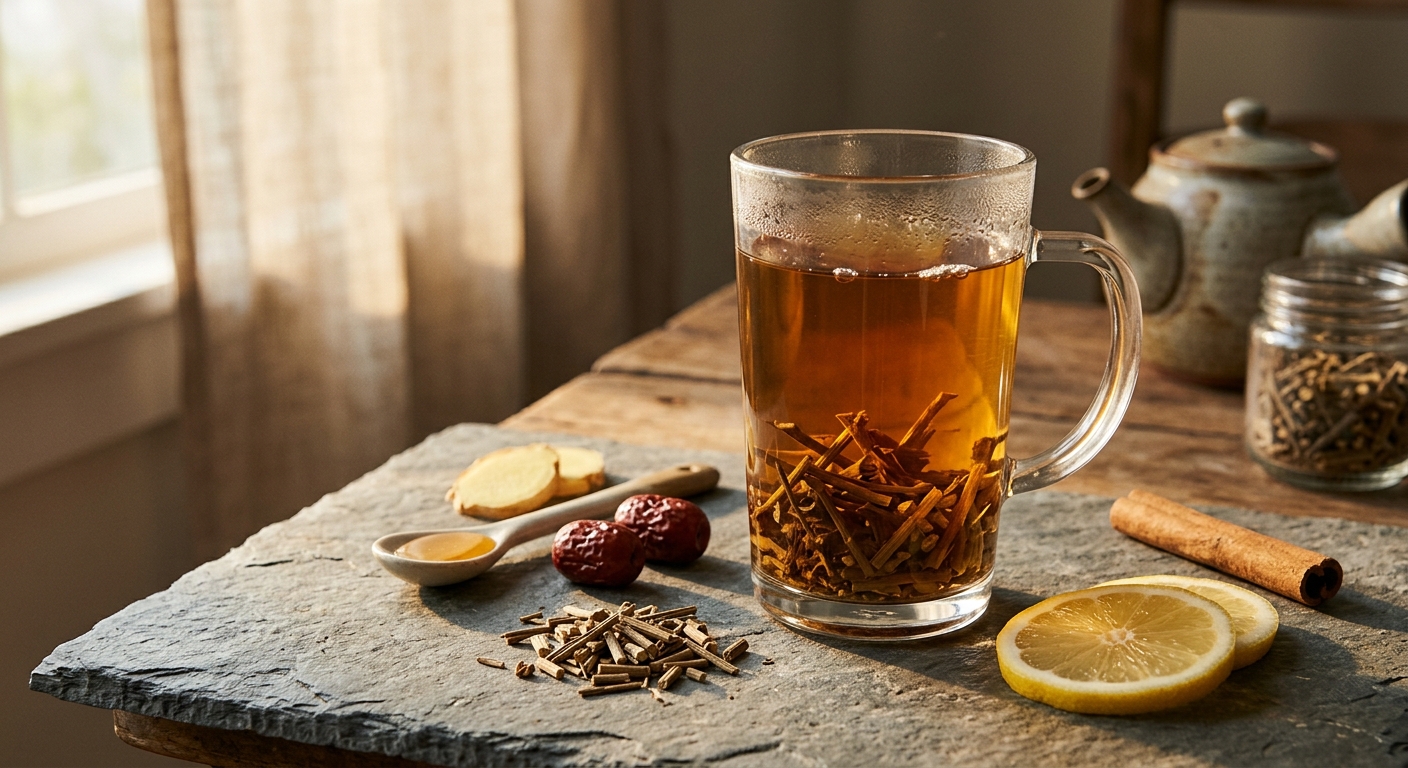
- Measure 15 g of dried, cut Ye Jiao Teng stems and place them into a ceramic teapot or a heatproof glass infuser with a fine mesh basket.
- Heat 500 ml of fresh filtered water to 90 to 95°C (194 to 203°F). Avoid a full rolling boil, as excessive heat can degrade some of the delicate flavonoid compounds.
- Pour the hot water over the herb, cover the vessel with a lid to trap the volatile aromatic compounds, and allow the tea to steep for 15 to 20 minutes.
- Strain carefully through a fine mesh strainer into two warmed mugs, pressing gently on the plant material to extract the full-bodied liquid.
- If desired, stir in raw honey or add two pitted jujube dates to the steeping vessel for natural sweetness and complementary calming properties. Drink warm, 30 to 60 minutes before bedtime.
- Place 20 g of dried, cut Ye Jiao Teng stems into a clean glass jar. Because cold water extracts compounds more slowly, a slightly higher herb-to-water ratio is used to ensure adequate potency.
- Add 600 ml of cool, filtered room-temperature water to the jar. Give the mixture a brief stir to ensure the herb is fully submerged.
- Seal the jar with a lid and allow it to steep at room temperature for the first 2 hours, then transfer it to the refrigerator for a further 8 to 12 hours, ideally overnight.
- When ready, strain the cold brew through a fine mesh strainer lined with cheesecloth to capture the fine fibrous particles from the stems.
- Pour into a glass and enjoy chilled, or transfer a serving to a small saucepan and warm gently over low heat without boiling, which preserves the smooth flavor profile achieved during the cold extraction.
- Combine 15 to 20 g of dried Ye Jiao Teng stems with 600 ml of cold filtered water in a small clay pot or stainless-steel saucepan. Starting with cold water allows a gradual extraction as the temperature rises.
- Bring the water to a full simmer over medium heat, then reduce to a low simmer. The surface should show gentle bubbling but not a rolling boil.
- Simmer uncovered for 25 to 35 minutes, allowing the liquid to reduce by roughly one-third. This concentration is intentional and characteristic of TCM decoctions.
- Remove from heat and allow to cool for 5 minutes. Strain through a fine mesh strainer or cheesecloth into two small cups or bowls, pressing the herb material firmly to extract every drop of the rich liquid.
- The finished decoction will be a deep reddish-brown with a robust, warming flavor. Add jujube dates, a small piece of longan fruit, or a few drops of raw honey to complement the earthy notes and enhance the calming synergy. Drink one cup warm, about 45 minutes before sleep.
Health Benefits
Ye Jiao Teng’s stilbene glycosides and flavonoids interact with GABAergic and serotonergic pathways in the central nervous system, mimicking the brain’s natural relaxation signals. Clinical and preclinical research suggests that these compounds reduce sleep latency and extend total sleep time without causing morning grogginess.
In TCM, this herb is a primary remedy for heart-blood deficiency patterns characterized by racing thoughts, irritability, and emotional restlessness. Modern research supports this through hyperoside’s demonstrated activity at GABA-A receptors, producing a gentle anxiolytic effect comparable to mild nervous system tonics.
According to classical TCM theory, Ye Jiao Teng tonifies the blood and calms the shen (spirit), making it especially valuable for people whose insomnia stems from emotional exhaustion, chronic stress, or prolonged illness. It is frequently combined with herbs like Suanzaoren (sour jujube seed) in classical formulas for this purpose.
The herb has a traditional reputation for addressing night sweats associated with deficiency heat patterns in TCM. Its mild anti-inflammatory and nervine properties help regulate the autonomic nervous system responses that contribute to nocturnal perspiration.
Beyond sleep, TCM practitioners use external washes of Ye Jiao Teng decoction to relieve skin itching and promote circulation through the channels. Internally, its anti-inflammatory flavonoids may support vascular health and reduce mild inflammatory discomfort that can disrupt sleep.
🧪 Key Bioactive Compounds
The Science Behind Ye Jiao Teng
The therapeutic activity of Ye Jiao Teng is anchored primarily in its stilbene glycoside content, particularly 2,3,5,4′-tetrahydroxystilbene-2-O-β-D-glucoside (THSG), a compound that has attracted growing scientific interest for its neuroprotective and sleep-modulating properties. Research published in journals including the Journal of Ethnopharmacology has demonstrated that THSG reduces oxidative stress in hippocampal neurons, protects against stress-induced neuronal damage, and improves measures of sleep quality in rodent models. Its structural similarity to resveratrol (a related stilbene found in grapes) suggests comparable antioxidant and anti-aging mechanisms at the cellular level.
The anthraquinone compounds emodin and physcion contribute meaningfully to the herb’s calming profile. Emodin in particular has been shown to interact with 5-HT (serotonin) receptors and to modulate inflammatory cytokines in nervous tissue, two pathways strongly implicated in both anxiety disorders and disrupted sleep. Meanwhile, the flavonoid hyperoside has been identified as a positive allosteric modulator of GABA-A receptors in vitro, meaning it enhances the binding of the brain’s primary inhibitory neurotransmitter in a manner that is mechanistically similar (though considerably milder) to how benzodiazepine drugs work, but without the same dependency risk at typical herbal doses.
Scopoletin, a coumarin compound present in the vine, adds antispasmodic and mild sedative properties to this already complex phytochemical profile, helping to relax smooth and skeletal muscle tension that can prevent physical unwinding before sleep. Taken together, the bioactive compounds in Ye Jiao Teng create a multi-target pharmacological action that addresses insomnia from several angles simultaneously: reducing neuroinflammation, calming GABAergic and serotonergic tone, protecting neurons from stress-induced damage, and gently lowering physiological arousal. This multi-compound, multi-pathway approach is consistent with the TCM philosophy of treating the whole pattern rather than a single symptom, and it helps explain why this herb has endured as a sleep remedy across more than a millennium of clinical use.
Brewing Tips
- Always source Ye Jiao Teng from a reputable supplier who clearly labels it as the stem (teng) rather than the root (he shou wu), as the two parts of the plant have very different safety profiles and should not be confused.
- For the most therapeutic effect, drink your Ye Jiao Teng tea as part of a consistent nightly routine, 30 to 60 minutes before your intended sleep time. Pairing it with a screen-free wind-down period amplifies its calming benefits significantly.
- If the earthy bitterness feels too pronounced for your palate, try adding two or three dried jujube dates directly to the steeping vessel during brewing. They will naturally sweeten and mellow the flavor while contributing their own mild sedative and blood-nourishing properties.