Long before sleep medications existed, herbalists across Europe, Asia, and the Americas turned to the plant kingdom for help with restless nights. Valerian root, known since ancient Greek and Roman times as a remedy for insomnia and nervous tension, formed the backbone of countless sleep preparations in medieval apothecaries and monastic healing gardens. Paired with passionflower, a vine native to the Americas that found its way into European folk medicine in the 17th century, and lemon balm, a fragrant mint-family herb prized since antiquity for its calming qualities, this trio forms one of the most complementary and well-researched combinations in herbal sleep medicine.
What makes this blend so effective is not any single dramatic compound but the gentle, layered way each herb addresses a different dimension of sleeplessness. Valerian quiets physical restlessness and helps you fall asleep faster. Passionflower eases the racing, looping thoughts that keep so many people awake long past midnight. Lemon balm softens anxiety and lifts mild low mood, rounding the blend with a bright, lemony warmth that makes it genuinely pleasant to drink. Together, they create a tea that works as both a ritual and a remedy.
This blend carries a rich sensory experience of its own. The earthiness of valerian is mellowed by lemon balm’s citrus brightness and the delicate, subtly grassy sweetness of passionflower. Sipping it in a quiet room, away from screens and artificial light, is itself a form of sleep hygiene. Whether you are a chronic light sleeper, navigating a stressful season of life, or simply looking for a gentle, plant-based evening ritual, this winding-down blend offers a time-tested invitation to rest.
2
cups
Ingredients
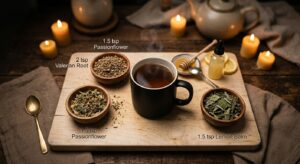
- 1 tspdried valerian root
- 1 tspdried passionflower herb
- 1 tspdried lemon balm leaves
- 480 mlwater (90°C / 194°F)
- —raw honey or chamomile honey to taste (optional)
- —a thin slice of fresh lemon (optional)
How to Brew
Click on an item below to shop for the recommended items for this recipe on Amazon.
As an Amazon Associate, we earn from qualifying purchases.
- Heat filtered water to 90 to 95°C (194 to 203°F). Avoid a full rolling boil, as excessive heat can degrade some of the delicate aromatic compounds in lemon balm and passionflower.
- Combine 1 teaspoon dried valerian root, 1 teaspoon dried passionflower, and 1 teaspoon dried lemon balm in a tea infuser or muslin bag. These proportions are per 240 ml of water, so double them for a two-cup batch.
- Place the infuser in your mug or teapot and pour the hot water directly over the herbs. Immediately cover the mug with a small saucer or lid to trap the volatile essential oils that carry much of the lemon balm’s calming aroma.
- Steep for 10 to 15 minutes. The longer end of this range will produce a stronger, more medicinal brew. If you are new to valerian, start at 10 minutes and assess the flavor and effect before steeping longer.
- Remove the infuser and squeeze gently to extract the remaining liquid. Stir in raw honey if desired and add a thin lemon slice for brightness. Sip slowly in the 30 to 60 minutes before your intended sleep time.
- Combine 1.5 teaspoons dried valerian root, 1.5 teaspoons dried passionflower, and 1.5 teaspoons dried lemon balm per 480 ml of cold, filtered water in a clean glass jar. Cold brew extraction is less efficient than hot brewing, so a slightly higher herb ratio compensates for the gentler process.
- Stir the herbs gently to ensure they are fully submerged. Cover the jar with a tight-fitting lid or a piece of muslin secured with a rubber band to keep out refrigerator odors.
- Let the jar sit at room temperature for 1 hour to begin the extraction process, then transfer it to the refrigerator for 7 to 11 hours. A total of 8 to 12 hours of combined steeping time is the target.
- Strain the liquid through a fine mesh strainer or cheesecloth into a clean glass, pressing the spent herbs firmly to extract as much liquid as possible.
- The cold-brewed tea can be consumed chilled directly from the refrigerator or gently warmed on the stovetop over very low heat, just enough to take the chill off without simmering. Add honey and lemon to taste before drinking in your pre-sleep wind-down window.
- Place 2 teaspoons of dried valerian root in a small stainless steel or enamel saucepan with 600 ml of cold filtered water. Starting the root in cold water and bringing it up to temperature together maximizes extraction of the dense root material.
- Bring the water slowly to a gentle simmer over medium-low heat. Do not allow it to reach a full boil. Once a light simmer is visible, reduce the heat to its lowest setting and maintain a gentle, barely bubbling simmer for 20 to 25 minutes. The liquid will darken considerably and reduce by roughly 20 percent.
- In the final 5 minutes of simmering, add 1 teaspoon dried passionflower and 1 teaspoon dried lemon balm directly to the saucepan. These more delicate herbs need only brief heat exposure to release their beneficial compounds, and adding them too early risks degrading their volatile oils.
- Remove the saucepan from the heat, cover with a lid, and allow the blend to rest for a further 5 minutes off the heat. This resting period lets the passionflower and lemon balm fully infuse without further evaporation.
- Strain the decoction through a fine mesh strainer into a mug, pressing the herbs well. Sweeten with honey to soften the strong, earthy flavor. Because this method produces a more concentrated brew, start with a smaller serving of around 150 to 180 ml and allow 45 minutes before bed to assess its effect.
Health Benefits
Multiple randomized controlled trials have found that valerian root supplementation significantly reduces the time it takes to fall asleep, particularly in people with mild to moderate insomnia. A 2020 systematic review in PLOS ONE concluded that valerian was associated with improved sleep quality without producing next-day sedation at recommended doses.
Passionflower has been shown in clinical studies to improve overall sleep quality scores, including reducing nocturnal awakenings. A 2011 double-blind trial published in Phytotherapy Research found that passionflower tea significantly improved subjective sleep quality compared to placebo after just one week of nightly use.
Lemon balm has demonstrated anxiolytic effects in multiple human studies. A notable trial published in Nutrients found that 600 mg lemon balm extract significantly reduced stress and improved mood scores within hours of administration, making it especially suited for winding down after high-stress days.
All three herbs in this blend interact with the GABA neurotransmitter system through different mechanisms, creating a complementary, multi-pathway approach to calming the nervous system. This synergistic action is thought to be more effective and better tolerated than relying on a single compound alone.
Valerian root has mild antispasmodic properties, helping to ease physical tension held in muscles during stress. This can be particularly helpful for people who experience restlessness as physical tightness rather than purely mental anxiety, making it easier to settle into comfortable sleep.
🧪 Key Bioactive Compounds
The Science Behind Valerian Root
The sedative and anxiolytic effects of this blend are rooted in a shared mechanism: modulation of gamma-aminobutyric acid (GABA), the brain’s primary inhibitory neurotransmitter. When GABA activity increases, neuronal excitability decreases, producing the subjective sensations of calm, drowsiness, and reduced mental chatter that characterize the onset of healthy sleep. Pharmaceutical sleep aids like benzodiazepines work by the same pathway, but the plant compounds in this blend act more gently and through several complementary sub-mechanisms rather than a single blunt receptor hit.
Valerian root’s valerenic acid works by inhibiting the enzyme that breaks down GABA, effectively keeping more of it available in the synaptic cleft for longer. Simultaneously, valerenic acid has been shown to act as a partial agonist at GABA-A receptors, directly mimicking some of GABA’s inhibitory signaling. Passionflower contributes vitexin and linarin, which bind to GABA-A receptors at a different site than valerian’s compounds, broadening the sedative signal. Lemon balm’s rosmarinic acid adds another layer by also inhibiting GABA transaminase, the enzyme that removes GABA from the synapse, overlapping with but distinct from valerian’s mechanism. This multi-compound, multi-site interaction is why the combination tends to outperform any single herb used alone.
Beyond the GABAergic pathway, rosmarinic acid in lemon balm has demonstrated meaningful antioxidant and anti-inflammatory effects in neural tissue, which may explain why regular lemon balm use has been linked to improved cognitive mood scores alongside reduced anxiety. Luteolin, shared between lemon balm and passionflower, further exerts neuroprotective and anti-neuroinflammatory actions. While much of the mechanistic research has been conducted in cell models or animal studies, a growing body of randomized human trials supports the clinical relevance of these compounds at the doses naturally achieved through strong herbal infusion, lending genuine scientific credibility to a tradition that herbalists have practiced for many centuries.
Brewing Tips
- Brew this tea in a covered mug or teapot every time. Lemon balm and passionflower contain volatile aromatic compounds that evaporate with steam, and covering the vessel during steeping preserves both the therapeutic potency and the pleasant aroma.
- If you find valerian’s earthy, slightly pungent flavor too strong at first, increase the ratio of lemon balm to valerian rather than reducing the total steep time. More lemon balm brightens and softens the overall cup without sacrificing the blend’s calming effect.
- Consistency matters more than dose intensity with this blend. Drinking it nightly for two to three weeks tends to produce noticeably better results than occasional use, as some of the adaptogenic and GABAergic effects build incrementally with regular exposure.