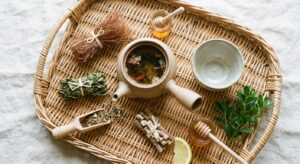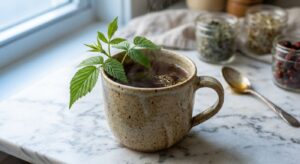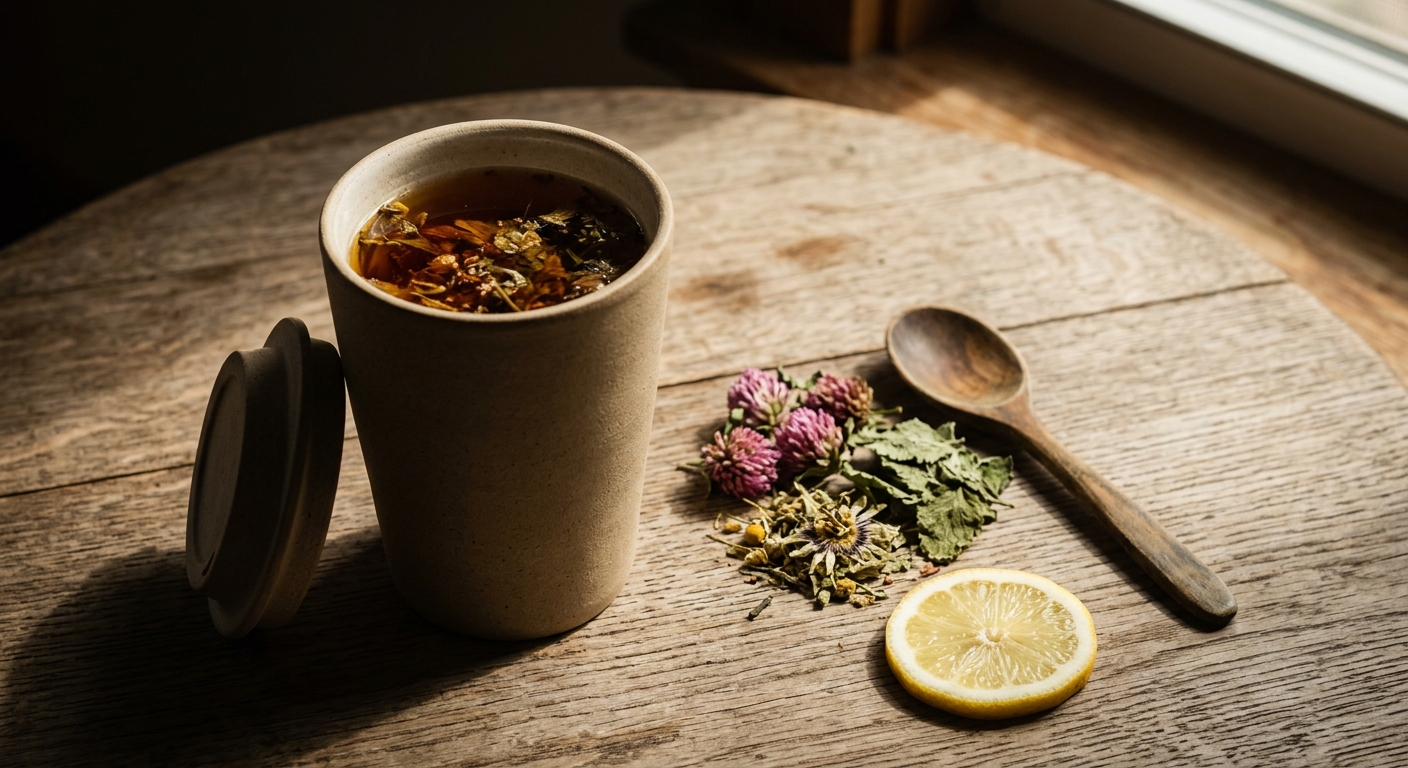
Menopause is a profound transition, and for many women, the emotional landscape of this phase can feel just as turbulent as the physical symptoms. Mood swings, heightened anxiety, sleeplessness, and sudden waves of irritability are among the most commonly reported complaints during perimenopause and menopause, driven largely by the erratic fluctuation and gradual decline of estrogen and progesterone. Long before modern medicine had a name for these experiences, herbalists across Europe, Asia, and the Americas were reaching for specific plants to help women move through this passage with greater ease and grace.
This Menopause Mood Tea draws on three botanicals with deep roots in women’s herbal medicine. Red clover has been prized for centuries as a tonic herb for women, revered in European folk traditions and now studied for its isoflavone content, which mimics estrogen at receptor sites and may help buffer the hormonal shifts of menopause. Lemon balm, a fragrant member of the mint family, has a 2,000-year history of use for calming the nervous system and lifting spirits, earning it the nickname ‘gladdening herb’ in medieval herbalism. Passionflower, native to the Americas and adopted enthusiastically by European herbalists in the 17th century, rounds out the blend with its remarkable ability to quiet a racing mind without heavy sedation.
Together, these three herbs create a tea that tastes as lovely as it functions. The blend is floral and lightly citrusy, with a soft, grassy sweetness that makes it genuinely pleasant to drink, not just medicinally obligatory. Whether you sip it warm in the evening to ease tension before bed, or cold-brew a pitcher to keep on hand through a long, unpredictable day, this tea is designed to become a reliable ritual during one of life’s most significant transitions.
2
cups
Ingredients
- 2 tspdried red clover blossoms
- 1.5 tspdried lemon balm leaves
- 1 tspdried passionflower herb
- 480 mlwater (90°C / 194°F)
- —raw honey or maple syrup to taste (optional)
- —thin lemon slice for garnish (optional)
How to Brew
Click on an item below to shop for the recommended items for this recipe on Amazon.
As an Amazon Associate, we earn from qualifying purchases.
- Heat filtered water to 90°C (194°F). Avoid a full rolling boil, as temperatures above 95°C can degrade some of lemon balm’s delicate volatile oils and may impart a slight bitterness to the red clover.
- Combine the dried red clover blossoms, lemon balm leaves, and passionflower herb in a roomy tea infuser or directly into a warmed teapot. The blend should have room to expand and circulate in the water.
- Pour the hot water over the herbs and immediately cover the infuser or place a small saucer over your mug. This traps the volatile aromatic compounds that would otherwise escape as steam, keeping more of lemon balm’s calming essential oils in the cup.
- Steep for 10 to 12 minutes undisturbed. The tea will deepen from a pale straw color to a warm amber-rose as the isoflavones and plant pigments from the red clover blossoms dissolve into the water.
- Remove the infuser and gently press the herbs with the back of a spoon to extract any remaining liquid. Sweeten lightly with raw honey if desired, and sip slowly, ideally during a quiet moment in the evening or whenever tension peaks during the day.
- Measure 3 tsp of dried red clover blossoms, 2 tsp of dried lemon balm, and 1.5 tsp of dried passionflower into a clean glass jar. For cold brewing, increase the herb quantity by approximately 50 percent compared to the hot brew ratio, as cold water extracts more slowly.
- Add 480 ml of cool, filtered water at room temperature. Do not use chilled water to start, as beginning at room temperature gives the herbs time to open and begin releasing compounds before the temperature drops in the refrigerator.
- Stir gently to ensure all the herbs are submerged and in contact with the water. Secure the lid and leave the jar on the counter for 30 minutes at room temperature before transferring it to the refrigerator.
- Refrigerate for 8 to 12 hours. An overnight cold brew is ideal, as the extended, slow extraction pulls a broad spectrum of polyphenols and isoflavones from the herbs without any heat-related degradation.
- Strain the tea through a fine mesh sieve or cheesecloth into a pitcher or two glasses, pressing the herbs gently. Serve over ice with a lemon slice. The cold brew keeps well in the refrigerator for up to 48 hours, making it a convenient option for a whole day of calm sipping.
- Measure 2.5 tsp dried red clover blossoms, 2 tsp dried lemon balm, and 1.5 tsp dried passionflower into a large, clear glass jar with a tight-fitting lid. A clear jar is essential so sunlight can penetrate the water and gently warm the infusion.
- Fill the jar with 480 ml of cool filtered water. Stir once to ensure all herbs are moistened and not clumped at the surface.
- Secure the lid tightly and place the jar in a sunny outdoor spot or a sunny windowsill that receives at least 4 to 5 hours of direct sunlight. The water will warm gradually to 30 to 40°C, which is ideal for this gentle extraction.
- Allow the jar to steep in the sun for 3 to 5 hours, checking occasionally. You will notice the water transition from clear to a luminous amber-rose as the herbs slowly release their color and constituents. Bring the jar indoors immediately once steeping is complete.
- Strain the tea through a fine mesh sieve into cups or a pitcher. Serve immediately at its gentle warm temperature, or allow it to cool before adding ice. Sweeten with honey or maple syrup if desired. Refrigerate any remainder and consume within 24 hours, as the mild temperatures of sun tea do not fully inhibit bacterial growth for extended storage.
Health Benefits
The combination of lemon balm’s rosmarinic acid and passionflower’s chrysin and vitexin supports GABAergic neurotransmission, the brain’s primary inhibitory system, helping to smooth the emotional peaks and valleys that declining estrogen can trigger. Several clinical trials have shown lemon balm extract significantly reduces anxiety and agitation scores in menopausal women.
Red clover isoflavones, particularly formononetin and biochanin A, act as selective estrogen receptor modulators (SERMs), partially compensating for declining endogenous estrogen. Multiple randomized controlled trials have found red clover isoflavone supplementation reduces hot flash frequency by 25 to 50 percent compared to placebo in perimenopausal women.
Both passionflower and lemon balm have demonstrated sleep-promoting effects in clinical studies, with passionflower improving sleep quality scores in a randomized double-blind trial and lemon balm reducing insomnia symptoms in menopausal women when consumed in the evening. Their combined action on the GABAergic system helps quiet the nervous system without causing morning grogginess.
Lemon balm has been evaluated in multiple human trials and consistently shows significant reduction in state anxiety and perceived stress. A landmark study published in Psychosomatic Medicine found that 600 mg of lemon balm extract reduced anxiety by 18 percent and improved mood and calmness in healthy volunteers, supporting its traditional reputation as a gladdening herb.
All three herbs contribute meaningful antioxidant polyphenols. Menopause is associated with increased oxidative stress as estrogen, which has antioxidant properties, declines. Rosmarinic acid in lemon balm and the flavonoids in red clover and passionflower help neutralize free radicals and dampen low-grade systemic inflammation that can worsen mood, fatigue, and joint discomfort during this transition.
🧪 Key Bioactive Compounds
The Science Behind Red Clover
The calming action of this blend centers on its collective ability to modulate the GABAergic system, the brain’s primary inhibitory neurotransmitter pathway. GABA (gamma-aminobutyric acid) is the chemical that tells the nervous system to slow down, and during menopause, falling estrogen levels reduce GABAergic tone, contributing directly to anxiety, irritability, and sleep disturbances. Lemon balm’s rosmarinic acid inhibits GABA transaminase, the enzyme responsible for breaking down GABA, effectively increasing the amount of GABA available in the synaptic cleft. Passionflower’s flavonoids, especially chrysin and apigenin, bind directly to GABA-A receptor subunits, mimicking the anxiolytic mechanism of benzodiazepines at a much gentler, non-addictive level. The result of combining these two plants is a synergistic uplift in inhibitory tone that measurably quiets an overstimulated nervous system.
Red clover’s contribution operates through an entirely different mechanism. Its isoflavones, primarily formononetin and biochanin A, are classified as phytoestrogens: plant-derived compounds that bind to estrogen receptors (ERs) in human tissue. Unlike synthetic estrogen, these compounds bind preferentially to the beta subtype of the estrogen receptor (ER-beta), which is concentrated in bone, the cardiovascular system, and the brain’s limbic system rather than in reproductive tissue. This selective binding profile means red clover isoflavones can help buffer the withdrawal of endogenous estrogen from neurological and skeletal tissues without the same degree of stimulation to uterine or breast tissue that full estrogenic activity would produce. In the brain, ER-beta activation has been linked to serotonin synthesis regulation and reduced hypothalamic sensitivity to temperature changes, offering a plausible mechanism for both mood stabilization and reduced hot flash severity.
Emerging research has also highlighted the anti-inflammatory dimension of these compounds, which is particularly relevant to menopause. The decline of estrogen is accompanied by a measurable increase in pro-inflammatory cytokines including interleukin-6 and TNF-alpha, a shift now believed to contribute to menopausal depression, cognitive fog, joint pain, and cardiovascular risk. Rosmarinic acid in lemon balm inhibits inflammatory enzyme cascades including COX-2 and LOX pathways, while red clover isoflavones have demonstrated the ability to reduce inflammatory biomarkers in several small human trials. Passionflower’s vitexin has shown similar anti-inflammatory activity in cell and animal models. While no single herb fully counteracts the inflammatory shift of menopause, this combination addresses it from multiple complementary angles, supporting a calmer, clearer, and more physically comfortable experience of the transition.
Brewing Tips
- Source organic, whole dried red clover blossoms rather than processed extracts or broken herb for maximum isoflavone content. The intact flowers contain higher concentrations of formononetin and biochanin A than cut-and-sifted material.
- Always cover your mug or teapot while steeping this blend. Lemon balm’s most calming volatile oils, including citronellal and geranial, evaporate readily with steam. Keeping them in the cup means more aroma and more therapeutic effect.
- Consistency matters more than dose with phytoestrogenic herbs. Red clover isoflavones work cumulatively over weeks rather than producing immediate results. Drinking 1 to 2 cups of this tea daily for at least four to six weeks gives the isoflavones time to interact meaningfully with estrogen receptors and produce noticeable changes in hot flash frequency and mood stability.