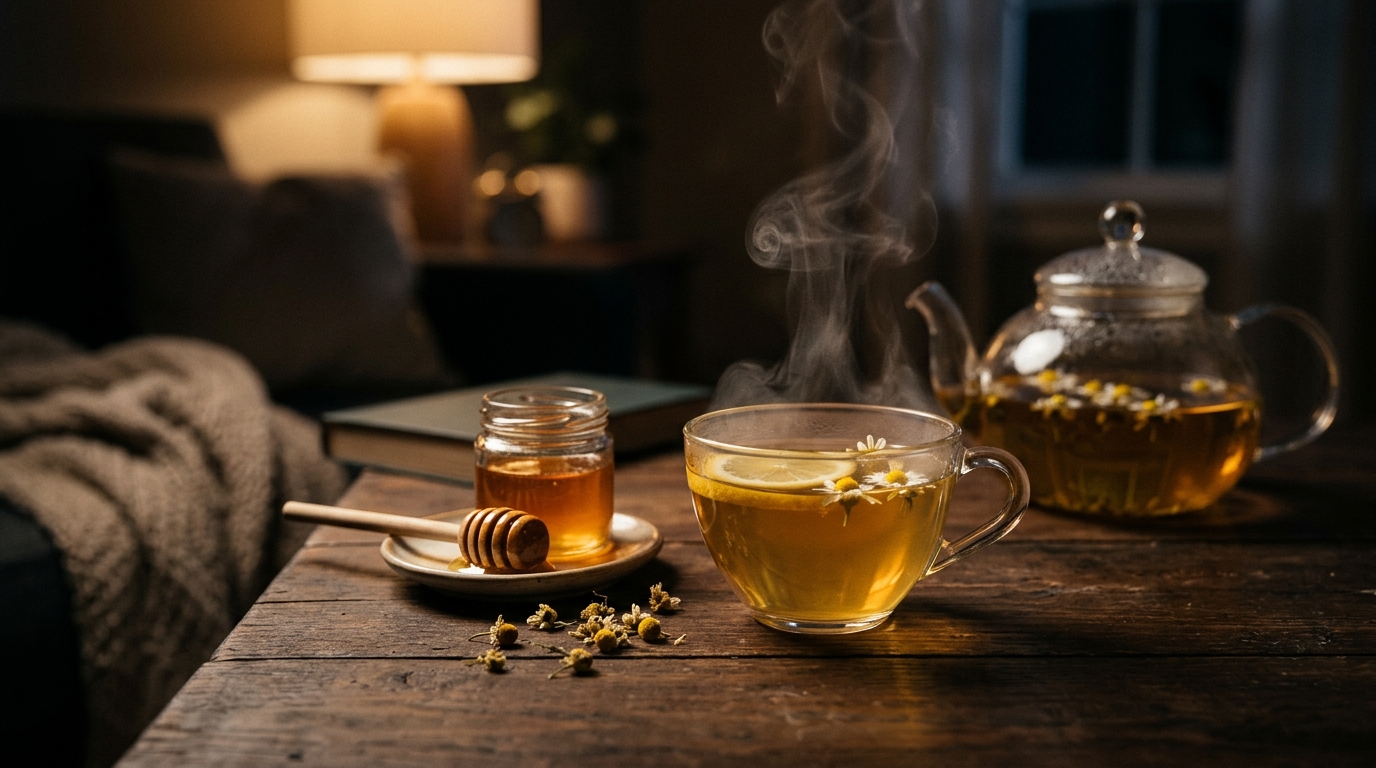
Few herbs carry as much quiet reputation as chamomile. The ancient Egyptians dedicated it to their sun god Ra, the Greeks named it khamaimelon, meaning “earth apple,” for its sweet, apple-like fragrance, and Roman physicians prescribed it for everything from restless nights to unsettled stomachs. Medieval European gardeners even planted it along paths, where its scent rose each time a foot crushed the low, feathery foliage.
The tea most people know comes from German chamomile (Matricaria chamomilla), whose small daisy-like flowers are harvested at peak bloom and dried to preserve their golden centers and delicate white petals. Roman chamomile (Chamaemelum nobile) is a close cousin with a slightly more bitter edge, but German chamomile is the classic choice for a smooth, honeyed cup.
Pairing chamomile with honey is more than a flavor decision. Honey rounds off the herb’s gentle bitterness, adds a velvety mouthfeel, and turns a simple infusion into a true ritual. Stirred slowly into a warm mug at the end of the day, it becomes a small ceremony of slowing down, which may be just as important to a good night’s rest as the herb itself.
2
cups
Ingredients
- 4 tspdried chamomile flowers
- 480 mlwater (95°C / 203°F)
- 2 tspraw honey, or to taste
- —a thin slice of lemon (optional)
How to Brew
Click on an item below to shop for the recommended items for this recipe on Amazon.
As an Amazon Associate, we earn from qualifying purchases.
- Bring fresh, cold water to a boil in a kettle, then let it rest for about 30 seconds so it settles near 95°C (203°F). Water that is fully rolling can flatten the flowers’ delicate aroma.
- Add 2 teaspoons of dried chamomile flowers per 240 ml cup to a teapot or directly into a mug fitted with a fine mesh infuser. Give the flowers room to expand and move.
- Pour the hot water over the flowers and cover immediately with a lid or small saucer to trap the aromatic oils.
- Steep for 5 minutes for a light, floral cup or up to 7 minutes for a fuller, more golden infusion. Going much past 8 minutes can pull out unwelcome bitterness.
- Remove the infuser or strain the flowers, pressing gently to release the last drops of liquid from the blossoms.
- Let the tea cool for a minute, then stir in 1 teaspoon of raw honey per cup. Adding honey once the tea is no longer scalding helps preserve its delicate flavor and natural enzymes.
- Add 4 teaspoons of dried chamomile flowers to a clean glass jar or pitcher. Cold water extracts more slowly, so use a slightly higher ratio of herb than you would for a hot cup.
- Pour 480 ml of cold, filtered water over the flowers and stir once to make sure every blossom is wet.
- Cover and place in the refrigerator for 8 to 12 hours, or overnight. There is no need to stir again.
- Strain through a fine mesh sieve or a piece of muslin into a serving glass or second jar, discarding the spent flowers.
- Whisk 1 teaspoon of honey into a tablespoon of warm water to loosen it, then stir it into the cold tea. Raw honey does not dissolve well in cold liquid on its own, so this step keeps it from sinking to the bottom.
- Serve chilled over a few ice cubes. The brew keeps well in the refrigerator for up to 48 hours.
- Bring 240 ml of water to a boil and let it rest for 30 seconds. Using only half the final volume of water is what makes this a concentrated, double-strength brew.
- Add 4 teaspoons of dried chamomile flowers to a heatproof jug or teapot and pour in the hot water. Cover and steep for 10 minutes.
- Strain out the flowers, then stir in 2 teaspoons of honey while the tea is still warm so it dissolves completely and evenly.
- Fill a tall glass with ice and pour the warm concentrate over it, letting the ice melt and dilute the tea to a full 480 ml of refreshing, sweetened chamomile.
- Stir gently and garnish with a thin lemon slice or a sprig of fresh mint. Taste and add a little more honey if you prefer it sweeter.
Health Benefits
Apigenin interacts with GABA receptors to promote relaxation. A small clinical trial in postnatal women and several studies in older adults found improvements in sleep quality with regular chamomile use, though results are modest.
Randomized trials of standardized chamomile extract have shown reductions in generalized anxiety symptoms. A warm cup also offers a calming behavioral ritual that may amplify the effect.
Chamomile’s antispasmodic and anti-inflammatory compounds, particularly bisabolol, have long been used to calm bloating, gas, and mild stomach upset after meals.
Warm chamomile tea combined with honey creates a soothing coating for irritated throat tissue, and honey itself has well-documented cough-soothing properties.
Flavonoids such as luteolin and apigenin act as antioxidants in laboratory studies, helping protect cells from oxidative stress.
🧪 Key Bioactive Compounds
The Science Behind Chamomile
Chamomile’s calming reputation rests largely on its flavonoids, especially apigenin. Laboratory studies show that apigenin binds to GABA-A receptors, the same family of receptors targeted by many sedative medications, though with far weaker and gentler activity. This is likely why chamomile promotes a feeling of calm without the heavy sedation associated with pharmaceutical sleep aids.
The herb’s essential oil adds another layer. Alpha-bisabolol and chamazulene have demonstrated anti-inflammatory and antispasmodic effects in preclinical research, which supports chamomile’s long traditional use for settling the digestive tract. Because these oils are volatile, covering your cup during steeping genuinely helps keep them in the final tea.
It is worth being honest about the evidence. While several randomized trials report benefits for anxiety and sleep quality, many are small, and results vary depending on whether tea or concentrated extract was used. Tea contains lower doses than extracts, so its effects are best understood as gentle and cumulative, working hand in hand with the calming ritual of preparing and sipping it.
Brewing Tips
- Choose whole dried chamomile flowers over dusty tea-bag fannings. Whole blossoms retain more essential oil and produce a noticeably sweeter, more fragrant cup.
- Store dried chamomile in an airtight, opaque container away from light and heat. It stays vibrant for about a year, but the apple-like aroma fades if exposed to air.
- Start your ritual about 30 to 45 minutes before bed and dim the lights while you sip, so the tea becomes a cue for your body to begin winding down.
- Use raw, local honey when possible for the fullest flavor, and stir it in after the tea has cooled slightly rather than into boiling water.