Few herbs carry the weight of history that ashwagandha does. Used for more than 3,000 years in Ayurvedic tradition, this small shrub native to India, North Africa, and the Mediterranean was described in ancient Sanskrit texts as a rasayana, a rejuvenating tonic meant to promote longevity, vitality, and mental clarity. Its Latin species name, somnifera, literally means sleep-inducing, a testament to how deeply its sedative qualities were recognized by the physicians of antiquity. Warriors drank it before battle, elders used it to restore vigor, and healers prescribed it to calm anxious minds. The root even takes its common name from the Sanskrit words for horse and smell, a nod to both its distinctive aroma and its legendary ability to impart the strength and stamina of a horse.
What makes ashwagandha genuinely remarkable is that modern science has largely confirmed what Ayurvedic practitioners knew for millennia. Clinical trials have documented its ability to reduce serum cortisol, improve sleep onset and quality, ease generalized anxiety, and support thyroid and adrenal function. Unlike many herbs whose reputations outpace their evidence, ashwagandha has earned its place in contemporary integrative medicine through a growing body of rigorous human trials. It belongs to a category of herbs called adaptogens, plants that help the body resist physical and psychological stress by modulating the hypothalamic-pituitary-adrenal (HPA) axis, the central stress-response system.
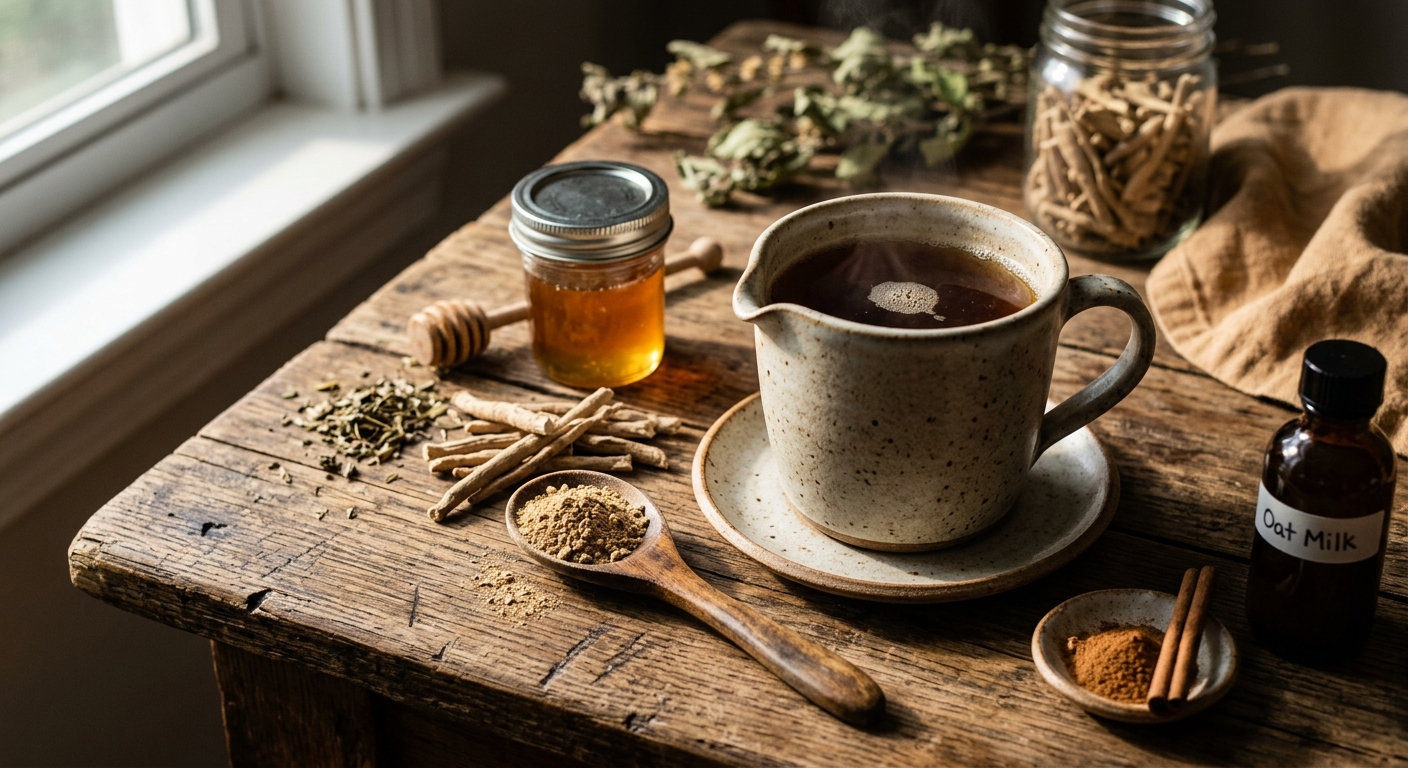
Brewed as a tea, ashwagandha root delivers a deeply earthy, slightly bitter, and faintly woody cup with a warm, grounding quality that feels almost meditative to drink. It is traditionally prepared with warm milk and honey in a preparation known as ashwagandha milk or golden moon milk, though a water-based decoction is equally effective and more accessible for daily use. Whether you are winding down after a demanding day, addressing chronic sleep difficulties, or simply building resilience to stress over time, ashwagandha tea is a ritual worth adopting.
2
cups
Ingredients
- 1 tspashwagandha root powder or 2 tsp dried ashwagandha root pieces
- 480 mlwater
- 1 tspraw honey or maple syrup (optional)
- —pinch of ground cinnamon (optional, to soften bitterness)
- —splash of warm milk or oat milk (optional, traditional style)
How to Brew
Click on an item below to shop for the recommended items for this recipe on Amazon.
As an Amazon Associate, we earn from qualifying purchases.
- Measure 1 teaspoon of ashwagandha root powder (or 2 teaspoons of dried root pieces) per serving into a small saucepan or directly into your mug if using powder.
- Bring your water to a full boil (95 to 100°C / 203 to 212°F). Unlike delicate floral herbs, ashwagandha root benefits from high-temperature extraction and will not turn harsh with boiling water.
- Pour the boiling water over the powder or root pieces. If using root pieces in a mug, place them inside a tea infuser first. If using powder, add it directly and stir well to combine.
- Cover your mug with a small saucer or lid to trap the volatile aromatic compounds and steep for 10 to 15 minutes. The longer end of the range will produce a stronger, more potent brew.
- Strain through a fine mesh strainer into your cup if using powder, or remove the infuser if using root pieces. Stir in honey, cinnamon, or a splash of warm milk to taste, and drink while warm, ideally 30 to 60 minutes before bed.
- Add 2 teaspoons of ashwagandha root powder or 4 teaspoons of dried root pieces to a glass jar for every 480 ml of filtered water. Cold brewing uses a slightly higher herb-to-water ratio to compensate for the lower extraction temperature.
- Pour cold, filtered water over the herb. Stir or shake briefly to ensure the powder is fully dispersed or the root pieces are fully submerged. Do not use hot water at any stage.
- Leave the jar uncovered or loosely covered at room temperature for 2 hours to allow the initial extraction to begin, then seal the jar and transfer it to the refrigerator.
- Let the brew continue to steep in the refrigerator for a further 8 to 12 hours (overnight works perfectly). The slow, cold extraction draws out withanolides and other compounds with a noticeably smoother, less astringent result.
- Strain the liquid through a fine mesh strainer or cheesecloth to remove all root particles. Serve chilled over ice or gently warm a single portion without boiling if you prefer a warm drink. Sweeten with honey or add a cinnamon stick for complexity.
- Combine 2 teaspoons of dried ashwagandha root pieces (or 1.5 teaspoons of root powder) with 600 ml of water in a small saucepan. The extra water accounts for evaporation during simmering.
- Place the saucepan over medium heat and bring the mixture to a gentle boil, then immediately reduce the heat to maintain a low, steady simmer. You want small bubbles breaking the surface consistently, not a rolling boil.
- Simmer uncovered for 20 to 25 minutes, stirring occasionally. As the liquid reduces, the brew concentrates and deepens in color from pale amber to a warm caramel brown. You should be left with approximately 350 to 400 ml of liquid.
- For a traditional Ayurvedic preparation, add 240 ml of whole milk or oat milk in the final 5 minutes of simmering, stirring continuously to prevent scorching. This is the base for classic ashwagandha milk.
- Remove from heat and strain through a fine mesh strainer into mugs. Stir in honey, a pinch of ground cinnamon, and a small pinch of black pepper (which enhances absorption of fat-soluble withanolides). Serve immediately and drink warm.
Health Benefits
Multiple randomized controlled trials, including a landmark 2019 study published in Medicine, found that ashwagandha supplementation significantly reduced serum cortisol levels by up to 30% in chronically stressed adults. The withanolides regulate the HPA axis, helping the body return to a hormonal baseline after stress exposure.
A 2020 double-blind, placebo-controlled trial published in PLOS ONE demonstrated that ashwagandha root extract significantly improved sleep efficiency, total sleep time, and sleep onset latency in adults with insomnia. Triethylene glycol and withanolides acting on GABA receptors are believed to be the primary mechanisms.
Ashwagandha has been shown in several clinical trials to reduce scores on validated anxiety scales (including the Hamilton Anxiety Scale) in individuals with generalized anxiety disorder and subclinical anxiety. Its effect on GABA-A receptor activity produces a calming action comparable in mechanism, though gentler in effect, to pharmaceutical anxiolytics.
Research suggests ashwagandha can stimulate thyroid hormone synthesis, making it potentially beneficial for those with subclinical hypothyroidism. It also supports adrenal gland health by reducing adrenal hyperactivity caused by chronic stress, a condition sometimes referred to as adrenal fatigue in integrative medicine contexts.
A 2015 study in the Journal of the International Society of Sports Nutrition found that ashwagandha supplementation significantly improved cardiorespiratory endurance, muscle strength, and recovery time in healthy adults. These effects are attributed to its anti-inflammatory withanolides and its role in reducing exercise-induced oxidative stress.
🧪 Key Bioactive Compounds
The Science Behind Ashwagandha
The therapeutic reputation of ashwagandha rests primarily on a class of compounds called withanolides, naturally occurring steroidal lactones unique to the Withania genus. Withaferin A and Withanolide D are the most extensively studied of these compounds. They interact with the hypothalamic-pituitary-adrenal (HPA) axis, the neurochemical cascade that governs the body’s response to stress, by down-regulating the production of stress hormones including cortisol and adrenocorticotropic hormone (ACTH). Several randomized controlled trials have demonstrated statistically significant reductions in serum cortisol levels among participants taking standardized ashwagandha extract compared to placebo, confirming what Ayurvedic practitioners observed empirically over millennia.
The sleep-promoting mechanism of ashwagandha is distinct from its stress-modulating pathway. Research published in PLOS ONE identified triethylene glycol, a small polyol compound present in the root and leaves, as a primary driver of non-REM sleep induction. Additionally, withanolides have been shown to enhance GABA-ergic neurotransmission by binding to GABA-A receptors in the brain, producing a calming, anxiolytic effect without the dependency risk associated with pharmaceutical GABA-targeting drugs. This dual mechanism, cortisol reduction during the day and GABA modulation at night, makes ashwagandha uniquely suited for addressing the stress-sleep cycle, where high daytime cortisol suppresses melatonin production and delays sleep onset.
Beyond the nervous system, ashwagandha’s withanolides exhibit notable anti-inflammatory activity by inhibiting nuclear factor kappa B (NF-kB), a protein complex that drives inflammatory gene expression. Chronic low-grade inflammation is increasingly linked to anxiety, depression, sleep disruption, and metabolic dysfunction, which may explain why ashwagandha’s benefits appear so wide-ranging in clinical settings. Its iron content and alkaloid profile contribute to hematopoietic support and overall cellular energy metabolism, aligning with its traditional classification as a rasayana, a substance that works systemically to restore balance and build long-term resilience rather than producing a single, isolated therapeutic effect.
Brewing Tips
- Start with a smaller dose of half a teaspoon of powder per cup and build up gradually over one to two weeks. Ashwagandha is a tonic herb whose benefits accumulate over time, and starting low allows your body to adjust to its earthy intensity.
- Pair ashwagandha with a fat source such as warm milk, coconut milk, or a few drops of ghee. The key withanolides are fat-soluble, meaning their absorption is meaningfully improved when consumed alongside a lipid, making the traditional milk-based preparation scientifically sound.
- Consistency matters more than dose. Clinical trials showing significant cortisol reduction and sleep improvement used ashwagandha daily for 8 to 12 weeks. Drinking it nightly as a pre-sleep ritual for at least one month gives the adaptogenic compounds time to produce measurable systemic change.