Long before pharmaceutical sleep aids existed, herbalists across Europe and Asia turned to the earth for relief from restless nights. Valerian root (Valeriana officinalis) has been used medicinally for over two thousand years, referenced by the ancient Greeks and Romans as a remedy for insomnia, nervousness, and palpitations. The name itself may derive from the Latin valere, meaning ‘to be strong’ or ‘to be well,’ a fitting tribute to a plant that has stood the test of time as one of herbal medicine’s most trusted sleep tonics. Hops (Humulus lupulus), best known today as a flavoring agent in beer, has its own deep medicinal history. Medieval monks who harvested hops in European fields famously reported unusual drowsiness, leading to centuries of use as a gentle sedative in pillows, tinctures, and teas.
What makes this blend particularly compelling is how the two herbs complement each other at the biochemical level. Valerian root works primarily through its effect on GABA, the brain’s primary inhibitory neurotransmitter, helping to calm nervous activity and ease the transition into sleep. Hops brings its own sedative compounds to the blend, including 2-methyl-3-buten-2-ol, which is formed during the drying of the plant, and a suite of bitter acids that reinforce valerian’s calming action. Traditional European herbalism often paired these two plants deliberately, and modern clinical research has since validated the wisdom of that pairing, with combination studies showing greater sleep-onset benefits than either herb used alone.
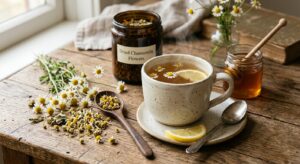
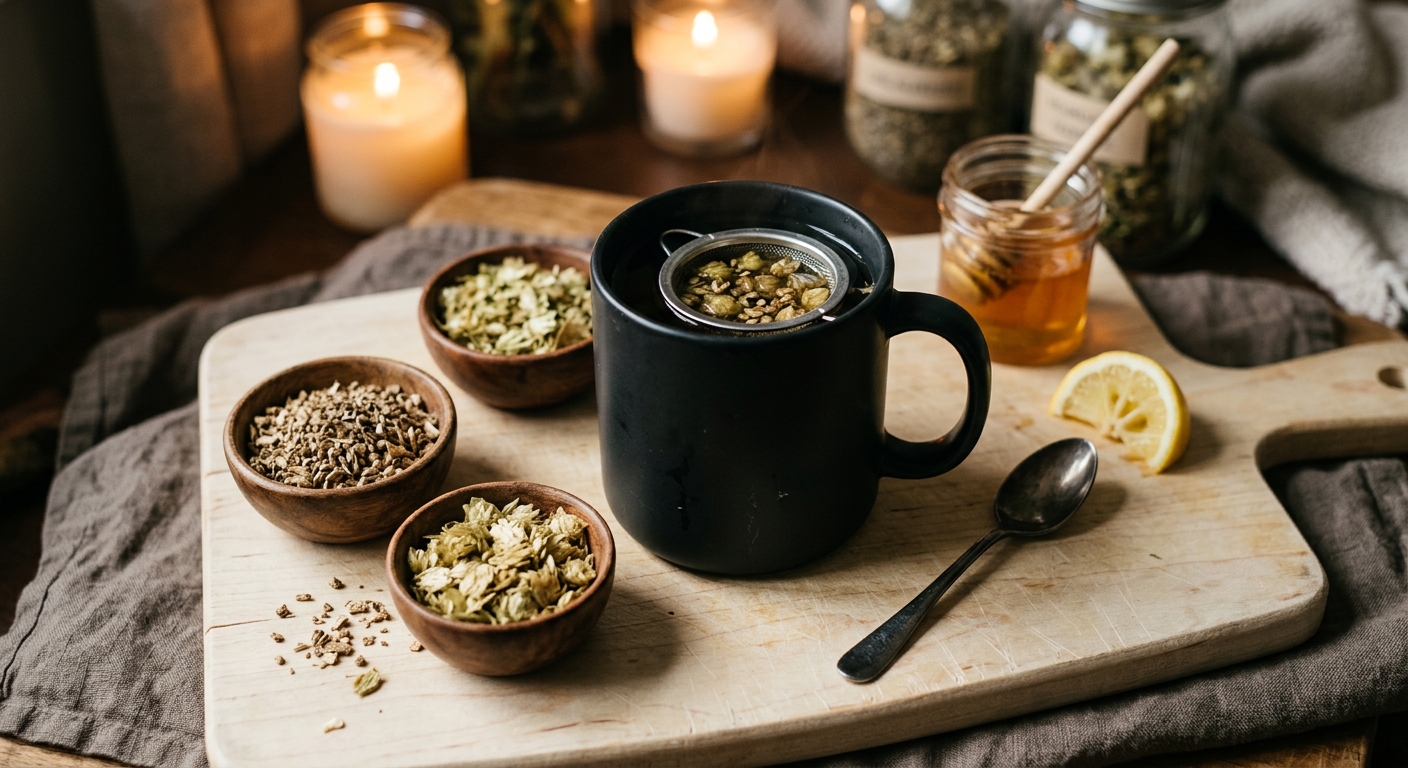
The sensory experience of this tea is earthy, bold, and unmistakably herbal. Valerian root carries a pungent, almost woodsy depth that can be polarizing for newcomers, while hops adds a pleasant, resinous bitterness reminiscent of pine and citrus peel. The result is a tea that feels medicinal in the best possible way, a ritual signal to the body that the day is done and rest is near. Brewed in the hour before bed, perhaps softened with a spoonful of honey and a squeeze of lemon, this blend has helped generations of restless sleepers find their way to a quieter night.
2
cups
Ingredients
- 2 tspdried valerian root (cut and sifted)
- 1 tspdried hops flowers (strobiles)
- 480 mlwater (90°C / 194°F)
- —raw honey to taste (optional)
- —fresh lemon juice to taste (optional)
How to Brew
Click on an item below to shop for the recommended items for this recipe on Amazon.
As an Amazon Associate, we earn from qualifying purchases.
- Measure 2 teaspoons of dried valerian root and 1 teaspoon of dried hops flowers per 2 cups (480 ml) of water. If using whole valerian root pieces rather than cut and sifted root, lightly crush them with the back of a spoon to increase surface area and improve extraction.
- Heat your water to 90 to 95°C (194 to 203°F). If you do not have a temperature-controlled kettle, bring water to a full boil and allow it to rest for 2 to 3 minutes before pouring.
- Place the herbs in a tea infuser, mesh basket, or French press. Pour the hot water directly over the herbs, ensuring they are fully submerged.
- Cover the vessel tightly with a lid or a small saucer to trap volatile aromatic compounds. Steep for 10 to 15 minutes. A full 15-minute steep will produce a stronger, more sedative cup. For first-time drinkers, start at 10 minutes.
- Remove the infuser or strain the herbs thoroughly. Add raw honey and a small squeeze of fresh lemon juice to soften the earthy bitterness if desired.
- Drink 30 to 60 minutes before bedtime for best results. Prepare your sleep environment while the tea steeps to reinforce the relaxation ritual.
- Measure 3 teaspoons of dried valerian root and 1.5 teaspoons of dried hops flowers per 480 ml of filtered water. Cold brewing extracts less efficiently than heat, so increasing the herb ratio by approximately 50 percent compensates for the lower extraction rate.
- Combine the herbs and room-temperature filtered water in a glass jar. Stir gently to ensure the herbs are fully saturated and not floating in a dry clump at the surface.
- Let the jar sit at room temperature for 30 minutes to allow initial hydration of the herb material, then seal the jar and transfer it to the refrigerator.
- Allow the blend to cold-steep for 8 to 12 hours, ideally overnight. Steeping beyond 12 hours may produce a more bitter or astringent cup due to extended extraction of hops’ bitter alpha acids.
- Strain the cold brew through a fine mesh strainer or cheesecloth into a serving glass, pressing the herbs gently to extract remaining liquid.
- Serve chilled or at room temperature. Sweeten with a small amount of honey or a few drops of liquid stevia if desired. Consume within 24 hours and keep refrigerated.
- Place 2.5 teaspoons of dried valerian root (cut and sifted or lightly crushed whole pieces) into a small saucepan. Add 600 ml of cold filtered water. Starting with cold water and bringing it up slowly helps draw compounds out of the root more gradually.
- Bring the water to a gentle simmer over medium heat, aiming for 85 to 90°C (185 to 194°F). Avoid a vigorous rolling boil, which can drive off volatile aromatic compounds. Reduce the heat as needed to maintain a steady, gentle simmer with small bubbles.
- Simmer uncovered for 20 to 25 minutes, allowing the liquid to reduce slightly. You should notice the water deepening in color to a rich amber and taking on the characteristic earthy aroma of valerian.
- After simmering, remove the saucepan from heat and add 1.5 teaspoons of dried hops flowers directly to the hot liquid. Cover the pan immediately with a lid to trap the aromatic volatile oils.
- Allow the hops to infuse in the covered, off-heat saucepan for 10 minutes. This passive infusion avoids degrading the more heat-sensitive compounds in hops while still fully extracting their calming properties.
- Strain the decoction through a fine mesh strainer into mugs, pressing the spent herbs to recover all liquid. The yield should be approximately 400 ml after evaporation. Add honey to taste. This method produces the most potent and deeply sedative cup of the three methods.
Health Benefits
Multiple double-blind clinical trials have found that valerian root supplementation, particularly when combined with hops, significantly reduces the time it takes to fall asleep compared to placebo. A pivotal study published in Pharmacology, Biochemistry and Behavior found the combination more effective than either herb alone, supporting the synergistic model of this traditional pairing.
Research suggests that regular use of valerian improves sleep architecture by increasing slow-wave (deep) sleep and reducing nighttime arousals. Participants in several trials reported waking less frequently and feeling more refreshed upon waking after using valerian-based preparations.
Valerenic acid modulates GABA-A receptors in the brain, the same receptors targeted by benzodiazepine medications, producing a calming effect on anxious thoughts without the dependency risk. A 2002 study in Phytotherapy Research found statistically significant reductions in state anxiety among participants taking valerian extract.
A randomized controlled trial published in Menopause found that a valerian and hops combination significantly improved sleep quality in postmenopausal women, a population particularly vulnerable to sleep disturbance. The researchers proposed a mild phytoestrogen-like action of hops as a contributing mechanism.
Isovaleric acid and other constituents of valerian have been observed to have mild antispasmodic properties, helping to relax physical tension in the body. This makes the tea particularly useful for those whose insomnia is accompanied by muscle tightness, restless legs, or physical stress held in the body.
🧪 Key Bioactive Compounds
The Science Behind Valerian Root
The scientific story of this blend begins with GABA, gamma-aminobutyric acid, the brain’s primary inhibitory neurotransmitter. When GABA binds to its receptors, it reduces neuronal excitability throughout the nervous system, producing feelings of calm, drowsiness, and reduced anxiety. Valerian root’s most studied compound, valerenic acid, inhibits the enzyme GABA transaminase, which is responsible for breaking down GABA in the brain. By slowing GABA degradation, valerenic acid effectively raises GABA levels, prolonging and amplifying its calming effects. This mechanism closely parallels that of pharmaceutical anxiolytics, though with considerably gentler potency and without the dependency profile.
Hops contributes its own sedative chemistry through a compound called 2-methyl-3-buten-2-ol, a volatile alcohol that forms when humulone and lupulone, the bitter alpha acids in hops, undergo oxidative degradation during the drying process. Research by Vonderheid-Guth and colleagues found that this compound has direct central nervous system depressant activity at physiologically relevant concentrations. Additionally, hops contains the potent phytoestrogen 8-prenylnaringenin and the flavonoid xanthohumol, which exhibit anti-inflammatory and neuroprotective properties that may contribute to the overall calming profile of the plant. A 2012 study published in PLOS ONE demonstrated that hops dry extract measurably reduced anxiety and improved sleep quality measures in a controlled crossover design, validating what traditional European herbalists observed centuries earlier among hops-harvesting workers.
The case for combining these two herbs is supported by pharmacological synergy research. A landmark study by Koetter and colleagues, published in Phytotherapy Research in 2007, compared the sleep effects of valerian alone, hops alone, and a fixed valerian-hops combination in a rat model using polysomnographic measurement. The combination produced significantly greater increases in non-REM sleep time than either herb individually, suggesting the compounds work through complementary pathways rather than simple additive effects. Human clinical trials have largely confirmed this picture. A multicenter study involving 184 participants with non-organic insomnia found that a valerian-hops preparation produced sleep improvements equivalent to the benzodiazepine bromazepam with fewer side effects, representing a meaningful finding for those seeking non-pharmaceutical support for chronic sleep difficulties.
Brewing Tips
- Store dried valerian root in an airtight container away from light and heat. The isovaleric acid that gives valerian its pungent smell intensifies with improper storage, and old, poorly stored root may smell more strongly without being more medicinally potent.
- For best therapeutic results, use this tea consistently for two to four weeks. Valerian’s sleep benefits are cumulative for many people and may not be fully apparent after just one or two cups. Expect mild effects initially that build over regular nightly use.
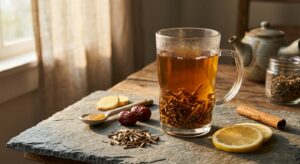
- If you find the flavor of valerian difficult to tolerate, try adding a cinnamon stick or a thin slice of fresh ginger to the brew. Both spices complement the earthy depth of the blend and help mask some of valerian’s more challenging bitter notes without reducing its effectiveness.