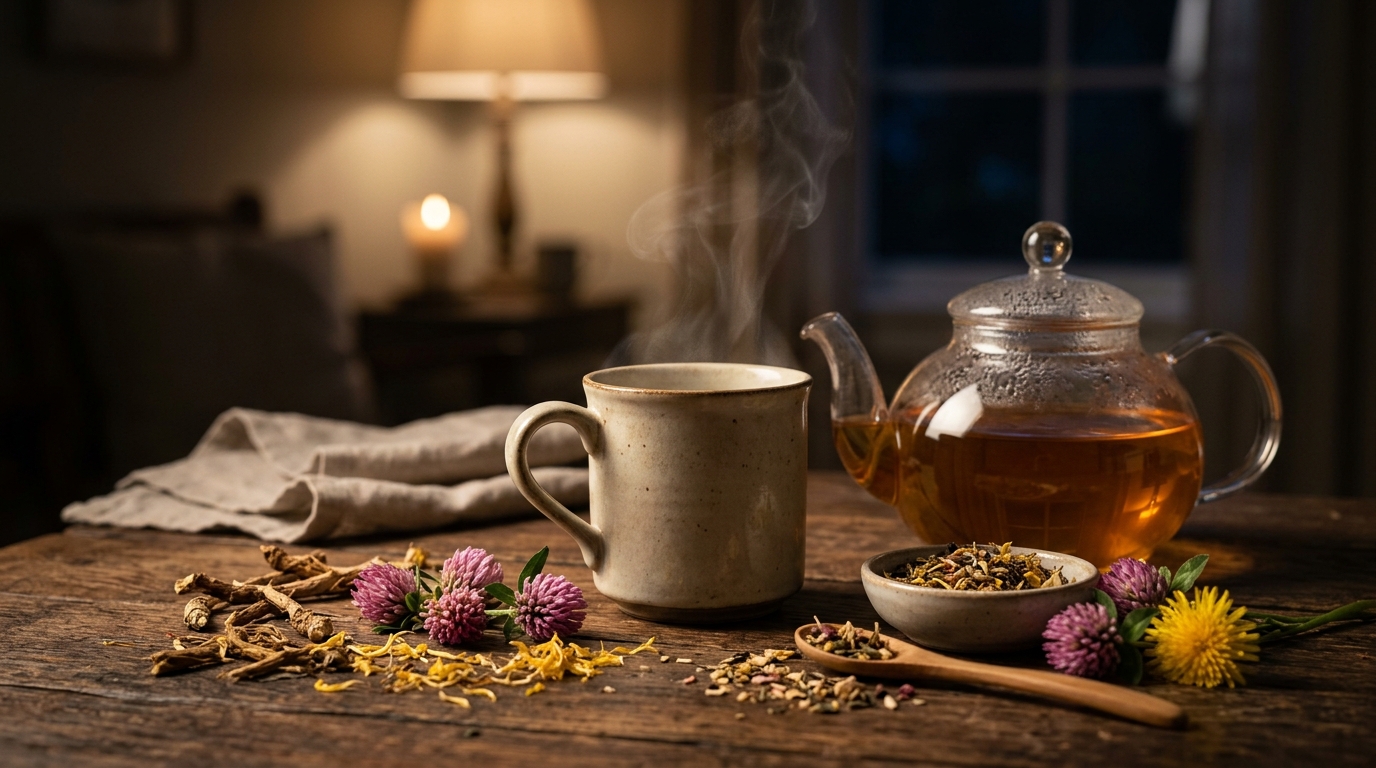
Red clover (Trifolium pratense) has grown in meadows across Europe and Asia for thousands of years, and its magenta blossoms have been brewed into tonics for just as long. Folk herbalists in Britain and North America valued it as a “blood purifier,” a traditional phrase for herbs believed to support the body’s cleansing organs. In the nineteenth century, the Eclectic physicians of America prescribed red clover for skin complaints and chronic conditions, and Native American communities used it as a gentle wash and tea. Today it is best known as a source of isoflavones, plant compounds that gently interact with estrogen receptors, which is why it features so often in herbal traditions focused on women’s health through menopause.
Dandelion (Taraxacum officinale) is the familiar lawn “weed” that herbalists have treasured since at least the tenth century, when Arabian physicians described it as a bitter remedy for liver and spleen complaints. The roasted or dried root carries a deep, coffee-like bitterness that stimulates bile flow and digestive secretions. In traditional European and Chinese medicine alike, dandelion root is a classic liver tonic, valued for supporting the organ that processes hormones, among many other tasks, for removal from the body.
Brewed together in the evening, these two herbs make a pairing that is both practical and pleasing. The red clover brings a soft, honeyed sweetness and a hay-like warmth that rounds out the roasty bitterness of the dandelion. Drinking it as a wind-down ritual an hour or two before bed fits the traditional idea of nighttime as the body’s time for repair and clearance. Note that this blend is a supportive tradition, not a treatment, and it works best alongside good sleep, fiber, hydration, and a nourishing diet.
2
cups
Ingredients
- 2 tbspdried red clover blossoms
- 1 tbspdried dandelion root (roasted or unroasted, cut and sifted)
- 500 mlwater (95°C / 203°F)
- —a thin slice of fresh ginger (optional, for warmth)
- —raw honey or a few drops of lemon to taste (optional)
How to Brew
Click on an item below to shop for the recommended items for this recipe on Amazon.
As an Amazon Associate, we earn from qualifying purchases.
- Measure 2 tablespoons of dried red clover blossoms and 1 tablespoon of cut dandelion root into a teapot or large infuser. Add the optional ginger slice now if using.
- Bring fresh water to a full boil, then let it rest for about 30 seconds so it settles near 95°C (203°F).
- Pour 500 ml of the hot water over the herbs, cover the pot or mug with a saucer to trap the volatile aromatics, and steep for 10 to 15 minutes. Taste at 10 minutes; the longer end gives a stronger, more bitter cup.
- Strain through a fine mesh strainer, pressing the herbs lightly to release the last of the liquid.
- Pour into two mugs, sweeten with a little raw honey if you like, and sip slowly one to two hours before bed.
- Combine 2 tablespoons of red clover blossoms and 1 heaping tablespoon of dandelion root in a clean glass jar.
- Add 500 ml of cold, filtered water and stir gently so all the herbs are fully submerged.
- Seal the jar and refrigerate for 8 to 10 hours, or overnight. Do not exceed 12 hours, as cold-steeped herbal teas are best consumed fresh.
- Strain through a fine mesh strainer or a nut milk bag, pressing gently to extract the liquid.
- Serve chilled over ice or let it come to cool room temperature. Drink within 24 hours and keep refrigerated.
- Add 1 tablespoon of dandelion root (and the optional ginger slice) to a small saucepan with 550 ml of cold water.
- Bring to a boil, then immediately reduce the heat to a gentle simmer. Cover with a lid and simmer for 15 minutes, which is enough to draw out the root’s bitter compounds and inulin.
- Remove the pan from the heat and stir in 2 tablespoons of red clover blossoms. Re-cover and let steep for 10 minutes so the blossoms infuse without turning grassy or harsh.
- Strain through a fine mesh strainer into a warmed teapot or directly into mugs.
- Sweeten lightly if desired. The decoction yields a deeper, richer, more coffee-like cup than the hot brew.
Health Benefits
Red clover isoflavones weakly bind estrogen receptors, and several clinical trials have examined them for hot flashes. Results are mixed, with some showing modest reductions and others finding little effect, so it is best viewed as a gentle, supportive option.
Dandelion root’s bitter compounds are traditionally used as a cholagogue, stimulating bile production. Because the liver and bile are central to how the body packages and removes used hormones, this is the basis for the herb’s reputation as a clearance-supporting tonic, though human trial evidence remains limited.
Dandelion root is rich in inulin, a prebiotic fiber that feeds beneficial bacteria. A healthy gut helps regulate the reabsorption of estrogen metabolites, so a thriving microbiome supports healthy elimination.
The warmth, aroma, and slow pace of a caffeine-free evening tea help signal to the body that it is time to wind down, which supports the quality of sleep, the period when much of the body’s restorative work occurs.
Dandelion leaf and root have long been used as mild diuretics, and small human studies suggest a short-term increase in urination, which may help ease occasional water retention.
🧪 Key Bioactive Compounds
The Science Behind Red Clover
Red clover is one of the richest known dietary sources of isoflavones, including formononetin, biochanin A, daidzein, and genistein. These plant compounds are structurally similar to human estradiol, which allows them to bind weakly to estrogen receptors, particularly the beta subtype. Rather than acting as a strong estrogen, they behave as gentle modulators, which is why researchers have investigated them for menopausal hot flashes and bone density. Clinical findings have been inconsistent, but the biochemistry explains why the herb has remained a staple of women’s health traditions.
Dandelion root works through a different but complementary route. Its bitter sesquiterpene lactones, such as taraxinic acid derivatives, stimulate the bitter taste receptors in the mouth and digestive tract, triggering a reflex that increases saliva, gastric secretions, and bile flow. Bile is the liver’s primary vehicle for escorting processed hormones and other metabolites into the intestine for removal. The root is also exceptionally high in inulin, a prebiotic fiber that feeds beneficial gut bacteria, and a balanced microbiome helps limit the reabsorption of estrogen metabolites back into circulation, a process researchers call the estrobolome.
It is important to be honest about the evidence. Laboratory and animal studies on dandelion’s liver effects are promising, but robust human trials are scarce, and the idea of “detoxing” hormones overnight is a traditional framing rather than a proven clinical claim. The most defensible reading is that these herbs offer mild, supportive actions on digestion, bile flow, and the gut-liver axis, delivered in a soothing nightly ritual that also promotes rest.
Brewing Tips
- Drink this tea one to two hours before bed so you are not woken by the mild diuretic effect of dandelion in the night.
- If the bitterness is too strong at first, start with half a tablespoon of dandelion root and increase gradually as your palate adjusts.
- Roasted dandelion root gives a smoky, coffee-like depth, while unroasted root is lighter and more herbal; try both to find your favorite.
- Buy organic, ethically sourced dried herbs, and avoid dandelion gathered from lawns or roadsides that may have been treated with pesticides or herbicides.
- Store dried red clover blossoms and dandelion root in airtight glass jars away from light and heat, and use within a year for best potency and flavor.