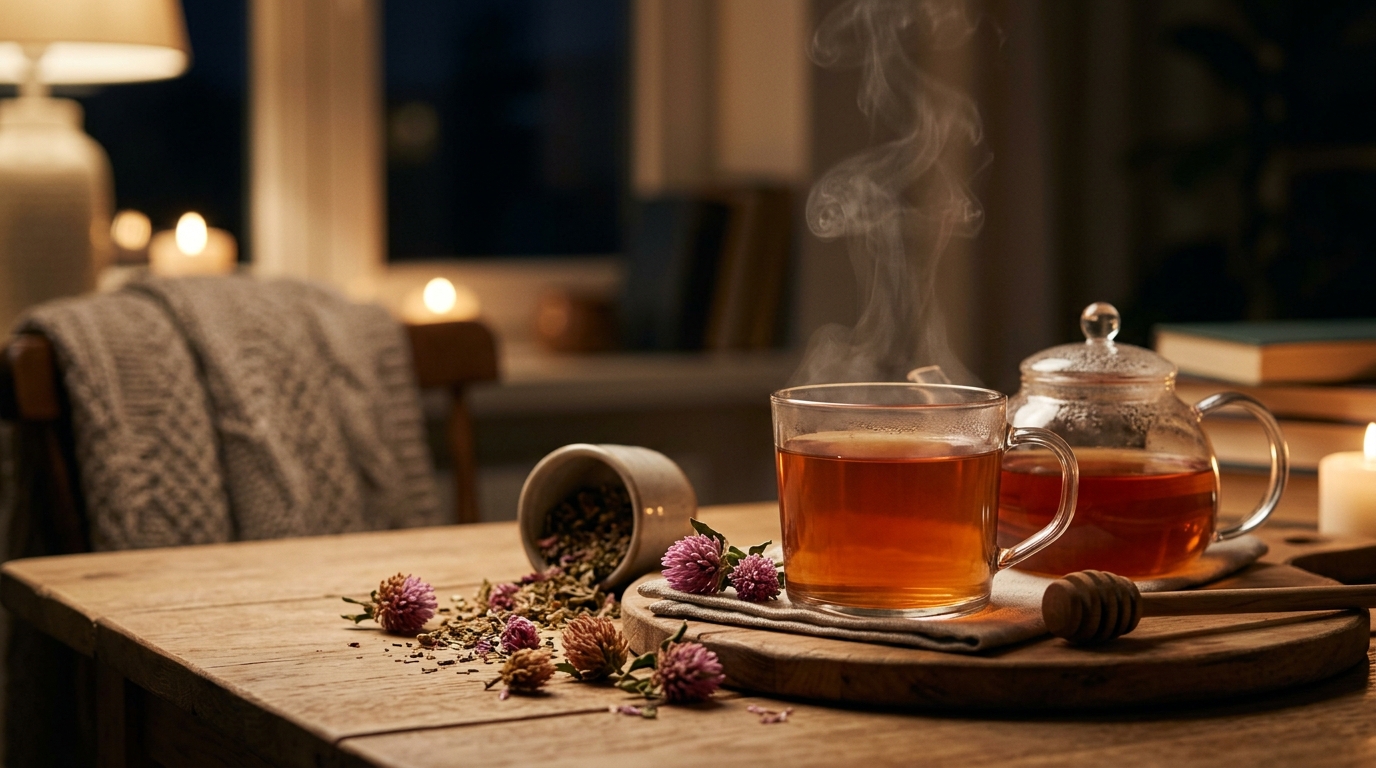
Walk through almost any meadow in the temperate world and you will find red clover nodding in the grass, its rose-magenta blooms humming with bees. Trifolium pratense has been a companion to people for centuries. Farmers grew it to enrich the soil, and herbalists gathered its blossoms for something quite different: a tonic for the blood, the skin, and the reproductive system.
In European folk medicine, red clover flower tea was prized as an alterative, a gentle herb believed to cleanse and restore the body over time. Eclectic physicians in nineteenth-century North America used it for coughs and skin conditions, while Chinese and Russian traditions also made room for clover in their healing practices. Today, red clover is best known for its isoflavone content, particularly the compounds formononetin, biochanin A, genistein, and daidzein, which is why it has become a staple in women’s wellness routines.
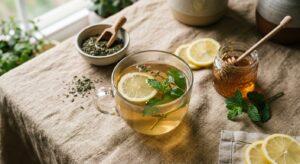
What makes red clover especially lovely as an evening tea is how it tastes and feels. It is naturally mild, faintly sweet, and hay-like, without the bitterness that makes some women’s herbs a chore to drink. A warm cup at the end of the day signals the body to slow down, and for many women the ritual itself is as valuable as the chemistry in the cup.
2
cups
Ingredients
- 2 tbspdried red clover blossoms
- 480 mlfreshly boiled water (95°C / 203°F)
- —raw honey or maple syrup to taste (optional)
- —a thin slice of lemon or a pinch of dried lemon balm (optional)
How to Brew
Click on an item below to shop for the recommended items for this recipe on Amazon.
As an Amazon Associate, we earn from qualifying purchases.
- Measure 2 tablespoons of dried red clover blossoms into a teapot or large mug. Use whole, vibrant blossoms that still smell sweet and grassy rather than dusty.
- Bring fresh water to a full boil, then let it rest for about 30 seconds so it settles just below boiling.
- Pour 480 ml of the hot water over the blossoms, making sure all the flowers are submerged and moving gently in the water.
- Cover immediately with a lid or saucer and steep for 10 to 15 minutes. Red clover is a delicate flower, so a longer steep draws out more isoflavones and a deeper, rounder flavor without turning bitter.
- Strain into two cups, pressing the blossoms lightly against the strainer to release the last of the liquid.
- Stir in a little honey or maple syrup if desired and drink slowly, ideally an hour before bed.
- Place 3 tablespoons of dried red clover blossoms in a clean glass jar. Cold extraction is gentler, so use a slightly higher ratio than for hot brewing.
- Add 700 ml of cool filtered water and stir gently to wet all the blossoms.
- Seal the jar and refrigerate for 8 to 10 hours, or overnight. There is no need to shake the jar, as slow, undisturbed infusion yields the cleanest flavor.
- Strain through a fine mesh sieve or a coffee filter into a pitcher, discarding the spent flowers.
- Serve over a few ice cubes, or pour a mug and warm it gently on the stove without letting it boil. Add a squeeze of lemon if you like a brighter finish.
- Place 1/2 cup of dried red clover blossoms into a quart-sized (about 1 liter) glass jar.
- Boil water, then pour it over the blossoms until the jar is full, leaving about a centimeter of space at the top.
- Cap the jar tightly and let it stand on the counter. As it cools, the water will gradually draw out more of the plant’s compounds than a short steep can.
- After 4 hours for a moderate infusion, or up to 8 hours or overnight for a rich, dark infusion, strain well through a fine sieve.
- Store the infusion in the refrigerator and drink within 24 hours. Pour 120 to 240 ml into a mug and warm gently before sipping in the evening.
- Compost the spent flowers, as they have given all they have.
Health Benefits
Red clover isoflavones act as weak phytoestrogens, and some clinical trials have found modest reductions in hot flash frequency, though results across studies are mixed and effects tend to be gentle rather than dramatic.
Isoflavones may help slow bone loss in perimenopausal and postmenopausal women by supporting estrogen-responsive bone cells, with some small studies showing preserved bone mineral density.
Isoflavones have been associated with improved arterial flexibility and modest improvements in HDL cholesterol, which makes red clover a heart-friendly choice for midlife women.
While not a sedative itself, the warm, mild, caffeine-free nature of red clover tea makes it an ideal wind-down ritual, and easing hot flashes at night can indirectly improve sleep quality.
Historically used as a blood-cleansing alterative for skin concerns like eczema, this use rests mainly on traditional practice, though the herb’s flavonoids do provide antioxidant support.
🧪 Key Bioactive Compounds
The Science Behind Red Clover
Red clover’s reputation rests primarily on its isoflavones, a class of plant compounds called phytoestrogens. Their molecular shape resembles human estradiol closely enough that they can bind to estrogen receptors, though far more weakly. Importantly, isoflavones show a stronger affinity for estrogen receptor beta than for receptor alpha. Because receptor beta is common in bone, blood vessels, and brain tissue, while receptor alpha dominates in breast and uterine tissue, this selectivity is thought to explain why isoflavones may offer some benefits without strongly stimulating tissues in the same way as pharmaceutical estrogen.
The story gets more interesting in the gut. Intestinal bacteria convert daidzein into equol, a metabolite with higher estrogenic potency and longer-lasting activity. Only about 30 to 50 percent of Western adults harbor the bacteria needed to make equol, which may partly explain why people respond so differently to red clover and soy. Some researchers believe equol producers experience more noticeable relief from hot flashes than non-producers.
Clinical evidence is encouraging but not conclusive. Several randomized trials, along with meta-analyses, suggest small to moderate reductions in hot flash frequency compared to placebo, while others show no significant difference. Most studies use standardized extracts rather than tea, which means a cup of tea delivers a gentler, more variable dose of isoflavones. For this reason, red clover tea is best viewed as a supportive daily ritual rather than a replacement for medical treatment of significant menopausal symptoms.
Brewing Tips
- Choose dried red clover blossoms that are still rosy-pink and fragrant. Brown, dusty flowers have lost both flavor and potency.
- Steep longer than you would for most floral teas. Ten to fifteen minutes covered extracts far more of the isoflavones and gives a rounder, sweeter taste.
- Drink it consistently for several weeks to judge its effects. Phytoestrogenic herbs work gradually, and most women need at least four to eight weeks to notice a difference.
- Store dried blossoms in a sealed glass jar away from light and heat, and use within a year for the best flavor.
- If you take any medication or have a hormone-related health condition, speak with your healthcare provider before making red clover a daily habit.