Ovarian cysts are a remarkably common experience, affecting millions of women during their reproductive years. While many cysts resolve on their own, the discomfort, hormonal disruption, and anxiety they bring are very real. Long before modern gynecology, herbalists and healers across Europe, Asia, and the Americas turned to the plant kingdom for support, using hormone-balancing and anti-inflammatory herbs to ease pelvic discomfort and encourage the body’s natural cycles. This tradition has never disappeared, and today it is being revisited with renewed scientific curiosity.
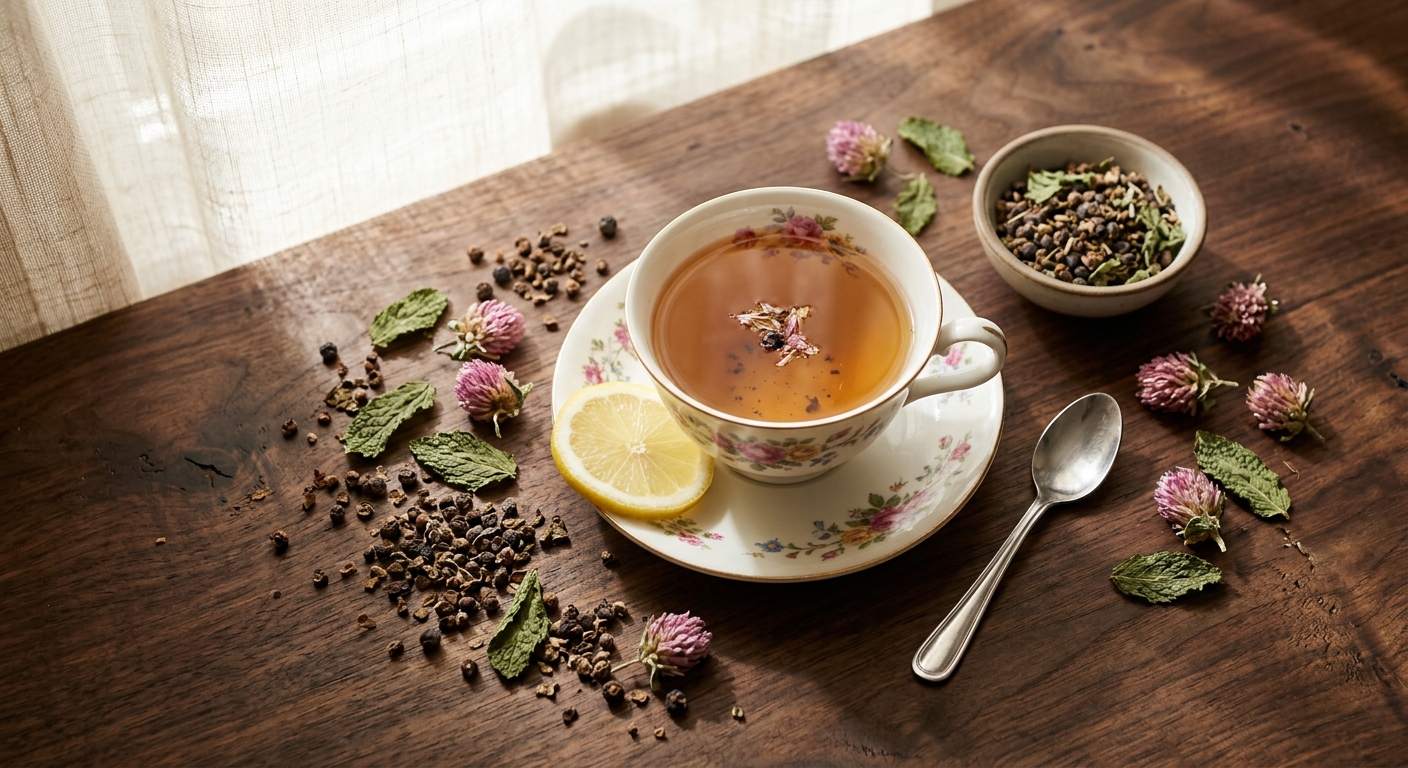
The blend at the heart of this recipe brings together three complementary herbs: vitex agnus-castus (chaste tree berry), spearmint, and red clover. Vitex has been used for over two thousand years in Mediterranean herbal medicine to regulate menstrual cycles and support progesterone balance. Spearmint, beyond its refreshing flavor, has been studied for its ability to reduce elevated androgens, which are often implicated in polycystic ovarian syndrome (PCOS). Red clover contributes isoflavones that interact gently with estrogen receptors, offering mild phytoestrogenic support. Together, these three herbs form a thoughtfully layered tea with both tradition and emerging science behind it.
This tea is not a treatment or cure for ovarian cysts, and it should never replace medical evaluation or care. However, as a complementary wellness practice, a daily cup of this blend can become a meaningful ritual, one that supports hormonal balance, reduces inflammation, and invites a moment of calm into a health journey that is often stressful and uncertain. Brew it with intention, drink it consistently, and pair it with open communication with your healthcare provider.
2
cups
Ingredients
- 1 tspdried vitex (chaste tree) berries, lightly crushed
- 1 tspdried spearmint leaves
- 1 tspdried red clover blossoms
- 480 mlwater (95°C / 203°F)
- —raw honey or maple syrup to taste (optional)
- —a thin slice of fresh lemon (optional)
How to Brew
Click on an item below to shop for the recommended items for this recipe on Amazon.
As an Amazon Associate, we earn from qualifying purchases.
- Lightly crush 1 teaspoon of dried vitex berries using the back of a spoon or a mortar and pestle. This breaks the outer shell slightly and helps release the active iridoid glycosides and flavonoids into the water.
- Combine the crushed vitex berries, 1 teaspoon of dried spearmint leaves, and 1 teaspoon of dried red clover blossoms in a tea infuser, muslin bag, or small teapot with a built-in strainer.
- Heat 480 ml of filtered water to approximately 95°C (203°F). If using a standard kettle, bring to a full boil and allow it to rest for 30 to 45 seconds before pouring.
- Pour the hot water over the herb blend and cover the cup or teapot with a lid or small plate. Covering is essential: it traps the volatile aromatic oils from spearmint that would otherwise escape with the steam.
- Steep for 10 to 15 minutes. For a milder flavor, remove at 10 minutes. For maximum medicinal extraction, allow the full 15 minutes.
- Remove the infuser, stir gently, and sweeten with raw honey if desired. Add a thin lemon slice for brightness. Drink one cup in the morning and, if desired, a second cup in the early evening.
- Lightly crush 2 teaspoons of dried vitex berries (double the hot-brew amount, as cold water extracts compounds more slowly). Combine with 2 teaspoons each of dried spearmint and dried red clover blossoms in a clean glass jar.
- Pour 480 ml of cold, filtered water directly over the herbs. Stir briefly to ensure all plant material is submerged and in contact with the water.
- Place a lid or cover on the jar and leave it at room temperature for 1 hour, then transfer to the refrigerator.
- Allow the herbs to infuse in the refrigerator for 8 to 12 hours, ideally overnight. The slow, cool extraction draws out the gentler, water-soluble phytochemicals while minimizing the extraction of harsher bitter compounds from vitex.
- In the morning, strain the cold brew through a fine mesh strainer or cheesecloth into a glass, pressing gently on the spent herbs to extract the last of the liquid.
- Serve over ice if desired. Sweeten with a small amount of maple syrup or honey stirred in while the liquid is slightly warmer than fridge temperature, as sweeteners dissolve poorly in very cold liquids. Drink within 24 hours for best freshness and potency.
- Place 2 teaspoons of lightly crushed dried vitex berries into a small stainless steel or ceramic saucepan. Add 600 ml of cold filtered water (extra volume accounts for evaporation during simmering).
- Bring the water slowly to a gentle simmer over medium-low heat. Do not allow it to reach a vigorous rolling boil. Maintain a steady, gentle simmer and allow the vitex berries to decoct uncovered for 20 minutes, stirring occasionally.
- After 20 minutes, remove the saucepan from the heat. Add 1.5 teaspoons of dried spearmint leaves and 1.5 teaspoons of dried red clover blossoms directly into the hot liquid.
- Immediately place a lid on the saucepan and allow the blend to rest off-heat for 10 minutes. This resting infusion step extracts the heat-sensitive volatile oils and isoflavones from the spearmint and red clover without destroying them through prolonged boiling.
- Strain the decoction through a fine mesh strainer into two mugs, pressing gently on the herb material. The resulting tea will be noticeably deeper in color and more robust in flavor than the hot-brew method.
- Sweeten lightly if needed and drink while warm. This method is best suited for the colder months or days when a stronger, more concentrated cup is desired. Because the decoction is more potent, limit intake to one cup per day.
Health Benefits
Vitex agnus-castus acts on dopamine D2 receptors in the pituitary gland, which suppresses excess prolactin secretion. Elevated prolactin can interfere with the LH surge needed for ovulation, and normalizing it supports more regular, cyst-reducing cycles. Multiple clinical trials, including a Cochrane-reviewed body of evidence, support vitex’s efficacy for cycle irregularities.
Spearmint tea has been shown in two small randomized controlled trials to significantly reduce free testosterone levels in women with PCOS. High androgens are a primary driver of polycystic ovarian morphology, and dietary reduction through spearmint represents a gentle, accessible complementary strategy.
The isoflavones formononetin and biochanin A in red clover bind preferentially to estrogen receptor beta, which has a more tissue-protective and less proliferative effect than estrogen receptor alpha. This selective binding may help buffer against the effects of estrogen dominance, a hormonal pattern linked to functional ovarian cysts.
Rosmarinic acid from spearmint and the flavonoids in vitex and red clover collectively inhibit pro-inflammatory cytokines including IL-6 and TNF-alpha. Chronic low-grade inflammation in the pelvic region is associated with cyst persistence and endometriosis-related ovarian cysts, making an anti-inflammatory herb blend a sensible supportive tool.
Carvone and other monoterpenes in spearmint act as antispasmodics on smooth muscle tissue, reducing the cramping and pelvic tension that often accompanies functional cysts. Red clover’s mild anti-inflammatory action further supports this, helping to ease the bloating and lower abdominal discomfort many women experience mid-cycle.
🧪 Key Bioactive Compounds
The Science Behind Vitex Agnus-Castus (Chaste Tree Berry)
The science behind this blend centers on the endocrine system, specifically the delicate feedback loop between the hypothalamus, pituitary gland, and ovaries known as the HPO (hypothalamic-pituitary-ovarian) axis. Vitex agnus-castus acts upstream in this axis by binding to dopamine D2 receptors in the anterior pituitary, which suppresses the release of prolactin. When prolactin levels are chronically elevated (a condition called hyperprolactinemia), LH secretion is blunted, ovulation is disrupted, and follicles may fail to release properly, forming functional cysts. By helping to normalize prolactin, vitex supports the hormonal environment in which ovulation can occur more consistently. The iridoid glycoside agnuside and the flavonoid casticin are considered the primary bioactive drivers of this activity, with casticin also demonstrating direct progesterone receptor interaction in vitro.
Spearmint’s contribution to this blend is best understood through the lens of androgen metabolism. In women with PCOS, elevated androgens (particularly testosterone and DHEA-S) disrupt the normal follicle maturation process, causing multiple small, undeveloped follicles to accumulate in the ovary. Rosmarinic acid and luteolin in spearmint inhibit 5-alpha-reductase, the enzyme that converts testosterone to its more potent form, dihydrotestosterone (DHT). A 2010 randomized controlled trial published in Phytotherapy Research found that two cups of spearmint tea daily for 30 days produced a statistically significant reduction in free testosterone in women with PCOS, with a corresponding trend toward improved hormonal ratios. While the study was small, its findings align with the known pharmacology of spearmint’s polyphenols.
Red clover’s isoflavones, formononetin and biochanin A, are phytoestrogens, plant-derived compounds that interact with mammalian estrogen receptors at a fraction of the potency of endogenous estrogen. Their selectivity for estrogen receptor beta (ERb) over estrogen receptor alpha (ERa) is an important distinction: ERb activation tends to have anti-proliferative, anti-inflammatory, and tissue-protective effects, in contrast to the ERa-mediated proliferative effects of stronger estrogens. This selective activity suggests that red clover isoflavones may help modulate, rather than amplify, the estrogen dominance patterns associated with functional ovarian cysts, though long-term clinical data in this specific application remain limited and further research is warranted.
Brewing Tips
- Consistency is everything with vitex: the hormone-balancing effects accumulate over weeks, not days. Commit to drinking this tea daily for at least two full menstrual cycles before evaluating results.
- Store your dried herb blend in an airtight glass jar away from direct sunlight and heat. Pre-mixing a two-week supply saves time and ensures you are using consistent ratios every day.
- Track your cycle alongside this tea practice. Note any changes in cycle length, mid-cycle discomfort, or PMS symptoms in a simple journal or app, as these shifts are often the first signs that the herbal blend is supporting hormonal rebalancing.