
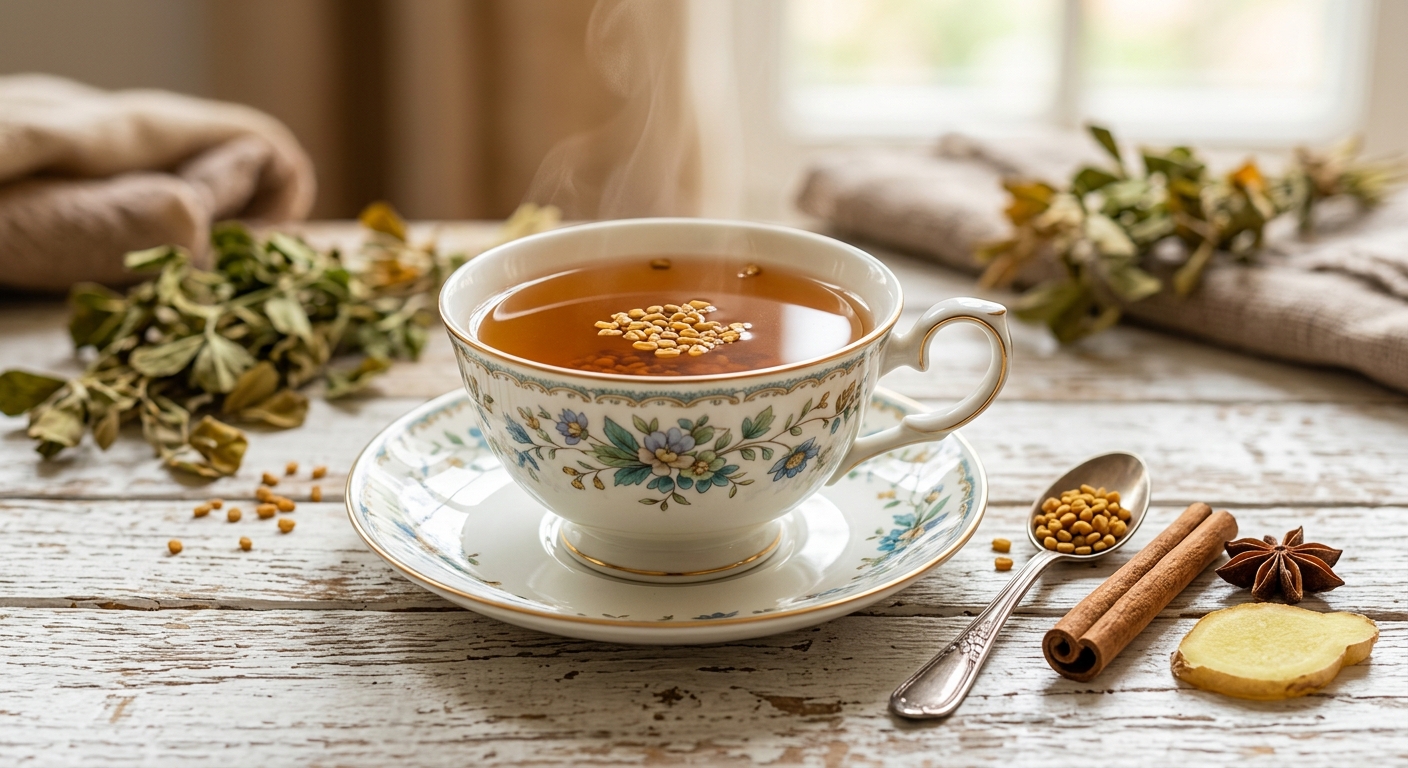
Fenugreek (Trigonella foenum-graecum) is one of the oldest cultivated medicinal plants on record, with documented use stretching back more than 6,000 years. Ancient Egyptian papyri reference it as a remedy for childbirth and nursing, while Ayurvedic texts classify it as a galactagogue, an herb that promotes breast milk production in nursing mothers. In traditional Greek, Roman, and Middle Eastern medicine, fenugreek seeds were boiled into teas and decoctions to ease menstrual cramps, reduce menopausal discomfort, and restore vitality during times of hormonal change. Its name itself reflects this long agricultural and medicinal history: foenum-graecum means ‘Greek hay,’ a nod to its widespread cultivation across the ancient Mediterranean.
What makes fenugreek particularly fascinating for women’s wellness is its rich content of diosgenin, a steroidal saponin with a molecular structure similar to estrogen. This compound, along with a suite of other active phytochemicals, gives fenugreek tea its reputation as a gentle hormonal ally. In many North African and South Asian households, a warm cup of fenugreek seed tea is still the first remedy reached for when a new mother’s milk supply feels low, or when monthly cramps make daily life uncomfortable. The seeds are often lightly roasted before brewing, which deepens their flavor and is said in traditional practice to improve their warming, digestive properties.
Beyond reproductive health, fenugreek tea carries a distinctive, deeply savory flavor profile that sets it apart from the floral or grassy notes of most herbal teas. Its taste is often described as reminiscent of maple syrup or butterscotch with a mild bitterness, thanks to a compound called sotolone. This makes it a uniquely enjoyable functional tea, one that nourishes the body while offering a genuinely satisfying sensory experience. Whether you are a breastfeeding mother, someone navigating perimenopause, or simply curious about this ancient seed’s wellness tradition, fenugreek tea is a brew worth exploring.
2
cups
Ingredients
- 2 tspwhole or lightly crushed fenugreek seeds
- 480 mlwater (95°C / 203°F)
- —raw honey or jaggery to taste (optional)
- —a thin slice of fresh ginger (optional, pairs well)
How to Brew
Click on an item below to shop for the recommended items for this recipe on Amazon.
As an Amazon Associate, we earn from qualifying purchases.
- Optional but recommended: place fenugreek seeds in a small dry skillet over medium-low heat and toast, stirring constantly, for 2 to 3 minutes until they turn a shade darker and release a warm, nutty aroma. Remove from heat immediately to prevent bitterness.
- Add 1 teaspoon of whole or lightly crushed toasted fenugreek seeds per serving (2 tsp total for 2 servings) to a small saucepan or your teapot’s infuser basket.
- Heat filtered water to 95°C (203°F), just below a rolling boil. Pour 480 ml of hot water over the seeds.
- Cover the teapot or saucepan with a lid to trap volatile aromatic compounds and steep for 10 to 15 minutes. The longer steep draws out more saponins and diosgenin but also increases bitterness, so taste at 10 minutes and adjust.
- Strain the seeds through a fine-mesh strainer into your mug. Sweeten with raw honey or jaggery if desired. Add ginger for extra warmth and digestive support.
- Measure 1 tablespoon of whole fenugreek seeds per 480 ml of water. No toasting is needed for cold brew as the long steep compensates for the lack of heat activation.
- Place the seeds directly into a clean glass jar and pour room-temperature filtered water over them. Stir gently to ensure all seeds are submerged.
- Seal the jar with a lid and leave it at room temperature for the first 2 hours, then transfer to the refrigerator.
- Allow the seeds to cold-steep for a total of 8 to 12 hours, or overnight. The seeds will absorb water and swell slightly, releasing their mucilaginous compounds gradually into the liquid.
- Strain through a fine-mesh strainer or cheesecloth into a pitcher or glasses filled with ice. The resulting tea should be golden, mildly sweet, and noticeably smoother than the hot brew. Sweeten lightly with honey if desired and consume within 24 hours.
- Measure 1.5 teaspoons of whole fenugreek seeds per serving and add them to a small saucepan. For 2 servings use 1 tablespoon of seeds with 600 ml of cold water (extra water is added to account for evaporation during simmering).
- Bring the water and seeds together to a full boil over medium-high heat, then immediately reduce the heat to low and maintain a gentle, steady simmer.
- Simmer uncovered for 15 to 20 minutes, stirring occasionally. You will notice the liquid deepening in color and the maple-like aroma intensifying as the seeds release diosgenin and other saponins more completely than hot steeping alone allows.
- Remove from heat and allow to cool slightly for 3 to 5 minutes. Strain through a fine-mesh strainer into mugs, pressing gently on the seeds with the back of a spoon to extract remaining liquid.
- Taste before sweetening. Decoctions are more concentrated and have a stronger bittersweet character. A small amount of jaggery, raw honey, or a pinch of cinnamon balances the intensity well. Drink warm, ideally after a meal.
Health Benefits
Fenugreek is among the most widely used galactagogues in both traditional medicine and modern lactation support. Several small clinical trials, including a 2018 randomized controlled trial published in Phytotherapy Research, found that fenugreek tea significantly increased breast milk volume in the first weeks postpartum. The mechanism is thought to involve diosgenin’s interaction with prolactin pathways and sweat-gland stimulation, as mammary glands are modified sweat glands.
Fenugreek seeds contain anti-inflammatory compounds and phytoestrogens that may reduce the severity of dysmenorrhea (painful menstruation). A randomized study published in the Journal of Reproduction and Infertility found that women who consumed fenugreek seed powder during menstruation reported significantly lower pain intensity and reduced need for analgesics compared to a placebo group.
The phytoestrogen diosgenin binds weakly to estrogen receptors, potentially helping to buffer some of the hormonal fluctuations associated with perimenopause and menopause. A 2017 study in the Journal of Obstetrics and Gynaecology found that women who took a fenugreek seed extract experienced reduced frequency of hot flashes and improved mood scores over an 8-week period.
Fenugreek’s soluble fiber galactomannan slows carbohydrate digestion and glucose absorption, while 4-hydroxyisoleucine directly stimulates pancreatic insulin secretion. This dual mechanism makes fenugreek tea a potentially useful complement for women with PCOS or insulin resistance, both of which are closely tied to hormonal imbalance.
Fenugreek has been used as a digestive tonic in Ayurvedic and Unani medicine for centuries. Its mucilaginous fiber coats and soothes the gastrointestinal lining, while its mildly bitter compounds (trigonelline and alkaloids) stimulate bile production and support healthy digestion, making it particularly useful when consumed after meals.
🧪 Key Bioactive Compounds
The Science Behind Fenugreek
Fenugreek’s most studied bioactive compound for women’s health is diosgenin, a steroidal saponin that belongs to a class of plant compounds capable of interacting with mammalian steroid hormone receptors. Diosgenin is structurally analogous to cholesterol-derived sex hormones and has been shown in both in vitro and animal studies to weakly activate estrogen receptor beta (ER-beta), which plays a role in modulating mood, bone density, and cardiovascular function. This phytoestrogenic activity is thought to explain fenugreek’s traditional reputation for easing estrogen-deficiency symptoms during perimenopause. Unlike synthetic estrogens, phytoestrogens such as diosgenin bind with far lower affinity to estrogen receptors, producing a modulatory rather than strongly stimulating effect, which is why they are often described as gentle hormonal adaptogens.
Fenugreek’s role in lactation is supported by a different but related mechanism. Research suggests that diosgenin may stimulate the proliferation of mammary gland cells and enhance sensitivity to prolactin, the hormone responsible for milk synthesis. Additionally, because mammary glands are embryologically derived from modified apocrine sweat glands, fenugreek’s well-known effect on sweat output (including the characteristic maple syrup odor caused by sotolone being excreted through sweat) is thought to be directly linked to its galactagogue effect. The steroidal saponin glycosides known as fenusides appear to play a complementary role, and are the subject of ongoing clinical investigation into standardized fenugreek extracts for lactation support.
Beyond reproductive hormones, fenugreek’s galactomannan fiber and the unique amino acid 4-hydroxyisoleucine create a compelling profile for metabolic health, particularly relevant for women with PCOS. Galactomannan forms a viscous gel in the digestive tract that physically slows glucose absorption and reduces postprandial blood sugar spikes. Meanwhile, 4-hydroxyisoleucine, found in concentrations of 0.5 to 0.9 percent in fenugreek seeds and rarely seen in other plants, has been shown in isolated pancreatic cell studies to directly potentiate glucose-dependent insulin secretion. For women whose hormonal imbalances are linked to insulin resistance, as is the case in a significant proportion of PCOS diagnoses, fenugreek tea may offer a dual-action benefit by gently supporting both insulin sensitivity and hormonal regulation through distinct but complementary pathways.
Brewing Tips
- Always crush or lightly crack fenugreek seeds with the back of a spoon or a mortar and pestle before hot brewing if you skip toasting, as this increases the surface area and speeds up extraction of active compounds without requiring a full decoction.
- If you find the flavor too bitter, shorten your steep to 8 to 10 minutes for hot brew and balance the taste with a natural sweetener that has its own health benefits, such as raw honey or coconut palm sugar, rather than refined white sugar.
- Store fenugreek seeds in an airtight glass jar away from heat and light. Whole seeds retain their potency for up to 2 years, while pre-ground fenugreek loses its volatile aromatic compounds and active saponins significantly faster, making whole seeds the better choice for medicinal tea preparation.