Wild yam (Dioscorea villosa) is a twining vine native to the forests and thickets of eastern North America and parts of Mexico, where indigenous healers and early herbalists turned to its gnarled, starchy root as one of their most trusted medicines. Known by many names, including colic root, rheumatism root, and devil’s bones, it earned a central place in the traditions of the Cherokee, Mayan, and Aztec peoples, who used it to ease childbirth pain, calm intestinal cramping, and support reproductive health across all stages of a woman’s life. By the eighteenth century, Eclectic physicians in the United States had adopted it widely, prescribing it for dysmenorrhea, nausea of pregnancy, and bilious colic.
What makes wild yam so botanically remarkable is the presence of diosgenin, a steroidal saponin that became the cornerstone of the mid-twentieth century pharmaceutical revolution. In the 1940s, chemist Russell Marker discovered that diosgenin could be laboratory-converted into progesterone, a breakthrough that eventually led to the creation of the birth control pill. While the human body cannot perform this conversion on its own, diosgenin and related saponins appear to exert meaningful effects on hormonal and inflammatory pathways, which helps explain why herbalists have long reached for wild yam during PMS, perimenopause, and uterine cramping.
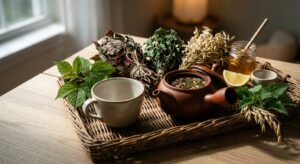
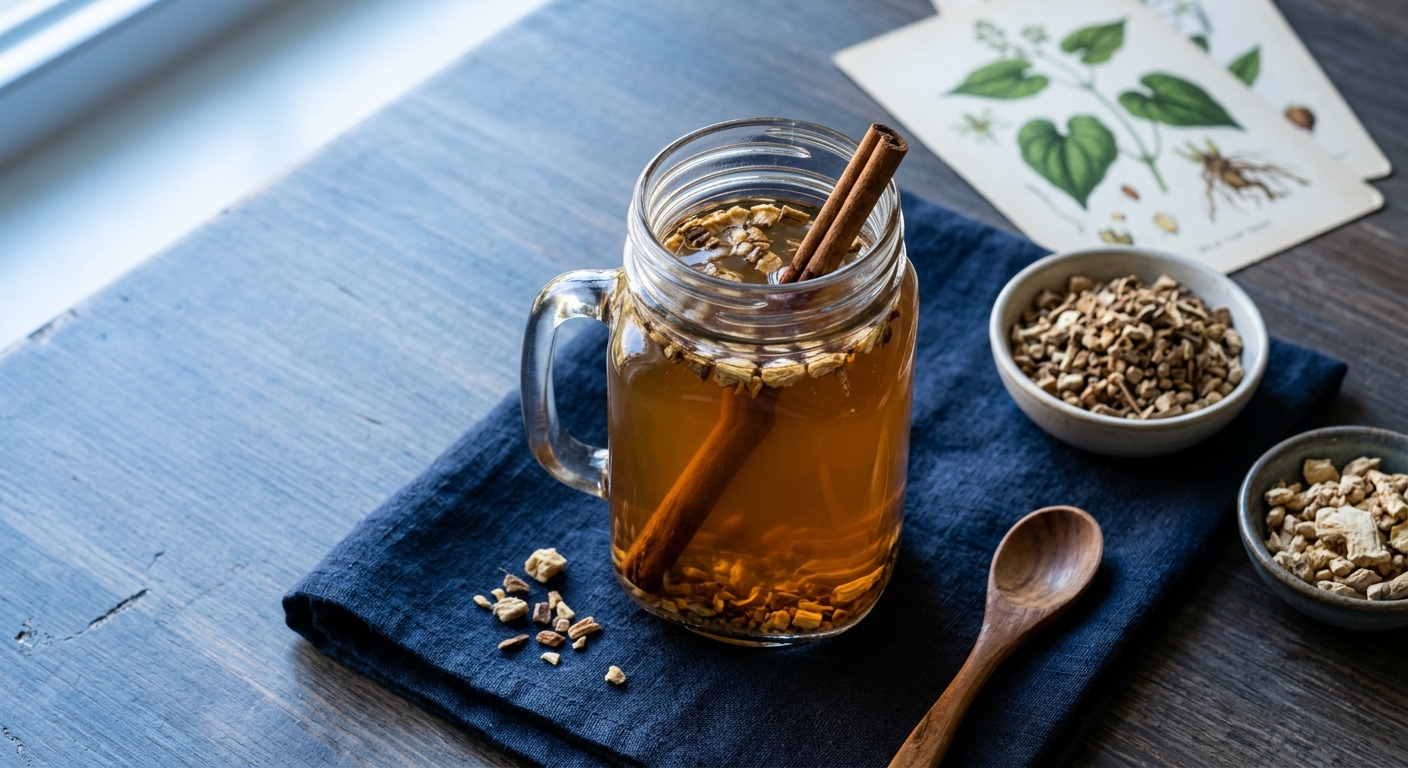
As a tea, wild yam root offers a grounding, slightly bitter, and faintly spicy experience that warms from the inside out. The root requires a proper decoction rather than a simple steep, as its tough, fibrous cell walls need sustained heat and time to release their full spectrum of bioactive compounds. Blended with warming spices like ginger or cinnamon, or sweetened gently with honey, it becomes a genuinely comforting ritual worth returning to throughout the month.
2
cups
Ingredients
- 2 tbspdried wild yam root (chopped or cut-and-sifted)
- 480 mlfiltered water
- 1 tspdried ginger root (optional, enhances absorption and warmth)
- —raw honey or maple syrup to taste (optional)
- —a cinnamon stick for garnish (optional)
How to Brew
Click on an item below to shop for the recommended items for this recipe on Amazon.
As an Amazon Associate, we earn from qualifying purchases.
- Measure 2 tablespoons of dried, chopped wild yam root and place it directly into a small saucepan. If using optional dried ginger root, add it now alongside the wild yam.
- Add 480 ml of cold filtered water to the saucepan. Starting with cold water and bringing it up to temperature together with the root allows deeper extraction of the root’s compounds.
- Place the saucepan over medium-high heat and bring the water to a full rolling boil, stirring once. Once boiling, immediately reduce the heat to a gentle, steady simmer.
- Allow the root to simmer uncovered for 20 to 25 minutes. The liquid will reduce slightly and deepen to a rich amber or tawny brown. If the liquid reduces too quickly, add a small splash of water to maintain volume.
- Remove from heat and allow the decoction to rest for 5 minutes off the burner. This brief resting period allows a final passive extraction as the temperature eases.
- Strain through a fine mesh strainer or cheesecloth into your mug, pressing the spent root gently to release any remaining liquid. Sweeten with raw honey or maple syrup if desired and serve immediately while hot.
- Measure 3 tablespoons of dried chopped wild yam root and place it in a clean glass jar with a lid. The higher ratio compared to the hot decoction compensates for the lower extraction efficiency of cold water.
- Pour 480 ml of cool, filtered water over the root. Stir gently to ensure all of the root is fully submerged and moistened. Do not use ice-cold water at this stage, as room temperature water begins the extraction process more effectively.
- Cover the jar loosely and allow it to sit at room temperature for 2 hours. This initial room-temperature phase jumpstarts saponin extraction before refrigeration slows the process.
- After 2 hours, seal the jar tightly and transfer it to the refrigerator. Allow the root to continue infusing for 10 to 14 additional hours, ideally overnight.
- When ready, strain the cold brew through a fine mesh strainer or muslin cloth into a glass, pressing the root gently. The resulting brew will be a clear, warm amber with a softer, more mellow flavor than the hot decoction.
- Serve chilled over ice or at room temperature. Sweeten lightly if desired. For a warming touch even in cold-brew form, add a pinch of cinnamon powder before drinking.
- Add 4 tablespoons of dried chopped wild yam root to a medium saucepan. Optionally add a 1-inch piece of fresh ginger or one cinnamon stick to complement the root and support circulation.
- Pour 700 ml of cold filtered water into the saucepan. The larger volume accounts for significant evaporation during the extended simmer and still yields a rich, usable concentrate.
- Bring the water to a full boil over medium-high heat, then reduce to the lowest steady simmer your stovetop allows. A gentle, barely bubbling simmer preserves delicate saponins that can degrade under prolonged aggressive boiling.
- Simmer uncovered for 35 to 45 minutes, checking every 10 minutes and adding small amounts of water if the liquid drops below roughly 300 ml. You are aiming for a final yield of approximately 250 to 300 ml of deeply colored, concentrated liquid.
- Remove from heat and cool in the saucepan for 10 minutes before straining through a fine mesh strainer or cheesecloth into a clean glass jar. Press the root firmly to extract all remaining liquid.
- Allow the concentrate to cool completely before sealing the jar and refrigerating. To serve, pour 60 to 80 ml of concentrate into a mug and top with 150 to 180 ml of hot water. Taste and adjust dilution to preference, then sweeten as desired.
Health Benefits
Wild yam’s antispasmodic compounds, particularly dioscin and related saponins, help relax smooth muscle tissue in the uterus and gastrointestinal tract. Traditional herbalists have relied on it for dysmenorrhea for centuries, and its mechanism aligns with modern understanding of smooth muscle modulation via steroidal saponin pathways.
Diosgenin and phytosterols in wild yam interact with estrogen receptors in ways that may help modulate the hormonal fluctuations characteristic of perimenopause. Several small clinical studies have found that wild yam cream and extract reduced hot flash frequency and improved hormonal markers, though more large-scale trials are needed.
Multiple compounds in wild yam root, including diosgenin, dioscin, and dioscorin, have demonstrated significant anti-inflammatory activity in preclinical studies by suppressing pro-inflammatory cytokines such as TNF-alpha and IL-6, which may benefit conditions like endometriosis, arthritis, and general inflammatory pain.
Wild yam was historically prescribed by Eclectic physicians specifically for nausea in pregnancy (under qualified guidance), bilious colic, and intestinal cramping. Its antispasmodic action on gut smooth muscle helps ease tension-driven digestive discomfort, bloating, and bowel irregularity.
The root’s tannins, dioscorin protein, and polyphenolic compounds contribute meaningful free-radical scavenging activity. Regular consumption as part of a varied herbal practice may help reduce oxidative stress, which plays a role in both hormonal imbalance and chronic inflammatory conditions.
🧪 Key Bioactive Compounds
The Science Behind Wild Yam
The most celebrated compound in wild yam root is diosgenin, a steroidal saponin sapogenin that garnered global scientific attention in the 1940s when chemist Russell Marker successfully synthesized progesterone from it in a process now known as the Marker degradation. This breakthrough made large-scale production of steroid hormones economically viable and directly enabled the development of hormonal contraception and corticosteroid medications. However, it is critically important to understand that while diosgenin can be chemically converted to progesterone in a laboratory using reagents and multi-step synthesis, the human body does not possess the enzymatic machinery to perform this conversion. Topical wild yam creams marketed as natural progesterone are not equivalent to bioidentical progesterone preparations, and claims that wild yam raises serum progesterone levels in humans are not supported by current evidence.
What the science does support is diosgenin’s role as a selective estrogen receptor modulator (SERM)-like compound. Cell culture and animal studies have demonstrated that diosgenin binds to estrogen receptors with varying affinity depending on tissue type, meaning it may exert estrogenic effects in some tissues while blocking them in others, a profile that has sparked interest in its potential applications for hormone-sensitive conditions. Related saponin glycoside dioscin has shown anti-inflammatory activity in multiple preclinical models by suppressing NF-kB signaling, a master regulator of inflammatory gene expression, and by reducing pro-inflammatory cytokines including TNF-alpha, IL-1-beta, and IL-6. This mechanism offers a plausible biochemical basis for the herb’s traditional antispasmodic and anti-inflammatory uses across cultures.
Dioscorin, a water-soluble storage protein unique to Dioscorea species, has attracted growing interest in nutritional biochemistry. Studies published in food science journals have identified its antioxidant activity via free-radical scavenging and its mild angiotensin-converting enzyme (ACE) inhibitory effects, which could have modest cardiovascular implications. The root’s tannin and polyphenol content adds another layer of antioxidant protection and may support gut barrier integrity by binding to and neutralizing gut irritants. While human clinical trial data on wild yam tea specifically remains limited, the convergence of its traditional uses with plausible molecular mechanisms makes it one of the more scientifically interesting herbs in the women’s health toolkit, and an active area for ongoing phytochemical research.
Brewing Tips
- Always use cut-and-sifted or coarsely chopped dried wild yam root rather than powder for decoctions. Powdered root can turn the brew murky and difficult to strain cleanly, and the increased surface area can make the flavor overly bitter and astringent.
- To align your wild yam tea practice with your cycle, many herbalists recommend drinking it during the luteal phase (days 15 to 28) when PMS symptoms tend to peak, rather than throughout the entire month, allowing the body natural periods of rest from the root’s active compounds.
- Store dried wild yam root in an airtight glass container away from light and heat. Properly stored, it retains its potency for up to two years. If the root has lost most of its earthy, slightly spicy aroma, it is likely too old to yield a therapeutically meaningful brew.