Bone loss is one of the quietest health concerns facing women, often progressing without symptoms until a fracture or diagnosis arrives unexpectedly. In the decades surrounding menopause, declining estrogen accelerates the breakdown of bone tissue faster than the body can rebuild it. Long before pharmaceutical interventions became standard, herbalists across Europe, Asia, and the Americas turned to mineral-rich plants to nourish the skeletal system from within. Horsetail, nettle leaf, oat straw, and red clover have each earned a place in women’s traditional medicine for this very purpose, offering a combination of bioavailable silica, calcium, magnesium, and isoflavones that support bone remodeling at a cellular level.
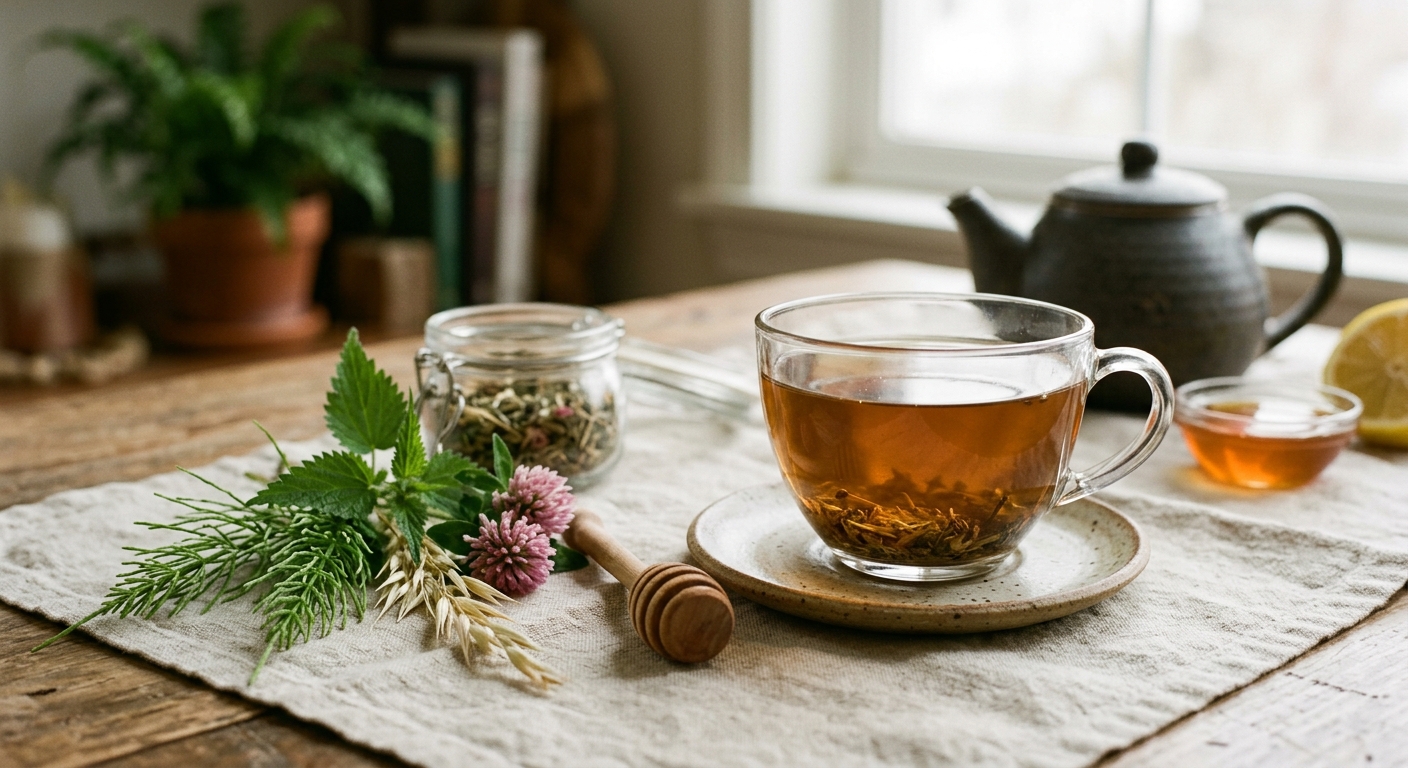
Horsetail (Equisetum arvense) is perhaps the most ancient of these allies, a plant so primitive it predates flowering plants by hundreds of millions of years. Its extraordinary silica content, up to 25% of its dry weight, has made it a cornerstone of bone and connective tissue support in European herbal medicine since at least the time of the Roman physician Dioscorides. Nettle leaf (Urtica dioica) contributes a remarkable concentration of calcium, magnesium, and vitamin K, while oat straw (Avena sativa) supplies additional silica, calcium, and nervine compounds that reduce the cortisol-driven bone breakdown associated with chronic stress. Red clover (Trifolium pratense) rounds out the blend with its well-studied isoflavones, plant compounds that gently mimic estrogen’s bone-protective action in postmenopausal women.
This tea is designed to be a daily ritual rather than a quick fix. Bone tissue renews itself on a months-long cycle, and the minerals and phytoestrogens in these herbs work most effectively when consumed consistently over time. The flavor is earthy and gently grassy with a mild sweetness from the red clover, making it a pleasant companion to a morning routine or an evening wind-down. Whether you are in your thirties building your peak bone mass, navigating perimenopause, or managing osteopenia, this blend offers a thoughtful, time-honored foundation of support.
2
cups
Ingredients
- 2 tspdried horsetail herb
- 1.5 tspdried nettle leaf
- 1 tspdried oat straw
- 1 tspdried red clover blossoms
- 480 mlwater (95°C / 203°F)
- —raw honey or a squeeze of lemon to taste (optional)
How to Brew
Click on an item below to shop for the recommended items for this recipe on Amazon.
As an Amazon Associate, we earn from qualifying purchases.
- Measure 2 tsp dried horsetail, 1.5 tsp dried nettle leaf, 1 tsp dried oat straw, and 1 tsp dried red clover blossoms per 480 ml of water. Combine all herbs in a tea infuser, muslin bag, or directly in a teapot.
- Heat filtered water to 95°C (203°F), just below a rolling boil. Using fully boiling water is acceptable for this blend, as the fibrous plant material benefits from high heat to release minerals.
- Pour the hot water over the herbs, cover the pot or mug immediately with a lid or small plate to trap the volatile aromatic compounds and prevent mineral-rich steam from escaping.
- Steep for a full 15 to 20 minutes. Set a timer and resist the urge to shorten the steep. The longer infusion time is what separates a mineral-rich medicinal tea from a simple beverage.
- Strain thoroughly into your mug, pressing the herbs gently against the strainer to extract every last drop of mineral-rich liquid.
- Taste before sweetening. The earthiness of the blend pairs well with raw honey or a thin slice of lemon, which also enhances mineral absorption through gentle acidification.
- Combine 3 tsp dried horsetail, 2 tsp dried nettle leaf, 1.5 tsp dried oat straw, and 1.5 tsp dried red clover blossoms in a clean glass jar. Cold brewing calls for slightly larger quantities than hot brew to compensate for lower extraction temperatures.
- Pour 480 ml of cold, filtered water over the herbs. Stir gently with a long spoon to fully saturate all plant material, ensuring no dry clumps remain floating at the top.
- Seal the jar with a lid and let it sit at room temperature for one hour to begin the extraction process, then transfer to the refrigerator.
- Allow the herbs to steep in the refrigerator for 10 to 12 hours, ideally overnight. The slow, cold extraction draws out mineral compounds and isoflavones gradually without degrading delicate phytonutrients.
- When ready, strain the cold brew through a fine mesh strainer lined with cheesecloth into a glass or pitcher, pressing the herbs to extract fully. Serve over ice or enjoy chilled.
- Cold brew concentrate can be stored in the refrigerator for up to 24 hours. Stir before serving as some mineral sediment may settle at the bottom.
- Combine 2.5 tsp dried horsetail, 2 tsp dried nettle leaf, 1.5 tsp dried oat straw, and 1 tsp dried red clover blossoms in a small stainless steel or ceramic saucepan with 600 ml of cold, filtered water. Starting in cold water allows mineral compounds to begin releasing as the temperature climbs.
- Place the saucepan over medium heat and bring the water slowly to a gentle simmer. Do not rush this with high heat. A gradual temperature rise encourages a fuller mineral extraction from the plant cell walls.
- Once simmering, reduce the heat to low, cover the pan with a lid, and allow the herbs to simmer gently for 20 to 25 minutes. Check occasionally and add a small splash of water if the liquid reduces too quickly.
- Remove from heat and allow the decoction to sit covered for an additional 10 minutes off the heat. This resting period allows residual heat to extract the final compounds without further cooking.
- Strain through a fine mesh strainer into a heatproof pitcher or directly into mugs, pressing the cooked herbs firmly to recover all liquid. You should yield approximately 400 to 450 ml of concentrated tea.
- Taste the decoction. It will be noticeably stronger and more mineral-forward than the hot brew. Dilute with a small amount of hot water if preferred, or sip as-is. A slice of fresh ginger added during the simmer can balance the earthiness with warming spice.
Health Benefits
The combination of bioavailable silica from horsetail, calcium and magnesium from nettle, and isoflavones from red clover addresses bone health through multiple pathways simultaneously. Studies on horsetail extract and red clover isoflavones have each independently shown measurable effects on bone resorption markers in postmenopausal women.
Formononetin and biochanin A from red clover act as selective estrogen receptor modulators at bone tissue, slowing the osteoclast activity that accelerates bone loss when estrogen levels decline during perimenopause and menopause. A 2007 randomized controlled trial found that red clover isoflavone supplementation significantly slowed the rate of lumbar spine bone density loss over two years.
Silicon from horsetail is a cofactor in the hydroxylation of proline and lysine, amino acids essential for collagen cross-linking that gives bone its flexible tensile strength. Without adequate silica, the collagen matrix weakens and bone becomes brittle even when calcium levels are sufficient.
Chronic elevated cortisol is a well-documented driver of bone mineral loss, inhibiting osteoblast function and increasing urinary calcium excretion. The adaptogenic and nervine compounds in oat straw help moderate the stress response, reducing cortisol-related bone breakdown over time.
Nettle leaf contains quercetin, kaempferol, and caffeic acid, all of which inhibit pro-inflammatory cytokines including TNF-alpha and IL-1 beta that contribute to inflammatory bone and joint degradation. Reducing systemic inflammation is increasingly recognized as central to preserving bone architecture.
🧪 Key Bioactive Compounds
The Science Behind Horsetail
The science behind this bone density blend centers on a concept that is often overlooked in conventional bone health discussions: calcium alone is insufficient for maintaining strong bones. Bone is a living matrix of collagen fibers, calcium phosphate crystals, and a network of osteoblast and osteoclast cells in constant dialogue. For this matrix to remain robust, the body requires silica for collagen synthesis, magnesium to direct calcium into bone rather than soft tissue, vitamin K to activate the proteins that anchor calcium into the bone matrix, and hormonal signals, particularly estrogen, to modulate the balance between bone-building and bone-resorbing cells. The herbs in this blend address every one of these requirements with documented bioactive compounds.
Horsetail’s silica content has been the subject of increasing scientific interest since research confirmed that silicon is a critical cofactor in collagen cross-linking. A 2016 systematic review in the Archives of Osteoporosis highlighted silicon’s role in stimulating type I collagen synthesis and osteoblast proliferation, noting that dietary silicon intake correlates positively with bone mineral density in women under 50. Red clover’s isoflavones, particularly formononetin and biochanin A, have been studied in multiple randomized controlled trials. A notable 2007 study published in Osteoporosis International found that women taking standardized red clover isoflavone extract experienced significantly less proximal radius bone density loss over 12 months compared to placebo. The mechanism involves competitive but weak binding to estrogen receptor beta at bone tissue, reducing osteoclast recruitment without the systemic estrogenic effects associated with pharmaceutical hormone therapy.
Nettle leaf’s contribution is more straightforwardly nutritional but no less important. Urtica dioica delivers calcium, magnesium, boron, and vitamin K1 in a food-matrix form that research suggests is more readily absorbed than isolated supplements. Boron, present in small but meaningful amounts in nettle, has been shown to reduce urinary calcium excretion and to modestly elevate serum estradiol levels in postmenopausal women, providing an additional hormonal bone-protective mechanism. Oat straw’s saponins and nervine compounds address the cortisol axis, an underappreciated pathway. Studies have confirmed that chronic cortisol elevation suppresses osteoblast differentiation, increases calcium losses through the kidneys, and promotes systemic inflammation that degrades bone architecture over years. By moderating the stress response, oat straw works indirectly but meaningfully alongside the more directly mineral-active herbs in this blend.
Brewing Tips
- Drink this tea daily for at least 8 to 12 weeks before evaluating its effects. Bone remodeling cycles operate on a three-month timeline, so consistency matters far more than intensity.
- Pair each cup with a meal that contains healthy fats, such as avocado, olive oil, or a handful of nuts. Several of the key compounds in this blend, particularly vitamin K1 from nettle, are fat-soluble and are significantly better absorbed when consumed alongside dietary fat.
- Source your horsetail from a reputable supplier that tests for heavy metals. As a silica-accumulating plant, horsetail can also absorb soil contaminants, so organic, tested material is especially important for this herb compared to others in the blend.
- Avoid drinking this tea within two hours of taking calcium or magnesium supplements. The tannins in nettle can bind to minerals and reduce their absorption, so spacing the tea and your supplements apart allows you to get the full benefit of both.
- Consider combining this tea practice with weight-bearing movement. Mechanical loading of bone is the most powerful stimulus for osteoblast activity, and the herbal compounds in this blend work most effectively when the bones are being regularly asked to bear and resist force.