For thousands of years, Ayurvedic healers across the Indian subcontinent have turned to a handful of sacred herbs to support women through every stage of life, from the first moon cycle to the transitions of menopause. Shatavari, whose Sanskrit name translates to ‘she who possesses a hundred husbands,’ has long been revered as the premier female tonic in Ayurvedic medicine. Combined with the adaptogenic strength of ashwagandha, the heart-opening sweetness of rose petals, and the warming digestive support of cardamom, this blend reflects centuries of careful botanical wisdom shaped by the understanding that women’s wellness is deeply cyclical, hormonal, and interconnected.
What makes this tea especially compelling is how these herbs work both individually and synergistically. Shatavari root is rich in steroidal saponins called shatavarins, which are believed to exert a gentle phytoestrogenic influence, making it particularly supportive during times of hormonal fluctuation such as PMS, perimenopause, or postpartum recovery. Ashwagandha brings its renowned adaptogenic properties to calm the HPA axis, lower cortisol, and restore energy reserves depleted by stress. Rose petals contribute antioxidant flavonoids and a sublime floral fragrance that makes the cup as pleasurable as it is therapeutic. Together, they create a tea that feels as much like a ritual as a remedy.
In contemporary wellness circles, this blend has found a new generation of devotees drawn to plant-based alternatives for hormonal support. Clinical research into each of its core herbs has steadily grown over the past two decades, with several randomized controlled trials affirming what Ayurvedic practitioners have always observed: these plants genuinely move the needle on stress markers, hormonal comfort, and reproductive vitality. Brewing a cup of this tea each morning or evening is a small, intentional act of self-care that connects you to one of the world’s oldest and most sophisticated healing traditions.
2
cups
Ingredients
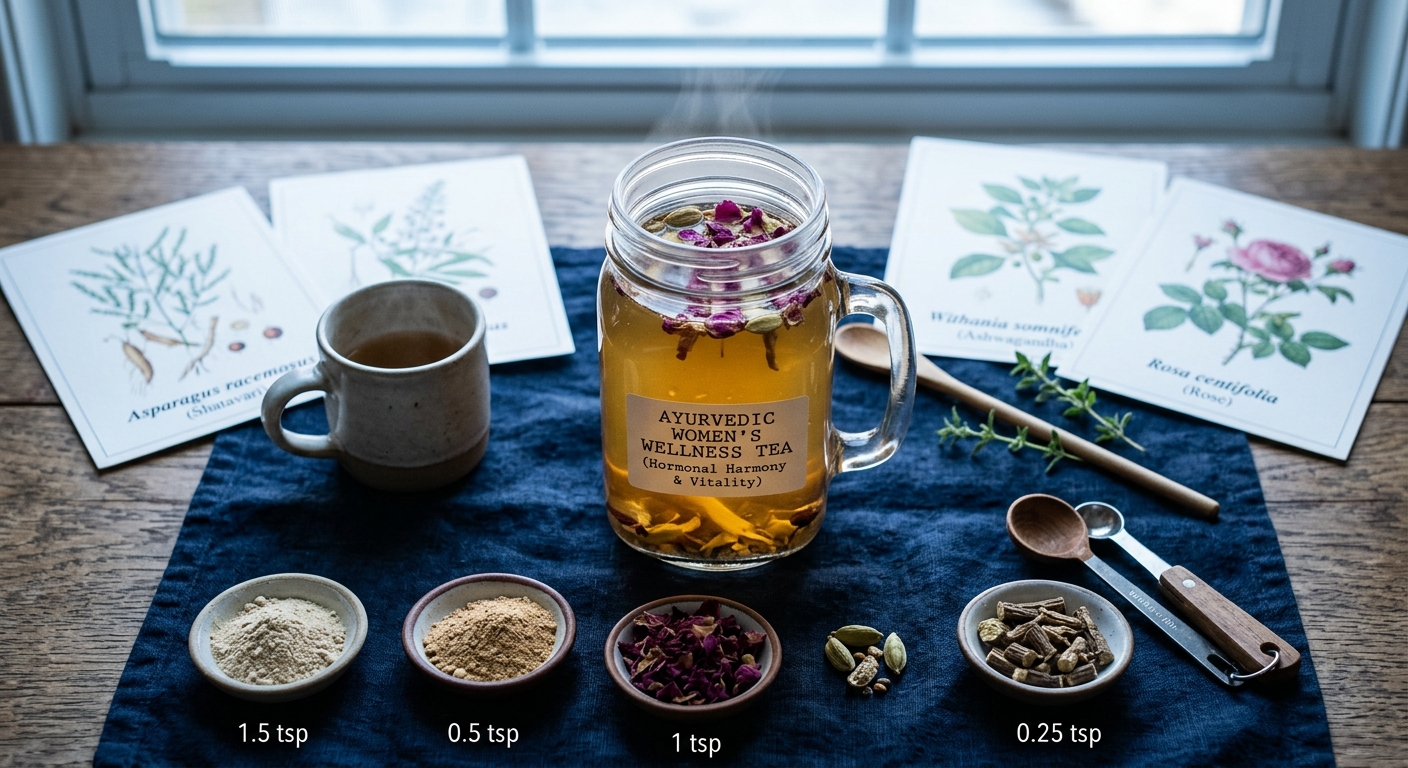
- 1.5 tspshatavari root powder or dried cut root
- 0.5 tspashwagandha root powder
- 1 tspdried rose petals
- 2 podsgreen cardamom, lightly crushed
- 0.25 tspdried licorice root (optional, for sweetness and adrenal support)
- 480 mlwater (95°C / 203°F)
- —raw honey or coconut sugar to taste (optional)
- —splash of warm oat milk or almond milk (optional)
How to Brew
Click on an item below to shop for the recommended items for this recipe on Amazon.
As an Amazon Associate, we earn from qualifying purchases.
- Bring 480 ml of filtered water to approximately 95°C (203°F). If using an electric kettle without temperature control, bring to a full boil and allow it to rest for 60 seconds.
- Place the crushed cardamom pods in a small saucepan or directly into your teapot. Add the shatavari and ashwagandha (powder or cut root). Pour the hot water over the herbs and cover immediately with a lid or small plate to trap volatile aromatic compounds.
- Steep for 8 to 10 minutes. If using cut root rather than powder, gently simmer the roots on the lowest possible heat for 5 minutes before removing from the stove and adding the rose petals. Then cover and steep for a further 3 minutes off the heat.
- Add the dried rose petals and licorice root (if using) during the final 3 minutes of steeping only. Rose petals are delicate and oversteeping them can make the tea slightly tannic and mute their floral quality.
- Strain through a fine mesh strainer into your mug. Stir in raw honey after the tea has cooled slightly below 60°C (140°F) to preserve honey’s enzymes. Add a splash of warm oat milk for a creamy, latte-like finish if desired.
- Measure out the full ingredient quantity for 2 servings into a clean glass jar. Because cold water extracts more slowly, increase the shatavari to 2 teaspoons and the rose petals to 1.5 teaspoons to compensate for the gentler extraction. Use cut root rather than powder if possible, as powder can make the cold brew cloudy and slightly gritty.
- Pour 480 ml of room-temperature filtered water directly over the herbs in the jar. Do not use hot water. Stir briefly to ensure all herbs are submerged, then seal the jar tightly with a lid.
- Leave the jar at room temperature for 1 hour to allow the initial extraction to begin, then transfer to the refrigerator. Steep overnight for 10 to 12 hours. The rose petals will gently blush the water a soft pink over time.
- The following morning, strain through a fine mesh strainer lined with a piece of cheesecloth to remove all root particles and fine powder. Press gently on the solids to extract the full liquid.
- Pour over a glass of ice, sweeten with a small amount of liquid honey or agave (which dissolve easily in cold liquid), and garnish with a single fresh or dried rose petal. Serve immediately or keep refrigerated for up to 24 hours.
- For a traditional kashaya, use double the herb quantity per serving: 3 teaspoons of shatavari root pieces (cut root, not powder) and 1 teaspoon of ashwagandha root pieces per 2 servings. Add the herbs and 700 ml of filtered water to a small stainless steel or ceramic saucepan.
- Bring the water to a full boil over medium-high heat, stirring occasionally. Once boiling, reduce the heat to the lowest possible setting to achieve a gentle, active simmer. The surface of the water should ripple softly but not roll.
- Simmer uncovered for 20 to 25 minutes, allowing the liquid to reduce by approximately one third. This concentrates the active compounds and follows the classical Ayurvedic principle of reducing the liquid to intensify its medicinal action. Stir every 5 minutes.
- Remove from heat and allow to cool for 2 minutes. Add the crushed cardamom pods, rose petals, and licorice root to the hot (but no longer simmering) liquid. Cover the saucepan and allow these delicate additions to infuse for 5 minutes in the residual heat.
- Strain through a fine mesh strainer into a small cup or tea bowl. The resulting kashaya is darker, more concentrated, and noticeably more earthy and bitter than a standard infusion. Traditionally it is taken as a 120 to 180 ml serving rather than a full mug. Stir in a small amount of raw honey or ghee, as fat helps with the absorption of the fat-soluble withanolides in ashwagandha. Sip slowly.
Health Benefits
Shatavari’s steroidal saponins, particularly the shatavarins, interact with estrogen receptors in a selective and modulatory way, helping to buffer the hormonal fluctuations associated with the menstrual cycle, PMS, and the perimenopausal transition. A 2018 clinical review in the Journal of Ethnopharmacology highlighted shatavari’s role as a female reproductive tonic with evidence for reducing dysmenorrhea and supporting cycle regularity.
Ashwagandha is one of the most extensively studied adaptogens in modern clinical research. A landmark double-blind, randomized, placebo-controlled trial published in Medicine (2019) found that participants taking ashwagandha root extract experienced a 23% reduction in serum cortisol levels and significantly lower scores on validated stress and anxiety scales compared to placebo over 60 days.
In classical Ayurvedic texts including the Charaka Samhita, shatavari is classified as a rasayana for women, meaning a rejuvenating herb that tonifies the reproductive organs and supports healthy ovarian function. Preclinical studies have shown shatavari extract to support follicular development and increase circulating luteinizing hormone levels, though robust human clinical trials in this area remain ongoing.
Unlike herbs that reduce anxiety through sedation, ashwagandha works by modulating the stress response at the root, calming overactivation of the HPA axis while simultaneously supporting thyroid function and mitochondrial energy production. Women in perimenopause or high-stress life phases often describe this combination as feeling alert and grounded simultaneously.
Rose petals contribute a dense array of polyphenols including quercetin, kaempferol, and gallic acid that combat oxidative stress linked to hormonal imbalance and aging. Studies have shown rose extract to reduce markers of systemic inflammation including C-reactive protein, which is relevant given the inflammatory component underlying many menstrual disorders including endometriosis and PCOS.
🧪 Key Bioactive Compounds
The Science Behind Shatavari
The science behind this blend’s efficacy for women’s wellness is increasingly well-supported, with shatavari and ashwagandha among the most studied herbs in contemporary Ayurvedic research. Shatavari’s primary active compounds, the shatavarins, are a group of steroidal saponins that have demonstrated selective estrogen receptor modulating activity in vitro. This means they can bind to estrogen receptors and produce a mild estrogenic effect when endogenous estrogen is low (as in menopause), or a mildly anti-estrogenic effect when estrogen levels are high, suggesting an adaptogenic quality specific to the endocrine system. This bidirectional activity may explain shatavari’s traditional reputation for supporting women across such diverse hormonal states, from the reproductive years through to postmenopause.
Ashwagandha’s withanolides, particularly withaferin A and withanolide D, are the compounds most responsible for its adaptogenic and anti-stress effects. These steroidal lactones act on multiple axes simultaneously: they downregulate cortisol secretion from the adrenal glands by modulating the HPA axis, inhibit the inflammatory transcription factor NF-kB, and appear to support mitochondrial function by reducing oxidative phosphorylation stress. For women in high-stress phases, elevated cortisol is a direct antagonist to progesterone synthesis (both cortisol and progesterone share the same precursor, pregnenolone), meaning that chronic stress can directly impair luteal phase adequacy and cycle regularity. Ashwagandha addresses this disruption at a physiological level rather than simply masking symptoms.
Rose petals, often considered primarily a sensory addition, contribute meaningfully to the blend’s therapeutic profile. Their dense polyphenol content, including quercetin, kaempferol, and ellagic acid, provides antioxidant activity that mitigates oxidative stress in reproductive tissues. Quercetin in particular has demonstrated the ability to inhibit aromatase, the enzyme that converts androgens to estrogens, which may have relevance for conditions associated with estrogen excess such as PCOS. The aromatic compounds in rose, including geraniol and citronellol, also engage the olfactory-limbic pathway during inhalation while brewing, triggering a relaxation response in the amygdala before a single sip is taken. This multi-sensory engagement is itself a therapeutic act, underscoring why Ayurvedic medicine has always considered the ritual of preparation as inseparable from the medicine itself.
Brewing Tips
- Source shatavari and ashwagandha from reputable suppliers who provide third-party heavy metal testing, as both are root herbs grown in regions where soil contamination is a genuine concern. Look for certifications from organizations such as the US Pharmacopeia (USP) or NSF International.
- For PMS support, begin drinking one cup daily during the luteal phase (the two weeks between ovulation and your period) and observe your body’s response over two to three cycles before adjusting the blend. Herbal tonics often require consistent use over multiple cycles to demonstrate their full benefit.
- If the earthy, slightly bitter taste of ashwagandha is too pronounced for your palate, adding a small piece of dried licorice root or a pinch of cinnamon can round the flavor significantly without compromising the blend’s efficacy. Licorice also supports adrenal health and pairs well with the adaptogenic theme of the blend.