In the quiet weeks before birth, many cultures have turned to the plant world for support. Labor preparation tea, often anchored by red raspberry leaf, is one of the oldest midwifery traditions in Western herbalism. Historical records from 17th-century European herbalists mention raspberry leaf as a uterine tonic, and indigenous communities across North America have long prepared similar infusions from local botanicals to support women approaching labor. This is not a tea of dramatic action but of quiet, cumulative preparation, honoring the body’s own wisdom as it readies for one of its most profound tasks.
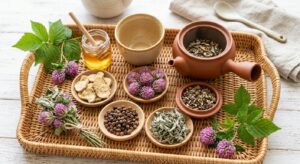
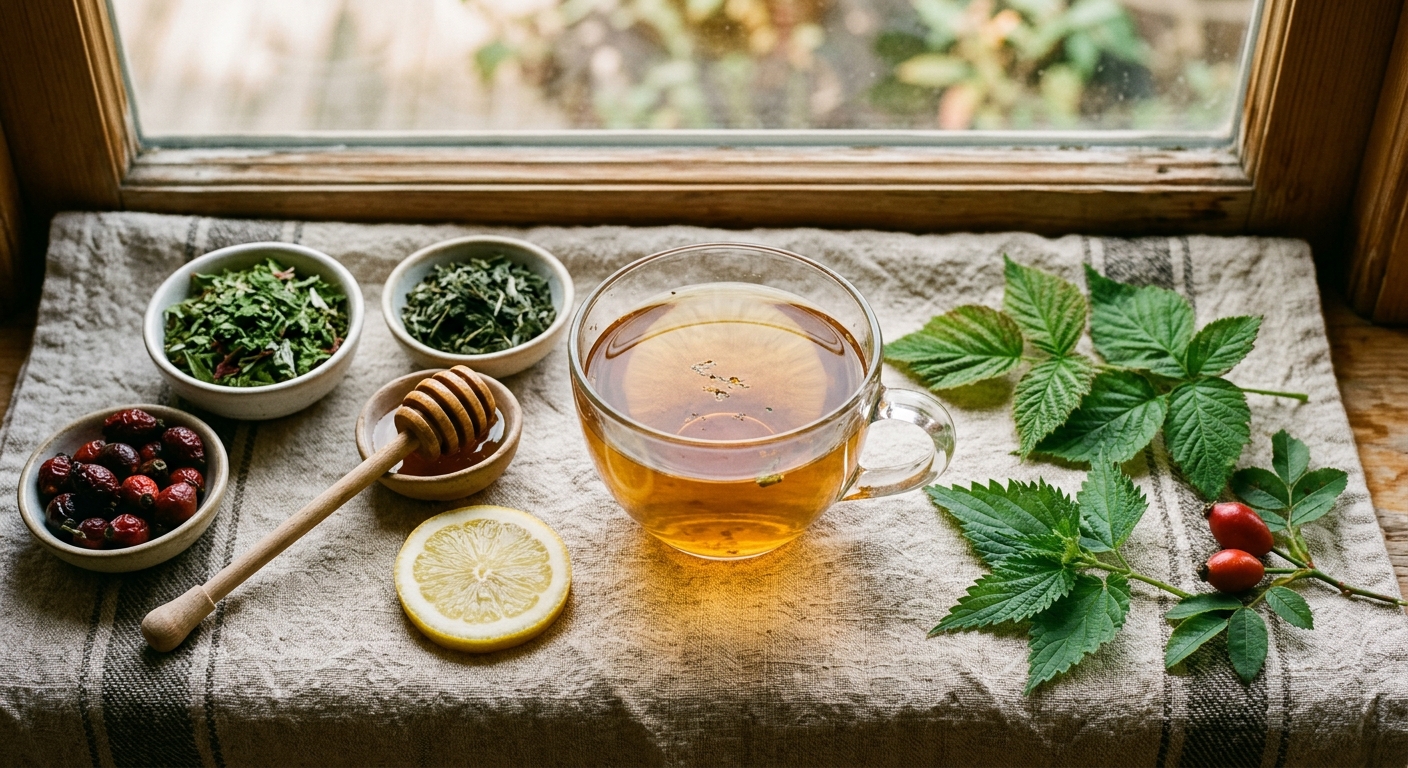
The foundation of most labor preparation blends is Rubus idaeus, red raspberry leaf, which contains a unique alkaloid called fragarine that is believed to tone and relax the smooth muscle of the uterus in a non-stimulating way. Alongside it, nourishing allies like nettle leaf (Urtica dioica) contribute iron, calcium, magnesium, and vitamin K, all vital minerals during the final stretch of pregnancy. Rose hips add a gentle tartness along with a significant dose of vitamin C, which enhances iron absorption and supports connective tissue integrity. Together, these herbs form a blend that is as nutritive as it is tonic.
What makes labor preparation tea special is its cumulative nature. Unlike an acute remedy taken for a sudden ailment, this tea is traditionally consumed daily from around 32 to 36 weeks of pregnancy onward, building up its gentle influence over time. The sensory experience is equally grounding, a warm, earthy, lightly astringent brew with a faint berry undertone from the rose hips, something that feels inherently nourishing to drink as the body does its deep preparatory work. As always, any herbal protocol during pregnancy should be discussed with a qualified midwife or healthcare provider before beginning.
2
cups
Ingredients
- 2 tspdried red raspberry leaf
- 1 tspdried nettle leaf
- 1 tspdried rose hips (whole or crushed)
- 480 mlwater (95°C / 203°F)
- —raw honey to taste (optional)
- —a slice of lemon (optional, enhances iron absorption)
How to Brew
Click on an item below to shop for the recommended items for this recipe on Amazon.
As an Amazon Associate, we earn from qualifying purchases.
- Heat filtered water to 95°C (203°F). If you do not have a temperature-controlled kettle, bring water to a full boil and allow it to rest for one minute before pouring.
- Measure 2 tsp dried red raspberry leaf, 1 tsp dried nettle leaf, and 1 tsp crushed rose hips per 480 ml of water. Place all herbs together in a tea infuser or directly into a teapot.
- Pour the hot water over the herbs, ensuring all plant material is fully submerged. Cover the teapot or mug with a lid or small plate to trap the volatile aromatic compounds and prevent heat loss.
- Steep for 10 to 15 minutes. For a more mineral-rich brew during the final weeks of pregnancy, steep the full 15 minutes. The tea will deepen in color and take on a more pronounced astringency, which is normal and desirable.
- Strain thoroughly, pressing the herbs gently to extract remaining liquid. Add a squeeze of lemon or a small amount of honey if desired. Drink warm, ideally in the morning or early evening.
- In a clean glass jar, combine 3 tsp dried red raspberry leaf, 1.5 tsp dried nettle leaf, and 1.5 tsp crushed rose hips per 750 ml of cold, filtered water. The slightly higher herb ratio compensates for the slower, cooler extraction.
- Stir gently to ensure all herbs are moistened and in contact with the water. Do not cover with a sealed lid immediately. Allow the jar to sit at room temperature for 30 minutes before sealing, to let the herbs fully hydrate.
- Seal the jar and transfer it to the refrigerator. Allow the blend to infuse for a minimum of 8 hours and up to 12 hours. Overnight cold brewing is the most convenient approach.
- In the morning, strain the brew through a fine mesh strainer or muslin cloth into a clean jar or pitcher. Press the herbs gently to release the remaining liquid.
- The finished cold brew will have a deep amber color with a smoother, more rounded flavor than the hot brew. Drink chilled or at room temperature. Consume within 48 hours and store refrigerated.
- Bring 1 liter of filtered water to a full boil at 95 to 100°C. While the water heats, measure 28 to 30 grams (approximately 1 oz) of dried red raspberry leaf, 2 tsp dried nettle leaf, and 2 tsp crushed rose hips. This higher herb-to-water ratio is essential for a true nourishing infusion.
- Place all herbs into a 1-liter glass jar or a large teapot with a lid. Pour the boiling water directly over the herbs, filling the jar completely to the top. A full jar with minimal air space helps preserve volatile compounds.
- Immediately cap the jar tightly with a lid or cover the teapot securely. This is critical to retain the aromatic and volatile elements of the blend. Wrap the jar in a small towel to retain warmth if desired.
- Allow the infusion to steep at room temperature for a minimum of 4 hours, and ideally up to 8 hours. The brew will turn a very deep, almost mahogany color and the flavor will be robust, earthy, and noticeably mineral-rich.
- Strain the infusion thoroughly through a fine mesh strainer or cheesecloth, pressing all liquid from the herbs. The resulting brew may be drunk warm (gently reheated on the stovetop) or at room temperature. It is best consumed within 24 to 36 hours and should be refrigerated between servings.
Health Benefits
Red raspberry leaf has been used for centuries as a uterine tonic in the final trimester. The alkaloid fragarine is thought to tone and coordinate uterine muscle fibers without inducing early contractions, with some clinical observations suggesting it may support more efficient, shorter labors, though large-scale randomized trials remain limited.
Nettle leaf is exceptionally rich in bioavailable iron, calcium, magnesium, and vitamin K. These minerals become especially important in the third trimester as maternal blood volume peaks and fetal bone mineralization accelerates, making nettle one of the most valued nutritive herbs in prenatal herbalism.
The combination of nettle leaf (a plant-based source of non-heme iron) and rose hips (high in vitamin C) creates a synergistic pairing: ascorbic acid from the rose hips significantly enhances non-heme iron absorption in the gut, helping to maintain healthy hemoglobin levels during a period when iron demands are highest.
Rose hips are among the most vitamin C-dense botanicals available, and alongside rutin and quercetin from raspberry leaf and nettle, they provide meaningful antioxidant support. Vitamin C is also essential for collagen biosynthesis, which supports the strength and elasticity of the perineal tissues and cervical structures that will be under significant stress during birth.
The minerals in this blend, particularly magnesium from nettle, play a direct role in nervous system regulation. Magnesium is well-documented for its calming effect on the central nervous system, helping to ease the anxiety and tension that often accompany the final weeks before labor.
🧪 Key Bioactive Compounds
The Science Behind Red Raspberry Leaf
The most studied constituent of red raspberry leaf is fragarine, a polypeptide alkaloid unique to Rubus idaeus. Research into fragarine’s mechanism suggests it acts on the smooth muscle of the uterus in a dual fashion, capable of both relaxing over-contracted muscle fibers and toning under-contracted ones, which is why it is described in herbalism as a uterine normalizer rather than a stimulant. A notable Australian retrospective study observed that women who consumed raspberry leaf in the final weeks of pregnancy had statistically shorter second stages of labor and a lower rate of forceps delivery, though the researchers noted the need for larger randomized controlled trials to confirm these findings. Fragarine is poorly understood in modern pharmacology relative to its long history of use, and research is ongoing.
Nettle leaf (Urtica dioica) brings a distinct nutritive science to this blend. Unlike most herbal infusions that are consumed primarily for their bioactive compounds at trace concentrations, a long infusion of nettle delivers measurable amounts of iron, calcium, magnesium, potassium, and vitamins A and K. The iron in nettle is non-heme iron (ferrous form), which has lower baseline bioavailability than heme iron from animal sources. However, when consumed alongside the ascorbic acid in rose hips, this bioavailability increases significantly, as vitamin C facilitates conversion of ferric to ferrous iron in the gut, the form absorbed through enterocytes. This is a textbook example of herbal synergy working at a biochemical level.
Rose hips (Rosa canina) round out the blend with a dense concentration of ascorbic acid (sometimes exceeding 400 mg per 100 g of dried hips), along with rutin, quercetin, lycopene, and beta-carotene. Rutin has been shown in clinical studies to strengthen capillary permeability and reduce vascular fragility, which is relevant in late pregnancy when blood volume has increased by up to 50 percent. Quercetin, meanwhile, demonstrates anti-inflammatory activity through inhibition of pro-inflammatory cytokines and has shown smooth-muscle-relaxing properties in vitro, complementing fragarine’s toning effect in a nuanced way. Together, these three herbs create a nutritive and tonic matrix that supports the body’s own preparatory physiology in the final weeks before birth.
Brewing Tips
- Begin with one cup daily from 32 to 34 weeks and gradually increase to two to three cups daily from 36 weeks onward, giving your body time to respond gently to the cumulative tonic effect rather than introducing a large amount all at once.
- Crush dried rose hips lightly before adding them to the brew using the back of a spoon or a mortar and pestle. This breaks open the seed-containing core and releases far more vitamin C and flavonoids into the water than whole, intact hips.
- Store dried herbs in airtight glass jars away from direct light and heat. Raspberry leaf, nettle, and rose hips are all sensitive to oxidation and UV degradation, and fresh, well-stored herbs will produce a noticeably more flavorful and potent brew than stale ones.