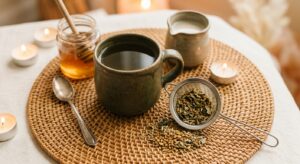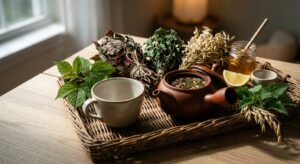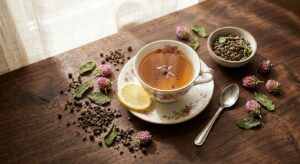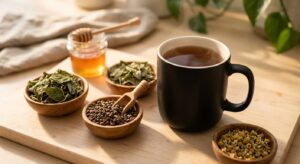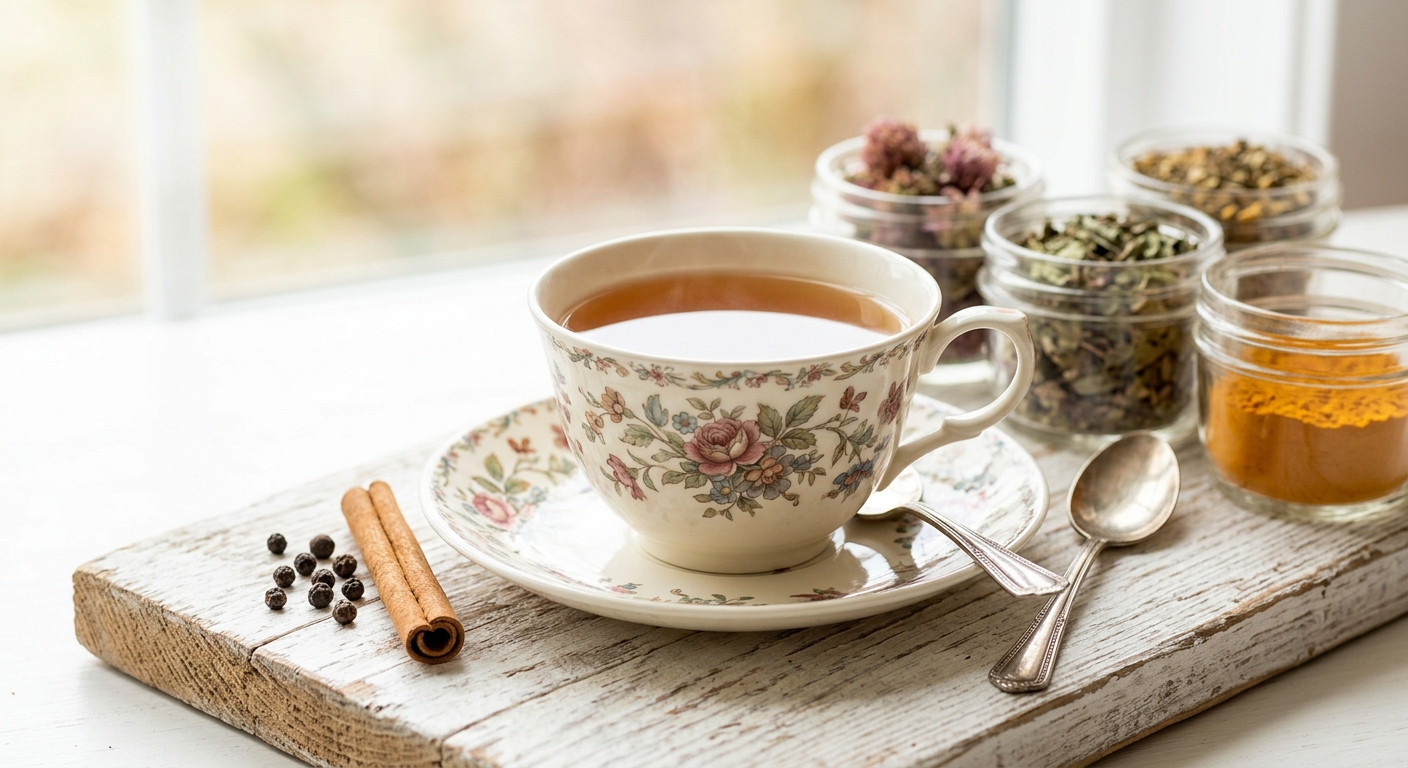
Cervical health sits at the heart of women’s reproductive wellbeing, and herbal traditions across centuries have turned to the plant kingdom for support. Red clover (Trifolium pratense) has been used by European herbalists and Native American healers alike as a tonic for the reproductive system, valued for its isoflavone content that gently modulates estrogen activity. Paired with raspberry leaf (Rubus idaeus), a celebrated uterine tonic rich in fragarine and minerals, and brightened by turmeric (Curcuma longa), one of the world’s most studied anti-inflammatory roots, this blend forms a thoughtful, evidence-informed foundation for supporting cervical tissue and hormonal balance.
Traditional Chinese medicine and Ayurvedic practice have long recognized the interconnectedness of pelvic health, immune function, and chronic inflammation. Modern research increasingly validates this view: persistent inflammation and oxidative stress are recognized contributors to cellular changes in cervical tissue. The herbs in this blend address these pathways directly. Red clover’s isoflavones, raspberry leaf’s ellagic acid, and turmeric’s curcumin each work through complementary mechanisms, making this combination more than the sum of its parts. Nettle leaf is added as a nutritive base, delivering iron, folate, and silica that support healthy tissue repair and immune surveillance.
Whether you are supporting your body through routine wellness, navigating hormonal transitions, or simply building a daily ritual of self-care, this tea offers a grounding, pleasantly earthy cup with floral overtones and a gentle golden warmth. It is best consumed consistently over weeks rather than as a one-time remedy, honoring the slow, nourishing pace at which herbs work most gracefully.
2
cups
Ingredients
- 2 tspdried red clover blossoms
- 1.5 tspdried raspberry leaf
- 1 tspdried nettle leaf
- 0.5 tspground turmeric or 3 thin slices of fresh turmeric root
- 0.25 tspfreshly ground black pepper (enhances curcumin absorption)
- 480 mlwater (95°C / 203°F)
- —raw honey or coconut sugar to taste (optional)
- —a squeeze of fresh lemon juice (optional, brightens flavor and adds vitamin C)
How to Brew
Click on an item below to shop for the recommended items for this recipe on Amazon.
As an Amazon Associate, we earn from qualifying purchases.
- Heat filtered water to 93 to 96°C (199 to 205°F). Avoid a full rolling boil, which can degrade delicate flavonoids in red clover and raspberry leaf.
- Combine the dried red clover blossoms, raspberry leaf, and nettle leaf in a tea infuser or reusable muslin bag. Place the ground turmeric and black pepper directly into your mug or teapot, as they are too fine for most infusers and will steep freely.
- Pour the hot water over all the herbs in the mug or teapot. Stir gently once to disperse the turmeric and black pepper.
- Cover the mug with a small saucer or lid to prevent steam loss and preserve heat-sensitive volatile compounds. Steep for 10 to 15 minutes.
- Remove the infuser and strain the liquid through a fine-mesh strainer into a clean mug to catch any loose turmeric or plant particles.
- Sweeten with raw honey or coconut sugar if desired, and add a squeeze of lemon juice to brighten the flavor and boost vitamin C content. Drink warm, ideally in the morning or at midday.
- Measure out the full herb blend (red clover, raspberry leaf, nettle leaf, turmeric slices, and black pepper) and place it into a clean glass jar or pitcher. If using ground turmeric rather than sliced root, wrap it in a small piece of muslin or use a fine-mesh reusable bag to make later straining easier.
- Add 600 ml of cold, filtered water per serving (use a slightly higher water ratio than the hot brew to compensate for the slower extraction). Stir briefly to wet all the herbs.
- Cover the jar loosely with a lid or clean cloth secured with a rubber band to allow any minor off-gassing while preventing contamination.
- Leave at room temperature for 1 hour to begin the infusion, then transfer to the refrigerator and steep for a further 7 to 11 hours, or overnight.
- The following morning, strain the infusion through a fine-mesh strainer lined with cheesecloth to remove fine turmeric particles and all plant material. Press the herbs gently to extract remaining liquid.
- Pour over a tall glass of ice. Finish with a squeeze of lemon and a drizzle of honey if desired. Store any unused cold brew in a sealed jar in the refrigerator for up to 48 hours.
- Place 6 to 8 thin slices of fresh turmeric root (or 1 tsp of dried turmeric root pieces) and 0.25 tsp of black pepper into a small saucepan with 600 ml of filtered water. If using dried nettle stems rather than leaf, add them here as well.
- Bring the water to a gentle simmer over medium heat (do not allow a vigorous boil), then reduce the heat to low and maintain a steady simmer for 20 minutes. The water will turn a rich golden-orange.
- While the decoction is finishing its final 5 minutes, place the dried red clover blossoms and raspberry leaf into a warmed teapot or heat-resistant glass measuring jug.
- After 20 minutes, remove the saucepan from heat and immediately pour the hot decoction liquid through a fine strainer directly over the red clover and raspberry leaf in the teapot, leaving the spent root slices behind.
- Cover the teapot and allow the delicate herbs to infuse in the hot decoction base for a further 8 to 10 minutes. This two-stage method gives each herb its ideal extraction conditions.
- Strain the final blend into mugs, sweeten to taste, and serve immediately. The resulting cup will be deeper in color, richer in body, and more robustly flavored than the standard hot brew, making it especially appropriate as a warming evening wellness drink.
Health Benefits
The isoflavones formononetin and biochanin A in red clover act as selective estrogen receptor modulators (SERMs), binding to estrogen receptors with mild activity that can help buffer the effects of estrogen dominance or deficiency, both of which affect cervical tissue health.
Curcumin from turmeric inhibits pro-inflammatory cytokines including interleukin-6 and TNF-alpha, while ellagic acid from raspberry leaf adds complementary antioxidant protection, collectively reducing the low-grade chronic inflammation associated with cervical tissue vulnerability.
Raspberry leaf’s fragarine compound has a long history of use as a uterine tonic, and emerging research supports its role in supporting smooth muscle tone in the pelvic region, which benefits overall reproductive organ health.
Nettle leaf provides bioavailable iron, folate, magnesium, and silica, nutrients critical for healthy cervical mucus production, tissue repair, and the immune cell activity needed for surveillance of cervical cells.
Quercetin, ellagic acid, and curcumin together provide multi-pathway antioxidant protection that helps neutralize the reactive oxygen species implicated in DNA damage to cervical epithelial cells, supporting long-term cellular integrity.
🧪 Key Bioactive Compounds
The Science Behind Red Clover
The scientific rationale for this cervical health blend centers on three interconnected mechanisms: phytoestrogenic modulation, anti-inflammatory pathway inhibition, and antioxidant protection of epithelial cells. Red clover’s isoflavones, particularly formononetin and biochanin A, are converted by gut microbiota into the active forms daidzein and equol. These molecules bind to estrogen receptor beta (ER-beta) with moderate affinity, producing a selective, tissue-specific estrogenic or anti-estrogenic effect depending on the body’s existing hormonal milieu. Several clinical trials and in vitro studies have explored the potential of these isoflavones to support healthy cervical epithelial cell maintenance and modulate the inflammatory microenvironment that can precede cellular changes.
Curcumin, the principal curcuminoid in turmeric, has been the subject of over 3,000 peer-reviewed studies. Its anti-inflammatory mechanism involves the suppression of nuclear factor kappa B (NF-kB), a transcription factor that drives the expression of pro-inflammatory cytokines and enzymes including COX-2. Persistent NF-kB activation is implicated in the inflammatory conditions associated with HPV persistence and cervical tissue stress. Importantly, curcumin’s bioavailability is substantially enhanced by piperine, the active compound in black pepper (included in this blend), which increases curcumin absorption by up to 2,000 percent by inhibiting its rapid hepatic metabolism.
Ellagic acid from raspberry leaf adds an additional and complementary dimension to this blend. Research published in peer-reviewed gynecological oncology journals has demonstrated ellagic acid’s ability to promote normal apoptosis in abnormal epithelial cells while leaving healthy cells unharmed, an effect linked to its interference with HPV E6 protein expression. Quercetin, found in both nettle and red clover, adds further antioxidant depth by scavenging reactive oxygen species and chelating transition metals that can catalyze DNA-damaging oxidative reactions. Together, these compounds create a synergistic phytochemical network that supports cervical wellness from multiple angles, reinforcing both structural tissue health and the immune environment in which the cervix operates.
Brewing Tips
- Steep covered at all times: the flavonoids in red clover and the volatile aromatic compounds in turmeric are sensitive to heat loss and steam evaporation. Even a small saucer over your mug preserves therapeutic potency and ensures you receive the full aroma experience.
- Consistency matters more than quantity: drinking one cup daily for four to six weeks yields more meaningful phytochemical accumulation in tissue than drinking three cups occasionally. Build this tea into a morning or midday ritual for best results.
- Source your red clover carefully: organically grown, sustainably harvested red clover blossoms retain significantly higher isoflavone levels than conventionally grown material that has been stored in non-airtight containers. Look for suppliers who list harvest dates and store your herbs in dark glass jars away from heat.