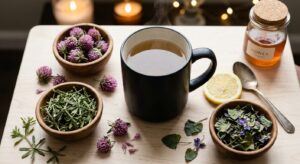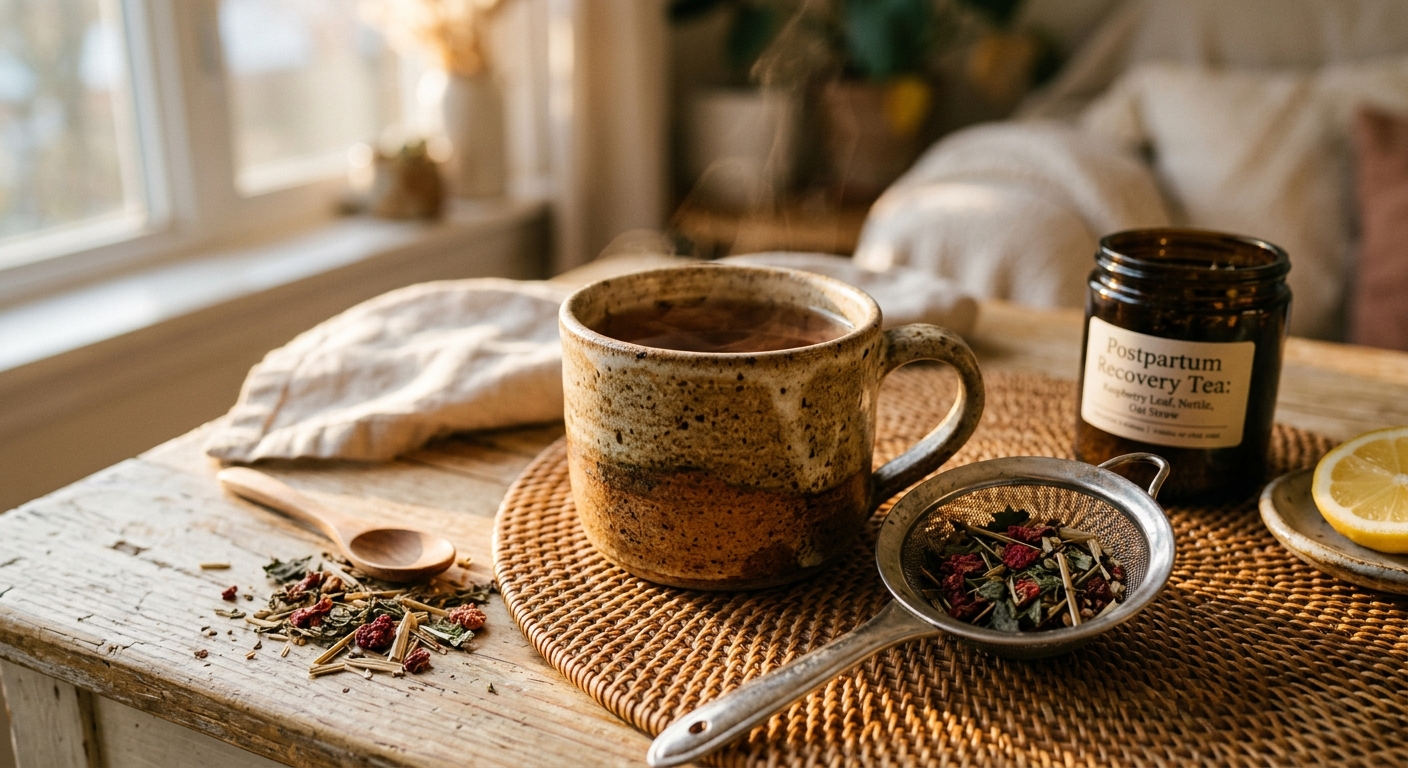
The weeks following childbirth are one of the most physically demanding transitions a body can experience. Across cultures and centuries, herbalists and midwives have turned to specific plants to help new mothers recover, replenish, and rebuild. From the raspberry-leaf tonics of European folk medicine to the nettle-rich broths consumed across West Africa and Southeast Asia, postpartum herbal traditions share a common wisdom: the body after birth is in deep need of minerals, warmth, and gentle restoration.
This postpartum recovery tea blends three time-honored herbs into a single restorative cup. Red raspberry leaf has been used for centuries as a uterine tonic, celebrated for its ability to support the tightening and healing of the uterus after delivery. Nettle leaf brings a remarkable wealth of iron, calcium, magnesium, and vitamin K, nutrients that are often severely depleted after blood loss in labor. Oat straw rounds out the blend with its nourishing effect on the nervous system, offering gentle support during the emotional adjustment that accompanies new motherhood.
This is a tea designed not for a single sipping occasion but for the daily ritual of early postpartum life. Brewed in generous batches and sipped throughout the day, it provides both physical nourishment and a quiet, grounding moment of self-care in what can otherwise be an overwhelming season. Whether you are one week postpartum or three months into recovery, this blend offers something the body genuinely needs: steady, plant-based restoration.
2
cups
Ingredients
- 2 tspdried red raspberry leaf
- 1 tspdried nettle leaf
- 1 tspdried oat straw
- 480 mlwater (95°C / 203°F)
- —raw honey or maple syrup to taste (optional)
- —a slice of lemon (optional, enhances iron absorption)
How to Brew
Click on an item below to shop for the recommended items for this recipe on Amazon.
As an Amazon Associate, we earn from qualifying purchases.
- Bring filtered water to 95°C (203°F). If using a standard kettle, allow just-boiled water to rest for one minute before pouring.
- Combine 2 teaspoons of dried red raspberry leaf, 1 teaspoon of dried nettle leaf, and 1 teaspoon of dried oat straw in a tea infuser or strainer placed inside a pre-warmed mug or teapot.
- Pour 480 ml of hot water over the herbs, ensuring all plant material is fully submerged. Cover the mug with a small plate or lid to trap volatile compounds and retain heat.
- Steep for 10 to 15 minutes. The longer end of this range extracts more minerals from the nettle and oat straw, which is ideal for daily nutritive use.
- Remove the infuser and gently press the herbs with the back of a spoon to extract the remaining liquid.
- Add a slice of lemon to the cup before drinking. The vitamin C in lemon juice converts non-heme iron from the nettle into a more bioavailable form. Sweeten with raw honey or maple syrup if desired, and sip slowly while warm.
- Measure 3 teaspoons of dried red raspberry leaf, 1.5 teaspoons of dried nettle leaf, and 1.5 teaspoons of dried oat straw into a clean glass jar. Cold brew requires slightly more herb than hot brewing to compensate for slower, cooler extraction.
- Add 700 ml of room-temperature filtered water to the jar. Stir gently to ensure all the herbs are moistened and no dry clumps remain at the surface.
- Loosely cover the jar with a lid, cloth, or beeswax wrap and leave it at room temperature for one hour, then transfer to the refrigerator.
- Allow the tea to steep in the refrigerator for 8 to 12 hours. Overnight preparation works beautifully: prepare before bed and strain first thing in the morning.
- Strain the tea through a fine mesh strainer or cheesecloth, pressing the spent herbs firmly to recover all liquid.
- Pour over a glass of ice or enjoy chilled. Add a squeeze of fresh lemon juice to support iron absorption, and sweeten lightly if preferred. The cold brew will keep refrigerated for up to 48 hours, making it easy to batch-prepare for a busy postpartum schedule.
- Bring 1 liter of fresh filtered water to a full boil at 100°C (212°F).
- Add 1 full ounce (approximately 28 grams or about 6 to 8 tablespoons) of the combined dried herbs, using a ratio of roughly 2 parts raspberry leaf to 1 part nettle to 1 part oat straw, into a quart-sized glass jar or French press.
- Pour the boiling water over the herbs immediately, filling the jar completely. Place the lid on the jar or press the plunger of the French press down just to the surface of the water without pressing through. This traps steam and prevents evaporation.
- Wrap the jar in a thick towel or place it inside an insulated bag to retain heat throughout the infusion period. Allow it to steep for a minimum of 4 hours, but up to 8 hours overnight for maximum mineral extraction.
- In the morning, strain the infusion through a fine-mesh strainer or cheesecloth, pressing the herbs firmly. The resulting liquid will be a deep amber-green, noticeably darker and more full-bodied than a standard hot brew.
- Drink 1 to 2 cups of the nourishing infusion throughout the morning and afternoon. It can be gently reheated on the stovetop over low heat without boiling, or enjoyed at room temperature. Store any remaining infusion in the refrigerator and consume within 24 hours, as the high mineral and nutrient content means it can ferment quickly at room temperature.
Health Benefits
Red raspberry leaf contains fragarine, an alkaloid that acts on the smooth muscle of the uterus to support toning and recovery after delivery. Traditional midwifery practice has long used it to promote the uterus returning to its pre-pregnancy size, and modern herbalists continue this recommendation as part of postpartum care.
Nettle leaf is one of the most iron-dense plants available as a tea herb, providing meaningful levels of non-heme iron in each cup. Consumed alongside a source of vitamin C such as lemon juice, which is included in this recipe, its iron becomes significantly more bioavailable, supporting recovery from the blood loss common in vaginal and cesarean deliveries.
Breastfeeding draws heavily on the mother’s reserves of calcium and magnesium, as these minerals are transferred to breast milk. Nettle and oat straw are both notably rich in these minerals, making this tea a gentle daily source of nutritional support during the months of lactation.
Oat straw has a long history of use as a nervine tonic, meaning it supports the structural and functional health of the nervous system over time rather than acting as a quick sedative. Its avenacosides and B vitamins are thought to ease nervous exhaustion, anxiety, and the emotional overwhelm that commonly accompanies sleep deprivation and hormonal shifts in early postpartum life.
The quercetin, kaempferol, and vitamin K content of this blend contribute to tissue repair, reduced inflammatory signaling, and healthy blood clotting at healing sites, including perineal tears, episiotomy sites, and cesarean incisions. These effects are gradual and cumulative, reinforcing the value of drinking this tea as a daily practice rather than a one-time remedy.
🧪 Key Bioactive Compounds
The Science Behind Red Raspberry Leaf
The nutritional science behind this tea blend centers on bioavailability, meaning how effectively the body can absorb and use the compounds present. Nettle leaf (Urtica dioica) is exceptional among herbal teas for its mineral density. Research has confirmed meaningful concentrations of iron, calcium, magnesium, potassium, and vitamin K in dried nettle, making it genuinely valuable as a dietary supplement in tea form rather than simply symbolic in its nutrition. The key to unlocking nettle’s iron content is pairing it with vitamin C, which converts ferric iron (Fe3+) to the ferrous form (Fe2+) that the small intestine can absorb. This is why lemon juice is included in every serving recommendation in this recipe.
Red raspberry leaf (Rubus idaeus) has been the subject of considerable scientific curiosity, particularly around its effects on uterine muscle. The alkaloid fragarine is believed to have a dual regulatory action on smooth muscle tissue, both relaxing and toning the uterus depending on its current state. A commonly cited 1999 study published in the Journal of Midwifery and Women’s Health found that women who consumed raspberry leaf in the third trimester had shorter labors and lower rates of forceps delivery, suggesting genuine uterotonic effects. Postpartum, this same toning action is thought to support the process of involution, where the uterus contracts back to its pre-pregnancy size over the weeks following birth. While more large-scale clinical trials are needed, the mechanistic rationale and centuries of traditional use align convincingly.
Oat straw (Avena sativa) contributes to this formula through a different mechanism, one rooted in nervous system nourishment rather than direct mineral supplementation. Its steroidal saponins, collectively called avenacosides, have been studied for their ability to modulate cortisol and support HPA axis function, which governs the body’s stress response. A 2011 study published in the Journal of Alternative and Complementary Medicine found that oat herb extract significantly improved cognitive performance and reduced stress markers in healthy adults under mental strain. For a postpartum mother navigating sleep deprivation, hormonal shifts, and the cognitive demands of caring for a newborn, oat straw’s gradual, cumulative support for the nervous system represents a genuinely meaningful contribution to this recovery blend.
Brewing Tips
- Prepare a large batch of the overnight nourishing infusion twice a week and store it in the refrigerator so you always have recovery tea on hand without needing to brew daily during a busy postpartum period.
- Use a French press for the overnight infusion method if you do not have a wide-mouth glass jar. It makes straining the spent herbs effortless and reduces cleanup significantly.
- Start with the lower end of steep times in the first week of use. The tannins in raspberry leaf and nettle can be mildly astringent and may cause nausea on an empty stomach if the brew is very strong. Build up to longer steeps as your body adjusts.