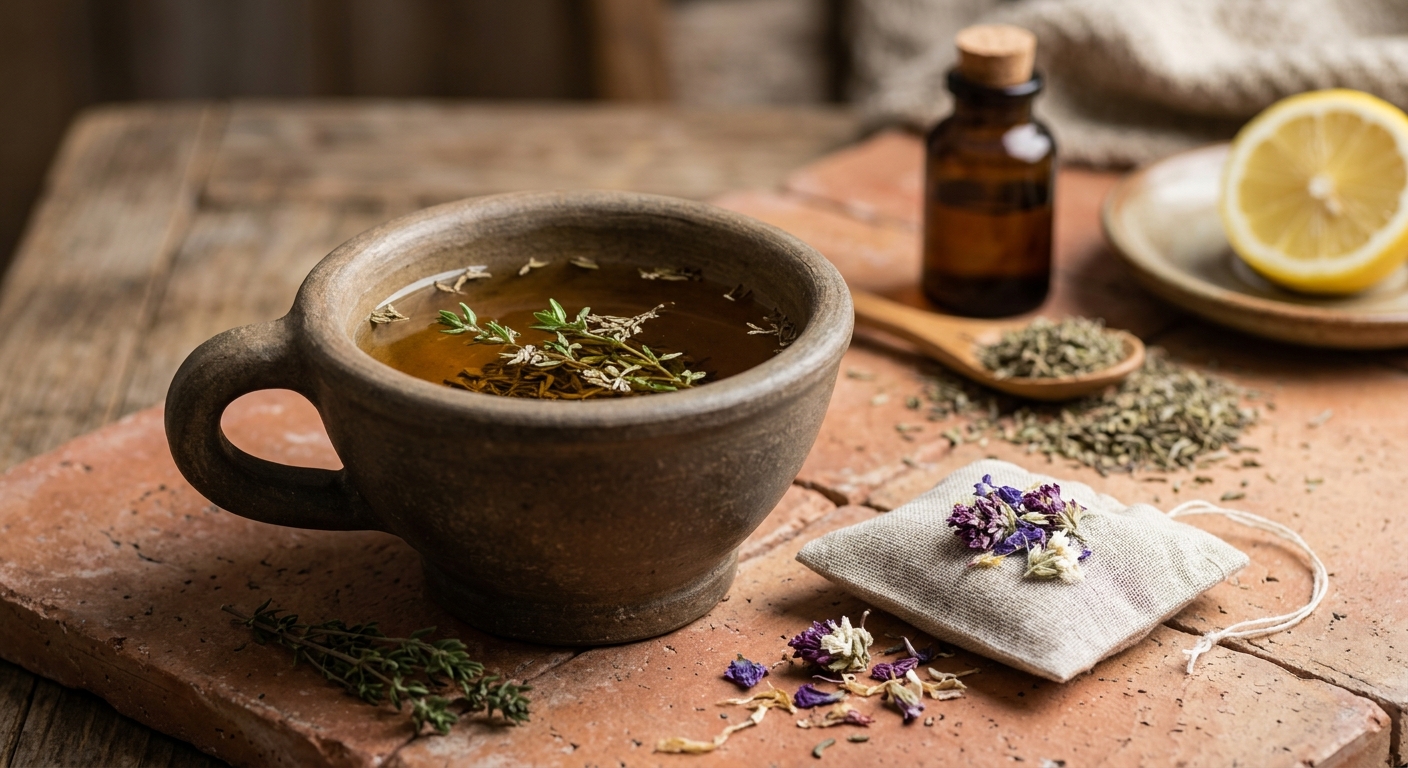
Long before antibiotics lined pharmacy shelves, thyme (Thymus vulgaris) was the herb healers reached for when infection struck. Ancient Egyptians used it in embalming rituals, the Greeks burned it as temple incense to purify the air, and medieval European monks cultivated it in monastery gardens as a frontline remedy against plague and pestilence. Its reputation as a purifying, germ-fighting plant was not superstition. Modern science has confirmed that thyme contains some of the most potent naturally occurring antimicrobial compounds in the plant kingdom.
As a tea, thyme delivers a deeply aromatic, slightly spicy brew with a warm, piney earthiness that immediately signals its medicinal power. A single cup brewed from fresh or dried thyme leaves fills the room with a scent that is both culinary and medicinal, straddling the line between your kitchen herb garden and your grandmother’s remedy cabinet. It is this duality that makes thyme tea so remarkable: an everyday cooking herb that doubles as a serious wellness tool backed by centuries of use and a growing body of research.
In traditional European herbalism, thyme tea was the go-to remedy for bronchitis, whooping cough, and chest infections. German Commission E, one of the world’s most respected herbal medicine authorities, officially approved thyme preparations for the treatment of upper respiratory tract inflammation and bronchitis. Whether you are fighting the first signs of a cold, nursing a stubborn cough, or simply looking to strengthen your immune defenses before winter arrives, a steaming cup of thyme tea offers comfort, flavor, and genuine botanical medicine in every sip.
2
cups
Ingredients
- 2 tspdried thyme leaves (or 4 tsp fresh thyme sprigs)
- 480 mlwater (95°C / 203°F)
- —raw honey to taste (optional, adds antimicrobial synergy)
- —fresh lemon juice to taste (optional)
How to Brew
Click on an item below to shop for the recommended items for this recipe on Amazon.
As an Amazon Associate, we earn from qualifying purchases.
- Bring filtered water to approximately 95°C (203°F). If you do not have a temperature-controlled kettle, bring water to a full boil and let it rest for 60 to 90 seconds before pouring.
- Place 1 heaped teaspoon of dried thyme leaves (or 2 fresh thyme sprigs) per cup into a tea infuser, strainer, or directly into a heatproof mug. Lightly bruise fresh sprigs between your fingers first to release the essential oils.
- Pour the hot water over the thyme and cover the mug immediately with a small saucer or lid. This trapping of steam is essential because thymol and carvacrol are volatile compounds that will escape with the steam if left uncovered, taking much of the tea’s medicinal potency with them.
- Steep for 7 to 10 minutes. A longer steep produces a stronger, more medicinal brew. Start with 7 minutes if you are new to thyme tea, as the flavor intensifies significantly.
- Remove the infuser or strain out the leaves. Add raw honey and a squeeze of fresh lemon juice if desired. Both complement the flavor and add their own antimicrobial and immune-supportive properties.
- Sip slowly while still hot. The steam itself has a mild decongestant effect, making this brew especially soothing for sinus congestion and sore throats.
- Add 3 teaspoons of dried thyme leaves (or 5 to 6 fresh sprigs) to a clean glass jar or cold brew pitcher. Use a slightly higher herb-to-water ratio than hot brewing to compensate for the slower, cooler extraction.
- Pour 480 ml of cold, filtered water over the thyme. Do not use ice at this stage, as the dilution will weaken the extraction.
- Stir gently with a clean spoon to ensure all the thyme is submerged and making full contact with the water. Cover the jar loosely with a lid or cloth to prevent the absorption of refrigerator odors.
- Leave the jar at room temperature for 30 minutes to begin the extraction process, then transfer to the refrigerator and steep for a further 8 to 12 hours (overnight is ideal).
- When the brew has reached your desired strength, strain out the thyme through a fine mesh strainer or cheesecloth into a clean glass. The resulting liquid should be a clear, pale golden-green.
- Serve over ice. Enhance with a ribbon of cucumber, a few mint leaves, or a squeeze of lime for a refreshing immune-boosting drink. The cold brew keeps refrigerated for up to 48 hours.
- Place 4 teaspoons of dried thyme leaves (or a generous handful of fresh thyme sprigs, roughly 8 to 10 sprigs) into a small saucepan. Add 480 ml of cold, filtered water.
- Bring the water slowly to a low simmer over medium heat, aiming for a temperature of around 85 to 90°C (185 to 194°F). Do not allow the water to reach a rolling boil, as sustained high heat will degrade the volatile antimicrobial oils.
- Once a gentle simmer is reached, reduce the heat to low, partially cover the saucepan with a lid (leaving a small gap for steam to escape), and maintain the simmer for 20 to 25 minutes. The liquid will reduce and deepen in color to a rich amber-gold.
- Remove from heat and allow the decoction to cool to approximately 60°C (140°F), which takes around 5 to 7 minutes. This cooling step is critical before adding honey, as temperatures above 65°C will destroy honey’s own antimicrobial enzymes and beneficial compounds.
- Strain the liquid through a fine mesh strainer into a heatproof mug or glass jar, pressing the spent thyme gently with a spoon to extract every last drop of the infusion.
- Stir in 1 to 2 teaspoons of raw, unfiltered honey per serving. Add fresh lemon juice to taste. Take in small, slow sips to allow the concentrated brew to coat the throat. Store any remaining decoction in a sealed jar in the refrigerator for up to 3 days and reheat gently before drinking.
Health Benefits
Thymol and carvacrol, thyme’s principal bioactive phenols, have been shown in multiple laboratory and clinical studies to inhibit the growth of bacteria, fungi, and certain viruses. Their mechanism involves disrupting microbial cell membranes, making it difficult for pathogens to survive, replicate, or develop resistance in the way they can with synthetic antibiotics.
German Commission E has formally approved thyme preparations for treating acute bronchitis and upper respiratory tract inflammation. Thyme acts as a bronchospasmolytic agent, relaxing the muscles of the bronchial airways and helping to loosen and expel mucus. A 2006 clinical trial published in Arzneimittelforschung found thyme-ivy syrup as effective as a leading pharmaceutical expectorant for acute bronchitis.
Luteolin, ursolic acid, and rosmarinic acid in thyme collectively support a balanced immune response by modulating inflammatory pathways without suppressing normal immune function. Regular consumption during cold and flu season may help prime the immune system to respond more efficiently to incoming pathogens.
Rosmarinic acid is a particularly well-studied anti-inflammatory compound that inhibits the production of pro-inflammatory mediators in the airway lining. This makes thyme tea beneficial not only for acute infections but also for chronic respiratory conditions like mild asthma or seasonal allergic rhinitis.
Thyme contains one of the highest antioxidant capacities of any culinary herb, with significant concentrations of flavonoids and polyphenols that neutralize free radicals generated during infection and inflammation. This antioxidant activity helps protect immune cells from oxidative damage and supports faster recovery from illness.
🧪 Key Bioactive Compounds
The Science Behind Thyme
The medicinal reputation of thyme rests primarily on two phenolic monoterpenoids: thymol and carvacrol. Together, these compounds can make up between 20 and 55 percent of thyme’s essential oil content, depending on the variety and growing conditions. Both compounds work by integrating into the lipid bilayer of microbial cell membranes, disrupting their structural integrity and causing cellular contents to leak out. This mechanism is effective against gram-positive and gram-negative bacteria alike, and crucially, it is difficult for microbes to develop resistance to because it targets the physical structure of the cell rather than a specific enzyme or protein pathway that can be mutated away.
Beyond direct antimicrobial activity, thyme’s polyphenols, particularly rosmarinic acid and luteolin, exert meaningful anti-inflammatory effects by inhibiting cyclooxygenase (COX) enzymes and suppressing the NF-kB signaling pathway. NF-kB is a master regulator of the inflammatory response, and its overactivation is associated with the runaway inflammation seen in severe respiratory infections. By moderating this pathway, thyme tea helps keep the immune response productive rather than destructive, reducing collateral tissue damage in the respiratory tract while still allowing the body to mount an effective defense against pathogens.
The flavonoids apigenin and luteolin also contribute immunomodulatory effects by influencing the activity and communication of key immune cells, including macrophages and T-lymphocytes. Ursolic acid adds antiviral properties to the profile, with studies demonstrating inhibition of influenza viral replication and reduced viral load in preclinical models. Taken together, thyme’s phytochemical complexity means that a single cup of tea delivers a coordinated, multi-mechanism immune-supportive effect rather than a single active ingredient working in isolation. This synergy between compounds is a hallmark of whole-plant medicine and a key reason why traditional herbal preparations often outperform isolated extracts in clinical outcomes.
Brewing Tips
- Always cover your mug while the thyme steeps. Thymol and carvacrol are highly volatile and will evaporate with uncovered steam, significantly reducing both the aroma and the antimicrobial potency of your brew.
- Fresh thyme sprigs produce a brighter, more complex flavor profile than dried leaves, but dried thyme offers a higher concentration of essential oils per gram. Use twice the volume of fresh thyme compared to dried for an equivalent strength brew.
- For an enhanced immunity blend, add a thin slice of fresh ginger and a small cinnamon stick to your hot brew. Ginger contributes gingerols with their own antiviral properties, and cinnamon adds cinnamaldehyde, another potent natural antimicrobial, creating a formidable cold-season tea.