Long before antibiotics were synthesized in laboratories, healers across every civilization turned to plants to fight infection. Thyme was carried into battle by Roman soldiers, pressed into medicinal poultices by Greek physicians, and burned as a purifying herb across medieval Europe. Ginger root traveled the ancient Silk Road as one of the most prized medicinal commodities in the world, valued in Ayurvedic and Traditional Chinese Medicine for its ability to warm the body, stimulate circulation, and clear pathogens. When you brew these two plants together with raw manuka honey, you are reaching back through thousands of years of accumulated plant knowledge.
What makes this blend exceptional is the convergence of three genuinely potent antibacterial agents working in harmony. Thyme contains thymol and carvacrol, volatile phenolic compounds that disrupt bacterial cell membranes with a mechanism similar to pharmaceutical antiseptics. Ginger contributes gingerols and shogaols, which inhibit bacterial biofilm formation and reduce the inflammation that bacteria exploit. Manuka honey adds methylglyoxal, a compound with documented activity against even antibiotic-resistant strains like Staphylococcus aureus. This is not folk belief layered over wishful thinking; it is traditional wisdom that has held up under modern laboratory scrutiny.
Beyond its antimicrobial properties, this tea is a genuinely pleasurable sensory experience. Thyme lends a savory, slightly herbal warmth that is earthy without being medicinal. Ginger brings that familiar bright heat and citrus-tinged sharpness. Manuka honey softens the edges of both, adding a complex, almost malty sweetness with a faint floral note. The brewed cup is a deep amber gold, aromatic and full-bodied, the kind of tea that feels like it is doing something the moment it reaches your throat.
2
cups
Ingredients
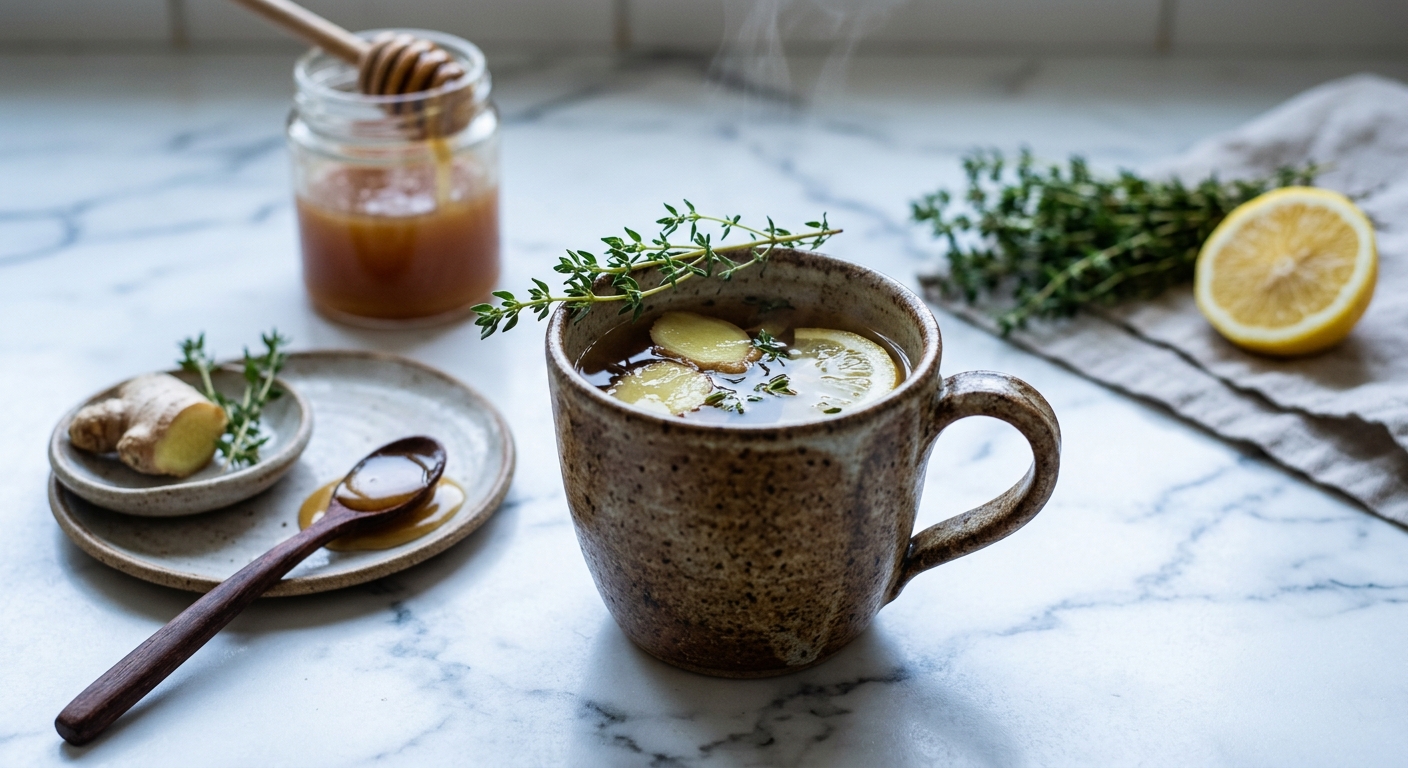
- 2 tspfresh thyme sprigs (or 1 tsp dried thyme)
- 1 inchfresh ginger root, thinly sliced
- 480 mlwater (95°C / 203°F)
- —1 to 2 tsp manuka honey per cup (added after brewing, not during)
- —juice of half a lemon (optional, enhances antimicrobial synergy)
How to Brew
Click on an item below to shop for the recommended items for this recipe on Amazon.
As an Amazon Associate, we earn from qualifying purchases.
- Slice fresh ginger root into thin coins, about 6 to 8 slices per 480 ml of water. If using dried ginger, reduce to half a teaspoon. Place the ginger slices directly into a small saucepan.
- Add 480 ml of filtered water to the saucepan with the ginger and bring to a gentle simmer over medium heat. Allow the ginger to simmer for 5 minutes before adding the thyme. This pre-simmering extracts more gingerols from the dense root tissue.
- Add the fresh thyme sprigs or dried thyme to the saucepan. Reduce heat to the lowest setting and steep uncovered for 10 minutes. Covering the pan traps the volatile thymol and carvacrol in condensation on the lid rather than in your cup.
- Remove from heat and allow the tea to rest for 2 minutes. Strain through a fine mesh strainer into your mugs, pressing the thyme gently to release any remaining liquid.
- Wait until the tea cools below 60°C (140°F), then stir in 1 to 2 teaspoons of manuka honey per cup. Add a squeeze of fresh lemon juice if desired. Drink immediately while still comfortably warm.
- Peel and finely grate 1.5 inches of fresh ginger root rather than slicing it. The increased surface area accelerates cold extraction, compensating for the lower temperature over the extended steep time.
- Place the grated ginger and fresh thyme sprigs into a glass jar. Pour 600 ml of cool filtered water over the herbs. Stir once to submerge all plant material.
- Leave the jar at room temperature for 1 hour to begin extraction, then seal and transfer to the refrigerator. Steep for 8 to 12 hours or overnight. Do not exceed 14 hours as the thyme can become bitter.
- Remove from the refrigerator and strain through a fine mesh strainer lined with cheesecloth into a clean pitcher, pressing the herbs gently. Discard the spent ginger and thyme.
- Stir in 1 to 2 teaspoons of manuka honey per serving directly into the cold liquid, as honey dissolves readily at cool temperatures without heat degrading its active compounds. Add lemon juice and ice if desired. Store any unused portion in the refrigerator and consume within 48 hours.
- Use a higher ginger-to-water ratio for the concentrate: slice or grate a full 3-inch piece of fresh ginger root and place it into a small saucepan with 480 ml of filtered water. Bring to a full boil over high heat.
- Once boiling, reduce heat to maintain a steady low simmer at approximately 85 to 90°C (185 to 194°F). Add 3 to 4 tablespoons of fresh thyme leaves or 1.5 tablespoons of dried thyme. Simmer uncovered for 20 to 25 minutes. The liquid will reduce by roughly one third, concentrating the active compounds.
- During the final 5 minutes of simmering, add the zest of one lemon directly to the pot. Lemon zest contributes limonene, which has its own antimicrobial properties and brightens the flavor of the concentrate.
- Remove from heat and allow to cool for 5 minutes. Strain through a fine mesh strainer, pressing the ginger and thyme firmly. You should have roughly 300 to 320 ml of deep, rich concentrate.
- To serve as a therapeutic shot, pour 60 ml of warm concentrate into a small cup, allow it to cool below 60°C (140°F), then stir in 1 teaspoon of manuka honey. To serve as a full cup of tea, dilute 60 to 80 ml of concentrate with 180 ml of hot water and sweeten with honey as above. Store remaining concentrate in a sealed glass jar in the refrigerator for up to 5 days.
Health Benefits
Thyme has been used clinically in Germany as an approved herbal medicine for bronchitis and upper respiratory infections. A 2006 study published in Arzneimittelforschung found that thyme-ivy syrup was as effective as a standard expectorant medication for acute bronchitis, with thymol shown to inhibit respiratory pathogens including Streptococcus pyogenes and Haemophilus influenzae.
Bacterial biofilms, the protective shields bacteria build to resist immune attack and antibiotics, are disrupted by both carvacrol from thyme and gingerols from ginger. A 2014 study in the journal Phytotherapy Research demonstrated that ginger extract significantly inhibited biofilm formation by Pseudomonas aeruginosa and Staphylococcus epidermidis, two common opportunistic pathogens.
Rosmarinic acid in thyme and shogaols in ginger both suppress the NF-kB inflammatory pathway, reducing the production of pro-inflammatory interleukins that cause throat pain and swelling. Manuka honey additionally forms a protective coating along mucous membranes, providing a physical barrier that reduces irritation and supports tissue repair.
6-Gingerol and thymol have both been shown to modulate macrophage activity, enhancing the innate immune response without triggering excessive inflammation. A 2019 review in the International Journal of Molecular Sciences confirmed that ginger compounds upregulate immune cell signaling pathways involved in pathogen clearance.
Oxidative stress increases significantly during bacterial infection as the immune system generates reactive oxygen species to kill pathogens. Rosmarinic acid, thymol, and the polyphenols in manuka honey provide substantial antioxidant activity that helps protect healthy cells from collateral oxidative damage during the immune response.
🧪 Key Bioactive Compounds
The Science Behind Thyme
The antibacterial activity of this tea blend is grounded in the membrane-disrupting chemistry of phenolic terpenes. Thymol and carvacrol, the two dominant volatile compounds in thyme, are lipophilic phenols that preferentially accumulate in the phospholipid bilayer of bacterial cell membranes. Once embedded, they increase membrane permeability, causing ion leakage and ultimately cell death. This mechanism is broadly effective across gram-positive and gram-negative bacteria and has been confirmed in dozens of in vitro studies. Importantly, because this mode of action targets the physical structure of the membrane rather than a specific enzyme (as most conventional antibiotics do), resistance development is significantly harder for bacteria to achieve.
Manuka honey operates through a distinct but complementary mechanism. Unlike regular honey, whose antibacterial properties come primarily from osmotic pressure and enzymatic hydrogen peroxide production, manuka honey contains high concentrations of methylglyoxal (MGO), formed from the conversion of dihydroxyacetone found uniquely in the nectar of the New Zealand Leptospermum scoparium plant. MGO covalently binds to bacterial proteins and nucleic acids through a process called glycation, causing structural damage to bacterial enzymes and impairing replication. Clinical studies have documented manuka honey’s effectiveness against MRSA, and it is used in certified wound care dressings approved by regulatory agencies in New Zealand, Australia, and the European Union. Critically, its active compounds remain intact in the jar and in your cup as long as the honey is not exposed to temperatures above 60°C (140°F), which is why timing the addition of honey after brewing is a non-negotiable step in this recipe.
Ginger adds a third antibacterial dimension through its gingerol and shogaol content, compounds that have been shown to interfere with bacterial quorum sensing, the chemical communication system bacteria use to coordinate group behaviors like biofilm formation and virulence factor production. By disrupting quorum sensing, ginger essentially prevents bacteria from organizing a coordinated attack on host tissue. Beyond its direct antimicrobial action, 6-gingerol’s anti-inflammatory effect is mediated through inhibition of cyclooxygenase-2 (COX-2) and suppression of TNF-alpha, the same pathways targeted by nonsteroidal anti-inflammatory drugs. This means the tea does double duty: fighting the bacteria causing illness while simultaneously dampening the inflammation that makes you feel unwell.
Brewing Tips
- Use fresh thyme over dried whenever possible. Fresh thyme contains significantly higher concentrations of volatile thymol and carvacrol than dried, as these compounds begin to evaporate once the plant is cut and dried. If using dried thyme, halve the quantity and steep no longer than 12 minutes to avoid bitterness.
- Choose a manuka honey with a certified MGO rating of at least 250 mg/kg (often labeled UMF 10+). Lower-rated manuka honeys contain minimal methylglyoxal and offer little advantage over regular honey. The certification label on the jar is the only reliable indicator of therapeutic potency.
- Bruise the fresh thyme sprigs by rolling them firmly between your palms for 10 to 15 seconds before placing them in the pot. This ruptures the oil glands on the leaf surface and releases a noticeably greater concentration of aromatic volatile compounds into the brew from the very first minute of steeping.