Lemon balm has been cherished for more than two thousand years. The ancient Greeks planted it near beehives, and its genus name, Melissa, is the Greek word for honeybee. Medieval monks and herbalists called it the ‘gladdening herb,’ brewing it to lift low spirits and settle a restless heart. Culpeper wrote that it ’causeth the mind and heart to become merry,’ and Paracelsus prized it as an elixir of life. A member of the mint family, lemon balm grows almost without effort in temperate gardens, releasing a clean lemon fragrance whenever a leaf is brushed.
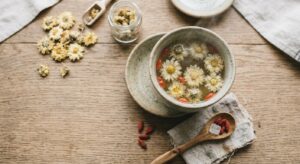
Roses carry their own long tradition in the tea cup. Dried rose petals have been steeped in Persian, Ayurvedic, and Traditional Chinese practice for centuries, valued for their cooling nature, their sweet perfume, and their association with comfort and the heart. In Ayurveda, rose is considered soothing to the nervous system and balancing for overheated, agitated states. Together, lemon balm and rose offer a tea that is both bright and tender, the citrus lift of one softened by the velvety floral notes of the other.
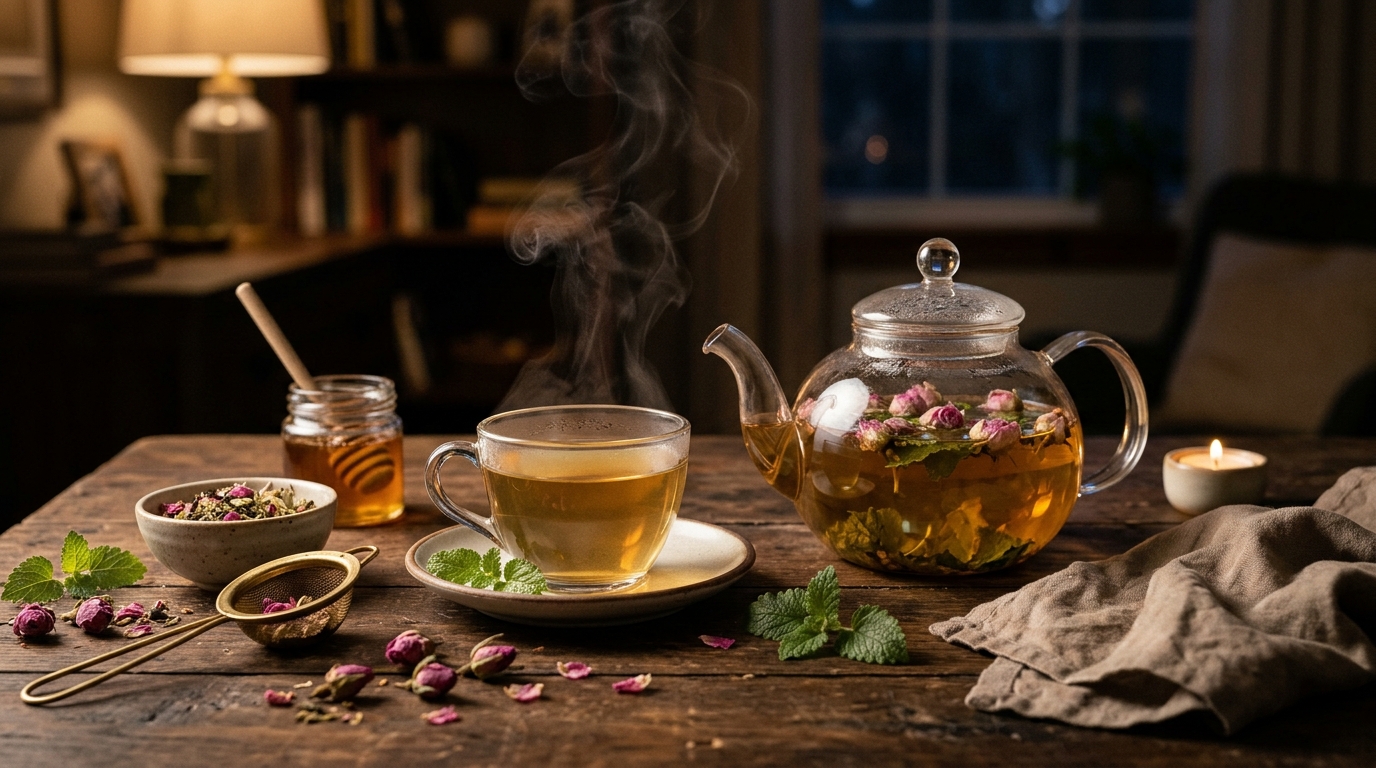
What makes this pairing special is how well it suits the hour between dinner and bed. It is caffeine free, gentle enough to drink nightly, and deeply sensory. The steam carries lemon and rose, the cup glows a pale gold, and the simple act of slowing down to brew it becomes part of the calming effect. Think of it less as a remedy and more as a small ritual, a way to tell your nervous system that the day is finished.
2
cups
Ingredients
- 2 tbspdried lemon balm leaves
- 1 tbspdried culinary rose petals
- 480 mlwater (just off the boil, about 95°C / 203°F)
- —raw honey to taste (optional)
- —a thin strip of lemon peel (optional)
How to Brew
Click on an item below to shop for the recommended items for this recipe on Amazon.
As an Amazon Associate, we earn from qualifying purchases.
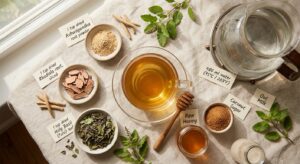
- Measure 2 tablespoons of dried lemon balm and 1 tablespoon of dried rose petals into a teapot or large mug. Gently crush the lemon balm leaves between your fingers first to help release their oils.
- Heat fresh water until it just reaches a boil, then let it rest for about 30 seconds so it settles to roughly 95°C (203°F). Boiling water straight from the kettle can dull the delicate floral notes of the rose.
- Pour the hot water over the herbs, then immediately cover the pot or place a saucer over the mug to trap the aromatic steam.
- Steep for 5 to 8 minutes. Closer to 5 minutes gives a light, floral cup; 8 minutes gives a fuller, more lemony body.
- Strain the tea into your cup, pressing the herbs lightly against the strainer to extract the last of the flavor. Add honey if you like, and sip slowly while it is warm.
- Add 3 tablespoons of dried lemon balm and 1.5 tablespoons of dried rose petals to a clean glass jar. Use a slightly higher herb ratio than hot brew, since cold water extracts more slowly.
- Pour 1 liter of cold, filtered water over the herbs. Stir gently with a long spoon so all the leaves are submerged.
- Seal the jar and place it in the refrigerator for 8 to 12 hours, or overnight. Avoid steeping longer than 12 hours to prevent a flat, grassy taste.
- In the morning, strain the tea through a fine mesh sieve into a clean jar or pitcher, discarding the spent herbs.
- Serve chilled over ice with a lemon slice or a few fresh rose petals. Keep refrigerated and drink within 2 days for best flavor.
- Combine 4 tablespoons of dried lemon balm and 2 tablespoons of dried rose petals in a heatproof jar or teapot.
- Pour 360 ml of hot water (about 95°C / 203°F) over the herbs. This is roughly half the usual water, so the tea will be strong and concentrated. Cover tightly.
- Steep for 10 minutes, then strain out the herbs. While the concentrate is still warm, stir in 1 to 2 teaspoons of honey until fully dissolved.
- Let the concentrate cool to room temperature, then refrigerate for at least 1 hour until thoroughly chilled.
- To serve, fill two tall glasses with ice and pour about 120 ml of concentrate into each. Top with 120 ml of cold water or sparkling water, stir, and garnish with a lemon wheel or a few rose petals.
Health Benefits
Clinical studies using lemon balm extract have reported reduced anxiety and improved calmness, likely through rosmarinic acid’s effect on GABA activity. Most research uses concentrated extracts, so a cup of tea is a gentler, supportive version of the effect.
Lemon balm is often combined with valerian and hops in sleep studies, and has been associated with improved sleep quality and fewer restless nights. Its mild sedative action helps the body wind down without heavy drowsiness.
Traditionally used for nervous stomach, bloating, and cramping, lemon balm’s volatile oils have mild antispasmodic effects on digestive muscle. This is helpful when stress shows up in the gut.
Small human trials suggest lemon balm can improve calmness and alertness together, making it one of the few relaxing herbs that does not cloud thinking. Rose’s aroma adds a comforting sensory layer that supports relaxation.
Both lemon balm and rose petals are rich in polyphenols such as rosmarinic acid, caffeic acid, and quercetin. These compounds help neutralize free radicals and are linked in laboratory studies to reduced oxidative stress.
🧪 Key Bioactive Compounds
The Science Behind Lemon Balm
The calming reputation of lemon balm rests largely on rosmarinic acid and its essential oil constituents, including citronellal, neral, and geranial. Laboratory research suggests rosmarinic acid may inhibit the enzyme GABA transaminase, which breaks down gamma-aminobutyric acid, the brain’s main inhibitory neurotransmitter. By slowing that breakdown, lemon balm may help preserve GABA activity, which is associated with feeling calmer and less tense. Lemon balm extracts have also been shown to interact with cholinergic receptors, which may explain the improved calmness and attention seen in small human trials.
Human studies are encouraging but modest. Several randomized, placebo-controlled trials using standardized lemon balm extracts reported reductions in anxiety symptoms, improved mood, and better sleep quality, particularly in people under mild to moderate stress. It is important to note that these studies typically use concentrated extracts in measured doses, so the effect from a cup of tea is likely milder. Even so, tea delivers a meaningful amount of water-soluble polyphenols along with aromatic compounds, and the ritual of preparing it adds a behavioral calming effect that research on mindfulness and routine supports.
Rose petals contribute differently. Their aroma comes from compounds such as geraniol, citronellol, and phenylethyl alcohol, and aromatherapy research has linked rose scent to lower self-reported anxiety and a slower heart rate. The petals also contain flavonoids like quercetin and kaempferol, plus tannins that lend a gentle structure to the cup. While research on rose tea specifically is limited, the combination of lemon balm’s neurochemical activity and rose’s soothing fragrance makes a thoughtful, evidence-informed pairing for evening relaxation.
Brewing Tips
- Use fresh lemon balm if you have it: about 6 to 8 lightly bruised fresh leaves per cup replaces 1 tablespoon of dried, and gives a brighter lemon flavor.
- Always cover your cup while steeping to keep the volatile citrus oils in the tea rather than drifting away as steam.
- Buy rose petals labeled culinary or food-grade, ideally organic, and store both herbs in airtight, light-proof containers for up to a year to keep their aroma.
- Drink the tea 30 to 60 minutes before bed and dim the lights while you sip, since the ritual itself helps signal your body to slow down.