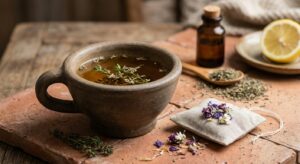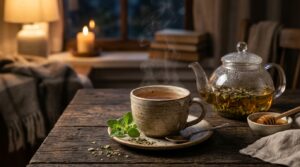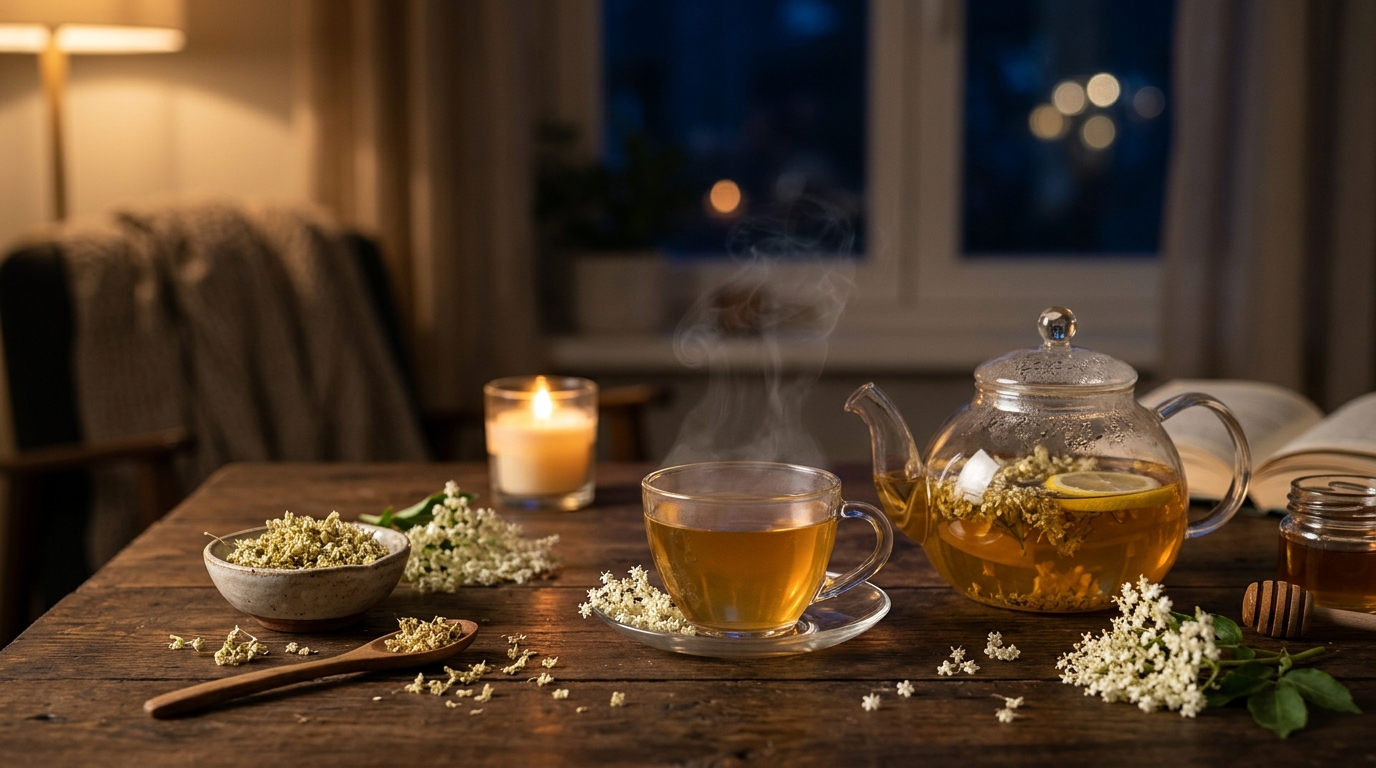
Every early summer, hedgerows across Europe fill with the flat, lacy umbels of elderflower, each one releasing a scent somewhere between lychee, honeysuckle, and sweet muscat grapes. The plant, Sambucus nigra, has been woven into folk traditions for centuries. In Britain and Scandinavia the elder tree was said to be home to a protective spirit, and gathering the blossoms was a seasonal ritual. Herbalists from medieval monasteries to Victorian apothecaries recommended the flowers for fevers, congestion, and the first scratchy signs of a winter cold.
While elderberry gets most of the modern attention, the flowers have their own distinct tradition. Where the berries are rich, tart, and dark, the blossoms are light, floral, and diaphoretic, meaning they were traditionally used to encourage a gentle, cleansing sweat at the onset of a fever. In classical Western herbalism, elderflower is often paired with peppermint and yarrow in a hot tea taken at bedtime when a cold is coming on, then followed by bed rest under warm covers.
That is what makes elderflower such a lovely nighttime tea. It is naturally caffeine-free, mildly soothing to the airways, and gentle enough to drink in the evening without the sharp tannic edge of many other cold remedies. It is a quiet, fragrant cup for the hours when your body is trying to rest and recover.
2
cups
Ingredients
- 2 tbspdried elderflowers (Sambucus nigra)
- 500 mlwater (95°C / 203°F)
- 1 tspdried peppermint leaf (optional, for a classic cold-season blend)
- —raw honey to taste (optional)
- —a thin slice of lemon (optional)
How to Brew
Click on an item below to shop for the recommended items for this recipe on Amazon.
As an Amazon Associate, we earn from qualifying purchases.
- Measure 1 tablespoon of dried elderflowers per 250 ml of water into a teapot or French press. Add the optional peppermint now if you are making a cold-season blend.
- Bring fresh water to a full boil, then let it rest for about 30 seconds so it settles near 95°C. Elderflowers are delicate, and a violent boil can flatten their floral aroma.
- Pour the hot water over the flowers and immediately cover with a lid or saucer to hold in the steam and essential oils.
- Steep for 10 to 15 minutes. Because these are light, airy blossoms, they need a longer infusion than most leaf teas to release their flavonoids and aroma.
- Strain through a fine mesh sieve to catch the tiny flower fragments, pour into a warm mug, and sweeten with honey if you like.
- Sip slowly about an hour before bed, ideally while wrapped in a blanket, in keeping with the traditional approach for a oncoming cold.
- Add 2 tablespoons of dried elderflowers to a clean glass jar or pitcher, then pour in 500 ml of cold, filtered water.
- Stir gently once to make sure all the blossoms are submerged, then cover loosely with a lid.
- Refrigerate for 6 to 8 hours. Avoid going much past 10 hours, as the flowers can begin to taste hay-like and slightly bitter.
- Strain through a fine mesh sieve lined with a piece of muslin or a paper coffee filter to remove all the tiny flower bits.
- Serve over ice with a lemon slice and a small drizzle of honey. Store leftovers covered in the refrigerator and drink within 48 hours.
- Use double the normal amount of flowers: 2 tablespoons of dried elderflowers for just 250 ml of hot water. The ice will dilute the finished tea.
- Heat water to 90°C (194°F), pour it over the flowers in a heatproof jug, cover, and steep for 8 to 10 minutes.
- Strain the concentrated tea through a fine mesh sieve into a second jug, pressing gently on the flowers to extract every drop.
- Stir in honey or a splash of lemon juice while the tea is still hot, so the sweetener dissolves completely.
- Fill two tall glasses with ice, pour the warm concentrate over the top until it chills, and top up with 250 ml of cold water or sparkling water.
- Garnish with a fresh lemon slice and a sprig of mint, and serve immediately.
Health Benefits
Elderflower has a long history as a diaphoretic, promoting a gentle sweat at the onset of fever. Early research on elder preparations suggests they may help ease upper respiratory symptoms, though most clinical data focuses on the berry rather than the flower.
Traditionally paired with peppermint, the warm steam and flavonoid content of elderflower tea are used to soothe stuffy sinuses and irritated mucous membranes. The effect is mild and comforting rather than medicinal.
Elderflowers are rich in rutin, quercetin, and phenolic acids, which neutralize free radicals in laboratory studies. These compounds are linked to general anti-inflammatory and circulatory support.
Elderflower has a traditional reputation as a mild diuretic and is sometimes used to support the body’s natural fluid balance. Because of this, it is best enjoyed an hour or two before bed rather than right before lying down.
Elderflower is caffeine-free, and its warm, floral aroma makes it a soothing wind-down drink. While it is not a sedative herb, the ritual of a warm cup in the evening supports relaxation and rest.
🧪 Key Bioactive Compounds
The Science Behind Elderflower
The therapeutic reputation of elderflower rests largely on its flavonoid profile. Dried Sambucus nigra flowers are particularly rich in rutin, quercetin, and kaempferol, along with phenolic acids such as chlorogenic acid. These polyphenols act as antioxidants in laboratory models, and several have been shown to modulate inflammatory signaling pathways. This fits well with the herb’s traditional role in easing the inflamed, congested tissues of a head cold.
Elderflower also contains triterpenes, including ursolic and oleanolic acid, and a modest amount of volatile oil responsible for its characteristic perfume. Some studies on elder extracts, including one well-known trial using a combination herbal preparation, have reported reduced symptom duration in upper respiratory infections. However, it is important to be honest about the evidence: most rigorous human research on elder involves the berry or multi-herb formulas, and the flowers on their own are less thoroughly studied.
The diaphoretic action described by traditional herbalists is thought to relate to how warm infusions encourage peripheral blood flow and perspiration. Part of this effect likely comes from the heat of the drink itself, but the flavonoid and volatile oil content may add to it. In short, elderflower tea is best understood as a gentle, supportive, comforting remedy rather than a treatment, a fragrant way to care for yourself when you feel a cold coming on.
Brewing Tips
- Always steep elderflower covered. The aromatic oils are volatile and escape quickly with the steam, taking much of the flavor and traditional benefit with them.
- Choose dried flowers that are creamy white to pale gold and smell sweetly floral. Brown, dusty, or musty-smelling flowers are old and will produce a flat, hay-like cup.
- Because elderflower is mildly diuretic, enjoy your last cup about 60 to 90 minutes before bed to avoid midnight bathroom trips.
- Store dried elderflowers in an airtight, opaque jar away from heat and light, and use within about a year for the best aroma.
- For a richer immune-season routine, drink elderflower tea in the evening and save elderberry syrup for the day, letting each herb play to its strengths.