Few plants carry the kind of cross-cultural reverence that ginger does. Revered for over 5,000 years across Ayurvedic medicine in India, Traditional Chinese Medicine, and ancient Greek and Roman pharmacopoeias, ginger root has been prescribed for everything from seasickness to menstrual cramps to plague prevention. Sanskrit texts from around 700 BCE describe it as a universal medicine, and traditional healers across Southeast Asia have long brewed fresh ginger into teas and tonics to warm the body from the inside out. It traveled the spice routes into medieval Europe, where it was considered so valuable it was used as currency in some regions.
What makes ginger truly remarkable is that modern science has largely confirmed what traditional healers observed intuitively. The rhizome is packed with bioactive compounds, most notably gingerols and shogaols, that act on the digestive system, the inflammatory response, and the nervous system in measurable, meaningful ways. Drinking ginger tea is not simply a folk remedy rooted in placebo, it is a genuinely functional food with a growing body of peer-reviewed evidence supporting its core uses.
As a tea, ginger is bold and unapologetic. It offers a sharp, peppery heat followed by a bright citrus-like warmth that lingers long after the last sip. Whether you brew it from fresh sliced root for maximum potency, or from dried and ground ginger for convenience, the result is a cup that commands your attention and rewards it with genuine comfort. It pairs beautifully with lemon and honey, mellows gracefully over ice, and intensifies into something deeply medicinal when simmered as a decoction.
2
cups
Ingredients
- 1 inchfresh ginger root, thinly sliced (or 1 tsp dried ginger)
- 480 mlwater (95 to 100°C / 203 to 212°F)
- 1 tbspfresh lemon juice (optional)
- —raw honey or maple syrup to taste (optional)
How to Brew
Click on an item below to shop for the recommended items for this recipe on Amazon.
As an Amazon Associate, we earn from qualifying purchases.
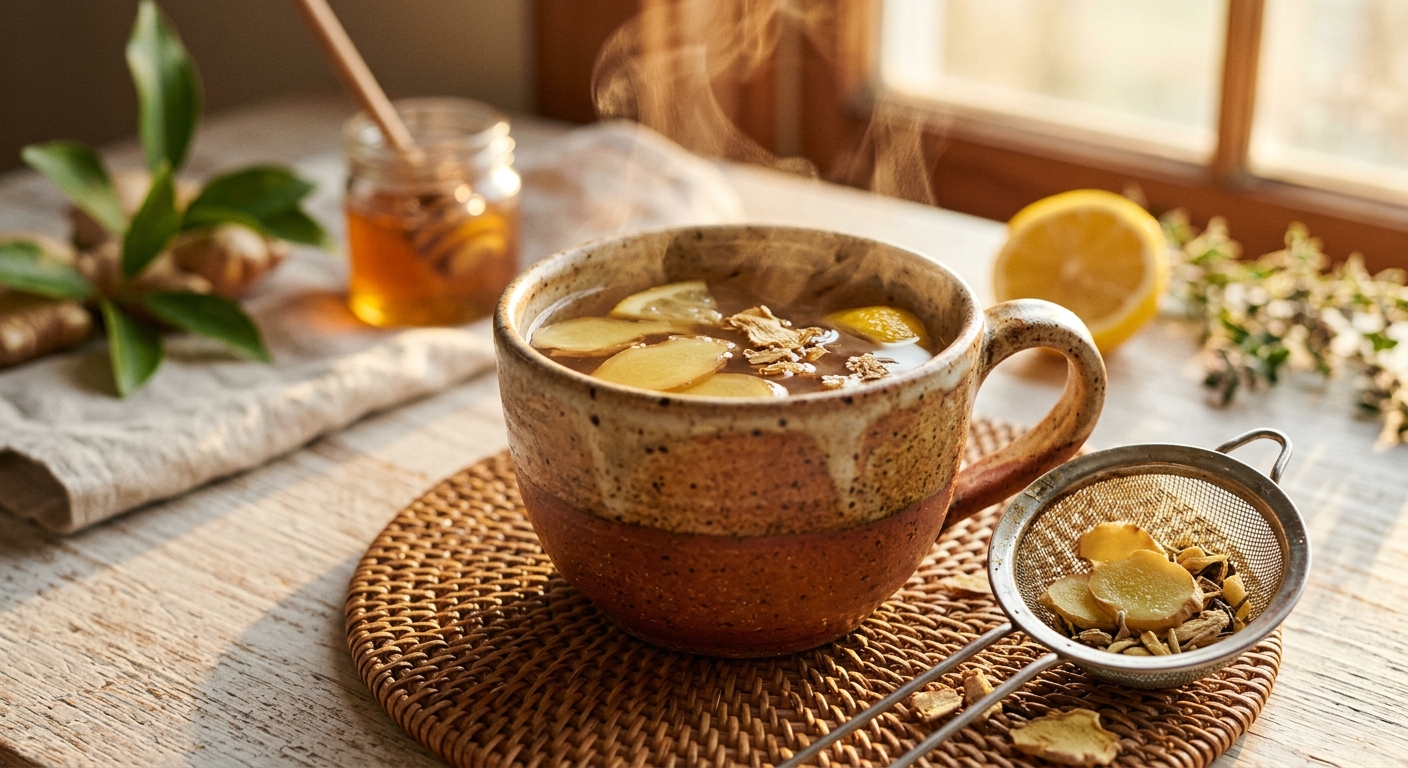
- Peel a 1-inch piece of fresh ginger root using the back of a spoon and slice it into thin rounds, about 4 to 6 slices per serving. Thinner slices release more surface area and intensify the brew.
- Bring 480 ml of water to a full boil (95 to 100°C / 203 to 212°F). Unlike delicate herbs, ginger thrives in near-boiling water, which helps extract its volatile oils and pungent compounds.
- Place the ginger slices directly into a small saucepan or heatproof teapot and pour the boiling water over them. Cover immediately to trap the aromatic steam.
- Steep for 10 minutes for a mellow warmth, or up to 15 minutes if you prefer a more assertive, fiery cup. Taste at the 10-minute mark and adjust to your preference.
- Strain the tea through a fine mesh strainer into two mugs. Add a squeeze of fresh lemon juice and stir in raw honey to taste. Serve immediately while hot.
- Peel and thinly slice a 2-inch piece of fresh ginger root. Because cold water extracts more slowly, use roughly double the amount you would for hot brewing to achieve a satisfying depth of flavor.
- Place the ginger slices into a clean glass jar or pitcher and add 480 ml of cold, filtered water. Do not use hot or warm water, the cold extraction is what gives this method its distinctive smooth character.
- Stir gently, seal the jar or cover the pitcher, and refrigerate for a minimum of 8 hours. Overnight works perfectly. For a stronger brew, allow up to 12 hours but taste it before going the full duration.
- When ready, strain the liquid through a fine mesh strainer into glasses filled with ice. The cold-brewed ginger will appear lighter in color than the hot brew and carry a gentler, more refreshing heat.
- Finish with a splash of sparkling water, a wedge of lemon, and a drizzle of honey or agave syrup if desired. Serve immediately over ice.
- Peel and cut a 2-inch piece of fresh ginger root into rough chunks or thick coins. For a decoction, there is no need for thin slicing since the prolonged simmering extracts compounds thoroughly regardless of thickness.
- Combine the ginger pieces with 600 ml of cold water in a small saucepan. Starting in cold water is important, it allows compounds to begin releasing as the temperature gradually rises, producing a fuller extraction.
- Bring the water to a full boil over medium-high heat, then immediately reduce to a gentle simmer. Partially cover the saucepan to retain volatile oils while allowing some evaporation to concentrate the brew.
- Simmer steadily for 20 to 30 minutes. The liquid will reduce and deepen to a rich amber color. At 20 minutes you will have a potent therapeutic tea; at 30 minutes you will have a concentrate that can be diluted with hot water or plant-based milk.
- Remove from heat and allow to rest uncovered for 2 minutes. Strain through a fine mesh strainer into mugs, pressing the ginger pieces gently with the back of a spoon to release any remaining liquid.
- Serve as-is for a medicinal dose, or dilute with an equal part of warm water or oat milk to soften the intensity. Sweeten with raw honey and a pinch of ground turmeric or black pepper to enhance absorption of active compounds.
Health Benefits
Ginger is one of the most clinically validated herbal remedies for nausea. Multiple randomized controlled trials confirm its effectiveness against morning sickness, chemotherapy-induced nausea, and postoperative nausea, with galanolactone and gingerols acting on serotonin receptors in the gut and brain.
Ginger stimulates the production of digestive enzymes and accelerates gastric emptying, meaning food moves more efficiently from the stomach into the small intestine. This reduces bloating, gas, and the sensation of uncomfortable fullness after meals.
Gingerols and shogaols inhibit key inflammatory enzymes including COX-2 and 5-LOX, pathways that are also targeted by common anti-inflammatory medications. Regular consumption of ginger tea has been associated with reduced markers of systemic inflammation in several clinical studies.
A 2009 clinical trial published in the Journal of Alternative and Complementary Medicine found that ginger was as effective as ibuprofen for reducing primary dysmenorrhea when taken during the first days of menstruation, likely due to its prostaglandin-inhibiting activity.
Ginger’s antimicrobial volatile oils, including zingiberene, combined with its anti-inflammatory action help the body mount a more effective response to respiratory infections. It has historically been used at the onset of colds and flu to reduce symptom severity and duration.
🧪 Key Bioactive Compounds
The Science Behind Ginger
The medicinal power of ginger root comes from a rich matrix of bioactive phenolic compounds concentrated in the rhizome’s resinous tissue. The most studied of these are the gingerols, particularly 6-gingerol, which dominate fresh ginger and are responsible for both its sharp bite and its primary therapeutic actions. Gingerols work through multiple mechanisms simultaneously: they inhibit prostaglandin synthesis by suppressing COX-1 and COX-2 enzymes, they modulate serotonin receptors (specifically the 5-HT3 receptor) in the gastrointestinal tract to reduce nausea signals, and they stimulate gastric motility by interacting with muscarinic receptors. This multi-pathway activity is why ginger is effective against such a broad range of digestive complaints.
When ginger is dried or subjected to heat, gingerols undergo a dehydration reaction that converts them into shogaols, most notably 6-shogaol. This transformation is pharmacologically significant: shogaols demonstrate antioxidant capacity approximately twice that of their gingerol precursors and show enhanced anti-inflammatory potency in cell-culture and animal studies. This means that dried ginger and decocted ginger, while less aromatically vibrant than fresh, may carry a distinct and arguably more concentrated therapeutic profile for inflammation-related conditions. The choice between fresh and dried ginger in preparation therefore matters, and the two forms offer meaningfully different compound compositions.
Ginger’s anti-nausea mechanism deserves particular attention given the strength of its clinical evidence. The compound galanolactone acts as a competitive antagonist at 5-HT3 receptors, the same receptor family targeted by pharmaceutical anti-nausea drugs like ondansetron. Additionally, the aromatic sesquiterpene zingiberene contributes to sensory signaling in the gut-brain axis. A 2014 meta-analysis in the British Journal of Anesthesia reviewed five randomized trials and concluded that ginger supplementation significantly reduced postoperative nausea compared to placebo. The convergence of traditional observational evidence and rigorous modern pharmacology makes ginger one of the most thoroughly validated herbal remedies in the global pharmacopoeia.
Brewing Tips
- For the freshest and most potent brew, choose ginger rhizomes that are firm, smooth-skinned, and heavy for their size. Wrinkled or soft ginger has lost much of its volatile oil content and will produce a flat, less effective tea.
- If you brew ginger tea regularly, keep a cleaned and peeled ginger root in the freezer. Frozen ginger grates effortlessly on a microplane and releases its juices more readily than fresh, making it a convenient and potent option for quick brews.
- Pairing ginger with lemon is more than a flavor choice. The vitamin C in lemon juice improves the stability of ginger’s phenolic compounds in hot water and adds its own antioxidant contribution to the cup, making the combination genuinely more beneficial than either ingredient alone.