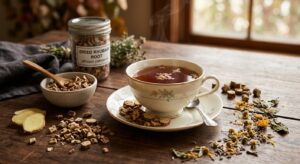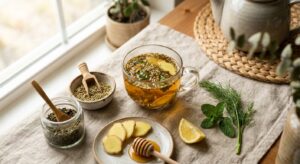
Few plants have traveled as far from weed to wonder as the dandelion. Its name comes from the French dent de lion, or lion’s tooth, a nod to the jagged leaves, and for centuries herbalists across Europe, China, and North America have valued every part of it. Roasted dandelion root was brewed as a coffee substitute during times of scarcity, while the leaves and roots were prescribed in traditional European and Chinese medicine as a bitter tonic for the liver, gallbladder, and digestive tract. Its Latin name, Taraxacum officinale, even hints at its medicinal standing, since officinale marked plants stocked in the apothecary.
Ginger, the knotty rhizome of Zingiber officinale, brings a very different energy. Where dandelion is bitter, earthy, and cooling, ginger is pungent, bright, and warming. Ayurvedic and traditional Chinese medicine have long used it to kindle digestive fire, ease nausea, and settle a restless stomach. Pairing the two creates a balanced evening tea: the dandelion root offers a gentle bitter stimulus to bile flow, while the ginger keeps digestion moving and adds a cozy, spicy lift to the cup.
This blend is designed for the quiet hours after dinner. It is caffeine-free, naturally low in sugar, and rooted in a long tradition of using bitter and carminative herbs to help the body process the day’s meal. Think of it as a warm hand on the shoulder for your digestive system before bed, with a flavor that sits somewhere between toasted chicory coffee and a mellow ginger snap.
2
cups
Ingredients
- 2 tspdried dandelion root (roasted or unroasted, cut and sifted)
- 1 tbspfresh ginger, thinly sliced or grated
- 480 mlfiltered water
- 1 tspdried dandelion leaf (optional, for extra bitterness and mineral content)
- —raw honey or a squeeze of lemon to taste (optional)
How to Brew
Click on an item below to shop for the recommended items for this recipe on Amazon.
As an Amazon Associate, we earn from qualifying purchases.
- Bring filtered water to a full rolling boil, then let it rest for about 30 seconds so it sits just off the boil.
- Add the dried dandelion root, optional dandelion leaf, and thinly sliced or grated fresh ginger to a teapot or large mug with an infuser. Grating the ginger exposes more surface area for a spicier cup.
- Pour the hot water over the herbs and immediately cover with a lid or saucer to trap the steam and essential oils.
- Steep for 10 to 12 minutes. The longer steep draws out the bitter compounds from the root, so taste at 10 minutes and extend if you want a stronger brew.
- Strain thoroughly into your cup, pressing lightly on the ginger to release the last of its juices.
- Stir in a small spoonful of raw honey or a squeeze of lemon if desired, and sip slowly about 30 to 60 minutes after dinner.
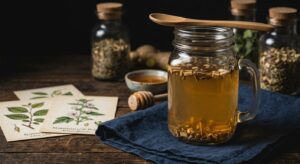
- Combine 3 tsp dried dandelion root and 1.5 tbsp thinly sliced fresh ginger in a clean glass jar. Use a little more herb than for hot brewing to compensate for the gentler extraction.
- Add 480 ml of cold, filtered water, stir once, and seal the jar with a tight lid.
- Refrigerate and let the mixture steep for 8 to 12 hours, ideally overnight. Shake the jar gently once or twice if you remember.
- Strain through a fine mesh sieve or a coffee filter into a clean pitcher or second jar, discarding the spent herbs.
- Serve cold over ice with a lemon wheel, or pour into a mug and warm gently on the stove to just below a simmer for a mellow evening cup. Keep any leftovers refrigerated and drink within 48 hours.
- Add 2 tsp dried dandelion root and 1 tbsp sliced fresh ginger to a small saucepan with 480 ml of cold filtered water. Starting with cold water lets the compounds extract gradually as the temperature rises.
- Bring the pot to a gentle boil over medium heat, then immediately reduce to the lowest heat so it barely simmers. Avoid a hard boil, which can drive off the ginger’s aromatic oils.
- Partially cover the pan and simmer for 15 to 20 minutes, until the liquid has reduced by about a quarter and turned a deep, rich brown.
- Remove the pan from the heat, stir in the optional dandelion leaf if using, cover fully, and let it rest for 5 minutes. The leaf is delicate and needs only a brief steep.
- Strain through a fine mesh sieve into a warmed mug. Sweeten with honey, or add a splash of oat milk for a latte-style evening drink.
Health Benefits
Dandelion root’s bitter compounds are traditionally used as a cholagogue, encouraging the liver and gallbladder to release bile that helps break down dietary fats. Animal studies support this effect, though human trials are limited.
Ginger is one of the best-studied digestive herbs, with clinical evidence that it speeds gastric emptying and reduces nausea. Its carminative action also helps relieve gas and a sense of fullness after meals.
Dandelion root is a rich natural source of inulin, a prebiotic fiber that selectively nourishes friendly bacteria in the colon. A healthier microbiome is linked to better regularity and digestive comfort.
Both herbs contain polyphenols and flavonoids that neutralize free radicals. Laboratory and animal research suggests dandelion extracts may protect liver cells from oxidative stress, although more human research is needed.
The mild bitter stimulation of digestive secretions, combined with inulin fiber and ginger’s motility-promoting action, may help ease occasional sluggish digestion without the harshness of stimulant laxatives.
🧪 Key Bioactive Compounds
The Science Behind Dandelion
The digestive reputation of dandelion root rests largely on its bitter taste. Bitter compounds such as taraxinic acid and other sesquiterpene lactones activate bitter taste receptors on the tongue and throughout the gastrointestinal tract. This triggers a reflex that increases the secretion of saliva, gastric juice, and bile, preparing the body to digest food. This is the principle behind the traditional European use of bitters before or after meals. While much of the supporting evidence comes from animal and in vitro studies, the mechanism is well established in digestive physiology.
Dandelion root is also notable for its inulin content, which can make up a substantial portion of its dry weight, especially in autumn roots. Inulin is a fermentable prebiotic fiber that passes undigested to the colon, where it is used by beneficial bacteria. In a tea, only a portion of this fiber dissolves, which is one reason decoction extracts more than a quick infusion. Dandelion also provides polyphenols and chicoric acid, which show antioxidant and anti-inflammatory effects in laboratory models.
Ginger complements this with a different mode of action. Its gingerols and shogaols interact with serotonin and vanilloid receptors in the gut and appear to promote gastric motility, helping food move through the stomach more efficiently. Multiple clinical trials support ginger for nausea, and smaller studies suggest it improves symptoms of functional dyspepsia. Together, dandelion’s bitter and prebiotic effects and ginger’s motility-boosting warmth create a synergistic evening tea, though it should be viewed as a supportive daily ritual rather than a treatment for any disease.
Brewing Tips
- Choose roasted dandelion root for a deeper, coffee-like flavor and less bitterness, or unroasted root for a lighter, more traditionally medicinal brew.
- Use fresh ginger rather than powdered whenever possible. The gingerols are more vibrant and the flavor is cleaner and brighter.
- Drink this tea 30 to 60 minutes after your evening meal so it can support digestion without waking you for a bathroom trip at night, since dandelion has a mild diuretic effect.
- Simmered decoction batches keep well in the fridge for up to 48 hours. Reheat gently on the stove rather than boiling again to preserve flavor.
- Start with a weaker brew if you are new to bitter herbs, then gradually increase the amount of root as your palate adjusts.